Written by a Lecturer in Sport and Fitness with over ten years' experience in teaching and devising degree modules, Sports Science: A Complete Introduction is designed to give you everything you need to succeed, all in one place. It covers the key areas that students are expected to be confident in, outlining the basics in clear, jargon-free English and providing added-value features like summaries of key experiments and even lists of questions you might be asked in your seminar or exam.Each chapter covers a key introductory area, so by the end of the book you'll have a clear understanding of the essential principles of sport science. Starting with key points in anatomy and physiology, it covers sports psychology, biomechanics and also introduces sports nutrition, as well as how to plan research in sport.It is structured to mirror the way sports science is taught on many first year undergraduate and foundation degree courses. By the end you'll have a clear understanding of the essential principles of sport science.
- 224 pages
- English
- ePUB (mobile friendly)
- Available on iOS & Android
eBook - ePub
Sports Science: A Complete Introduction: Teach Yourself
About this book
Information
Topic
MedicineSubtopic
Sports Medicine1
Studying sports science: A multidisciplinary approach

The scope of sports science
As outlined in the introduction, sports science has biomechanics, physiology and psychology as its core subjects. However, over time sports science has come to encompass many other disciplines as well. The scope of sports science covers the subjects shown in Figure 1.1.
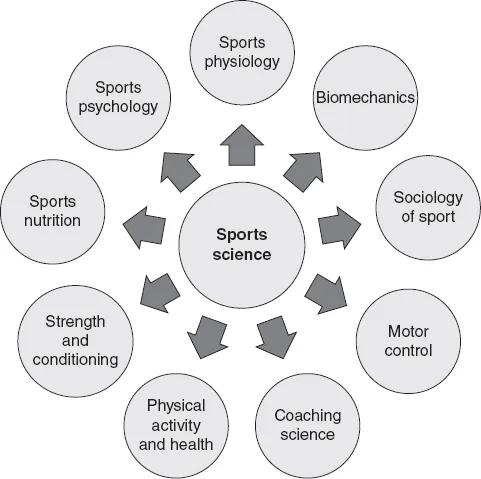
Figure 1.1 The scope of sports science
Sports science has been tailored to specific career paths or areas of research interest. For example, many students of sports science are interested in the application of sports science principles to coaching, teaching, fitness training or strength and conditioning development. Hence the inclusion of subjects such as coaching science and strength and conditioning in many sports science programmes.
The sociology of sport looks at the role of sport in society, how sports have developed and why they have become what they are today. For example, in the 19th century and for large parts of the 20th century, higher levels of violence were acceptable in sports; however, as violence has become less acceptable in society, it has become less acceptable in sport as well. Current issues are often examined in the sociology of sport, with social theory being applied to help explain drug use in sport and important social issues such as racism, sexism and homophobia. Once these topics are understood more deeply, action can be taken or policies developed to address these issues.
Motor control is a branch of psychology that examines how motor skills are acquired, coordinated and controlled. Investigations into principles and theories of learning, phases of learning, information processing and the nature of feedback are undertaken in the study of motor control.
Careers in sports science
The growth in sports science courses has been fuelled by the growth in demand for sports science services. This has come from many directions, not least from the need in the UK to offer support services to the many professional and amateur athletes who require advice on every aspect of their performance. Sport has become increasingly professionalized in the UK since receiving the boost of funding from the National Lottery, which has been made available to athletes and for facilities since 1994. Over the 20 years since funding was introduced there has been a disproportionate increase in the success of British athletes in international competitions; Team GB won a total of 15 medals, only one of them a gold medal, at the 1996 Olympic Games, compared with a total of 65 medals, 29 of them gold, at the 2012 Olympics. Home advantage may have played a role in 2012, but it still leads us to question what else happened.
Sports science support has been offered by sport scientists and other graduates working in the following roles:
• sports biomechanists
• sport psychologists
• sports physiologists
• performance analysts
• sports nutritionists
• sports coaches
• strength and conditioning coaches
• sports physiotherapists and masseurs.
The demand for exercise specialists to advise the general public on their fitness levels and increase their awareness of the benefits of exercise has increased the demand for graduates working in the following roles:
• fitness trainers
• personal trainers
• exercise consultants and advisers
• health promotion
• sports managers
• sports development officers.
The third area in which demand has risen is in the development and distribution of knowledge. There are many graduates working in academic roles as:
• sports science lecturers
• physical education (PE) teachers
• research scientists or associates.
The interest in and development of sport shows no signs of abating. Sports science is able to accommodate students with wide ranges of interest in sport, both academically and practically.
Developing a multidisciplinary approach to sports science
In the introduction, it was mentioned that the British Association of Sport and Exercise Science recommends that an interdisciplinary approach should be adopted to address the performance issues of athletes. This would involve applying knowledge from more than one of the subdisciplines within sports science.


‘Only connect … live in fragments no longer.’
E.M. Forster (1879–1970), British novelist and critic
To illustrate how a sports scientist or sports science team would adopt an interdisciplinary approach, it is best to look at a case study.
 | Case study: Henry |
Henry is a 21-year-old gymnast who has moved seamlessly from competing successfully at school, club and county level up to national standard. His aim has always been to represent his country at the Olympic Games.
Recently, however, Henry has found that his performances have started to decline and he is performing less well than some of his peers. He has also started to make more mistakes than usual. His response has been to train harder and harder but he has found that this is not producing the results he would like and is leaving him feeling more tired. He has also been talking to other coaches about his performances and where they think he has been going wrong.
Over the past three months he has started to become slightly disillusioned with gymnastics and he finds himself increasingly choosing to get away from gymnastics and socialize with friends away from sport. Henry decides that he needs to seek help from a sports science support team.
How can sports science professionals help Henry to halt the decline in his performance and start enjoying gymnastics again?
• The sports psychology approach
A sport psychologist would look first at Henry’s motivation. They would examine how Henry has been motivated over the previous years and how this motivation has changed. It may be that he no longer is as clear about his goals and how to achieve them. Or Henry may be experiencing over-motivation, as his response to failure is to train harder and harder, and this may be having a negative impact on his mental and physical wellbeing.
A sport psychologist may also look at other factors that could be negatively impacting on his performance. Is he experiencing stress either within sport or through external factors, such as his personal life? Or it could be that his over-motivation is causing high arousal levels and increased feelings of anxiety when he is performing? This may explain why he is making more mistakes than usual.
• The sports physiology approach
The sports physiologist would look at Henry’s physical conditioning and whether his training is producing adaptations that are specific to his performance. For example, is he strong enough and flexible enough for the movements he is performing? Or is this why he is making mistakes? It may be that his aerobic conditioning is not specific enough and the mistakes he is making are the result of fatigue during the performance.
The sports physiologist would also look at Henry’s schedule of rest and recovery. They would ask if he was getting appropriate amounts of sleep and rest to ensure he was in optimal condition for competition.
• The biomechanics approach
The biomechanist would look at Henry’s performance by examining the quality of his movement and the execution of his techniques. They would analyse whether the decrement in his performance and increased prevalence of mistakes was owing to the development of poor techniques. The biomechanist could capture Henry’s performances on video and then analyse his movements before giving Henry feedback about any weaknesses and seeking ways to improve these weaknesses.
• The nutritionist approach
The nutritionist would analyse whether Henry was eating correctly and getting the correct balance of carbohydrates, proteins, fats, vitamins and minerals to support his training schedule. They would be interested in Henry’s body composition and whether it has been changing over the previous few months.
The nutritionist would also be keen to find out what Henry was eating when he was out with his friends and exposed to external influences. They may also question the link between Henry’s nutrit...
Table of contents
- Cover
- Title
- About the Author
- Dedication
- Contents
- Introduction
- 1 Studying sports science: A multidisciplinary approach
- 2 Key principles in anatomy and physiology 1: The musculo-skeletal system
- 3 Key principles in anatomy and physiology 2: The cardio-respiratory system
- 4 The essentials of sports physiology
- 5 The fundamentals of sports psychology
- 6 The basics of biomechanics
- 7 Introducing sports nutrition
- 8 Planning research in sport
- References
- Fact-check answers
- Copyright
Trusted by 375,005 students
Access to over 1.5 million titles for a fair monthly price.
Study more efficiently using our study tools.
Frequently asked questions
Yes, you can cancel anytime from the Subscription tab in your account settings on the Perlego website. Your subscription will stay active until the end of your current billing period. Learn how to cancel your subscription
No, books cannot be downloaded as external files, such as PDFs, for use outside of Perlego. However, you can download books within the Perlego app for offline reading on mobile or tablet. Learn how to download books offline
Perlego offers two plans: Essential and Complete
- Essential is ideal for learners and professionals who enjoy exploring a wide range of subjects. Access the Essential Library with 800,000+ trusted titles and best-sellers across business, personal growth, and the humanities. Includes unlimited reading time and Standard Read Aloud voice.
- Complete: Perfect for advanced learners and researchers needing full, unrestricted access. Unlock 1.5M+ books across hundreds of subjects, including academic and specialized titles. The Complete Plan also includes advanced features like Premium Read Aloud and Research Assistant.
We are an online textbook subscription service, where you can get access to an entire online library for less than the price of a single book per month. With over 1.5 million books across 990+ topics, we’ve got you covered! Learn about our mission
Look out for the read-aloud symbol on your next book to see if you can listen to it. The read-aloud tool reads text aloud for you, highlighting the text as it is being read. You can pause it, speed it up and slow it down. Learn more about Read Aloud
Yes! You can use the Perlego app on both iOS and Android devices to read anytime, anywhere — even offline. Perfect for commutes or when you’re on the go.
Please note we cannot support devices running on iOS 13 and Android 7 or earlier. Learn more about using the app
Please note we cannot support devices running on iOS 13 and Android 7 or earlier. Learn more about using the app
Yes, you can access Sports Science: A Complete Introduction: Teach Yourself by Simon Rea in PDF and/or ePUB format, as well as other popular books in Medicine & Sports Medicine. We have over 1.5 million books available in our catalogue for you to explore.