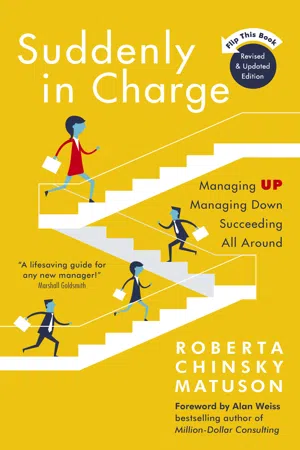
As companies reorganize and reengineer, thousands of people are finding themselves tossed into management every day. "You may go to bed as a member of the team and wake up to find yourself suddenly in charge, " says Matuson. The key to success is managing effectively both up and down the line of organization. And Suddenly in Charge provides this unique approach with two books in one: read it in one direction and you'll find all the tips and tools you need to manage down, establishing credibility with your team and leading in a way that both builds rapport and garners respect. Flip the book over and you'll find success strategies for managing up, interacting successfully with your bosses and developing strong relationships. In the Managing Up side of the this book, you will learn how to manage your relationships and responsibilities as an employee, including how to understand the boss's style of management; deal with dictatorial, indecisive or otherwise difficult bosses; promote yourself; ask for raises; and know when it's time to leave a position. With key learning points, real-life examples and proved strategies for effective communication, Managing Up helps you navigate the world of office politics while staying true to yourself. In the Managing Down side of this book, you will learn how to manage your relationships and responsibilities as a boss, including how to stay sane during conflicts, evaluate performance, and make the hiring and firing process easier and more mutually beneficial. With key learning points, real-life examples and proven strategies for effective communication, Managing Down helps you clearly define your new role and cultivate an environment of engaged, motivated employees.
eBook - ePub
Suddenly in Charge
Managing Up, Managing Down, Succeeding All Around
- 240 pages
- English
- ePUB (mobile friendly)
- Available on iOS & Android
eBook - ePub
About this book
Information
Suddenly in Charge
Managing up,
MANAGING DOWN,
Succeeding All Around
MANAGING DOWN,
Succeeding All Around
Revised and Updated

First published in 2017 by Nicholas Brealey Publishing
An imprint of John Murray Press
An imprint of John Murray Press
An Hachette company
23 22 21 20 19 18 17 1 2 3 4 5 6 7 8 9 10
Copyright © Roberta Chinsky Matuson 2011, 2017
The right of Roberta Chinsky Matuson to be identified as the Author of the Work has been asserted by her in accordance with the Copyright, Designs and Patents Act 1988.
All rights reserved. No part of this publication may be reproduced, stored in a retrieval system, or transmitted in any form or by any means without the prior written permission of the publisher, nor be otherwise circulated in any form of binding or cover other than that in which it is published and without a similar condition being imposed on the subsequent purchaser.
Library of Congress Control Number: 2017012373
ISBN 978-1-473-65605-5
U.S. eBook ISBN 978-1-857-88467-8
U.K. eBook ISBN 978-1-473-64412-0
U.S. eBook ISBN 978-1-857-88467-8
U.K. eBook ISBN 978-1-473-64412-0
Nicholas Brealey Publishing Carmelite House 50 Victoria Embankment London EC4Y 0DZ Tel: 020 3122 6000 | Nicholas Brealey Publishing Hachette Book Group 53 State Street Boston, MA 02109, USA Tel: (617) 263 1834 |
www.nicholasbrealey.com
How to Navigate This Book
Why is it that so many people believe everyone should have to go through the same school of hard knocks that they’ve suffered through? This is common in the field of medicine, where young interns are subject to the same stresses their mentors have gone through just because it’s viewed as the rite of passage. We also see this in management, where people of all ages are dropped into their chairs and expected to know exactly what to do by osmosis. I’m here to tell you that the rite of passage is wrong, and I’m doing something about it.
I’ve devoted an entire section to Managing DOWN because I believe most people who take on the responsibilities of management really want to do a good job and are capable of doing so, with proper guidance. The problem is that in this fast-paced world no one has time to show you the ropes. Therefore, you must take control and learn how to become an effective manager on your own in order to thrive in the business world.
Management is not for the faint of heart, nor is it for people who believe if you want something done right, you have to do it yourself. It’s ideally suited for those who are committed to helping others succeed. It requires patience, diligence, and, most certainly, as you’ll see, a good sense of humor.
There will be days when you’ll feel like you are riding the crest of a wave and other days when you might feel as if the next wave is going to take you out. Don’t despair. Thumb through this section of the book and remind yourself that through practice and determination, you can do this.
Now hang on. It’s going to be one heck of a ride!
Contents
INTRODUCTION TO MANAGING DOWN
CHAPTER ONE
Welcome to Management
Welcome to Management
Now What the Heck Do I Do?
Tossed into Management
The First Ninety Days
How to Build Productive Relationships
Establishing Credibility
Creating Credibility
Productive Relationships Self-Assessment
Key Learning Points
CHAPTER TWO
From Me to We
From Me to We
It’s Really not about you!
Why Engage Your Employees?
Reality Check
The Road to Engagement
Ways You Can Influence Employee Engagement
The Young, the Restless, and the Disengaged
Reconnecting with the Moderately Disengaged
Damaged Beyond Repair
Key Learning Points
CHAPTER THREE
Purpose: The Secret Ingredient that Will Separate You from the Pack
Purpose: The Secret Ingredient that Will Separate You from the Pack
Why Purpose Matters
How to Discover and Ignite Your Team’s Purpose
Four Important Characteristics of Your Work Group’s Core Purpose
Three Questions Every Leader Must Ask about Purpose
How to Lead On Purpose: The Seven Principles of Purposeful Leadership
Key Learning Points
CHAPTER FOUR
Talent Magnetism
Talent Magnetism
Talent Magnetism 101
The Case for Hiring on Talent, Rather than on Skills
Speed Trumps Perfection
Changing Behavior
Key Learning Points
CHAPTER FIVE
Guard Your Exits: How to Prevent Your Employees from Taking the Next Flight Out
Guard Your Exits: How to Prevent Your Employees from Taking the Next Flight Out
Common Reasons Employees Leave Their Job
Signs Your Employees May Be Seeking Greener Pastures and How You Can Bring Them Back into the Fold
How to Pinpoint the Real Reason People Are Leaving
What to Do if People Are Leaving Because of You
How to Create a Magnetic Connection with Your People
The Leaving Speech: Why You Should Say Goodbye to Your Employees on the Day They Start
How to Write a Leaving Speech that Will Get People to Stay
Stay Interviews
Questions All Leaders Should Be Asking Their People on a Regular Basis
Drop the Excess Baggage
Key Learning Points
CHAPTER SIX
Generation Integration
Generation Integration
Leveraging Workplace Differences into Opportunities
Meet the Generations
Seismic Shift: The Impact of the Changing Demographics on the Workplace
Busting Common Myths Associated with the Generations
Motivating Your Mature Workers
Help! My Employee Is Treating Me Like Her Child!
Unleashing the Potential of Younger Workers
Key Learning Points
CHAPTER SEVEN
Dealing with Difficult Employees
Dealing with Difficult Employees
Strategies to Keep You Sane during Insane Times
Toxic Employees
My Employee Is Going through a Difficult Period: Avoiding the Shift from Manager to Therapist
Using Sugar to Sweeten an Employee’s Disposition
Tools You Can Use to Reduce Conflict
Can This Marriage Be Saved?
Signs This Relationship Cannot—or Should Not—Be Saved
Key Learning Points
CHAPTER EIGHT
Should You Care if Your Employees Love You?
Should You Care if Your Employees Love You?
How to Create a Respectful Workplace
College Buddies Rather than Subordinates
Communicating versus Commiserating
Going with the Flow, Even though the Company May Be Racing toward a Waterfall
BFF (Best Friends Forever)
Avoidance: Are You Doing Your Employee’s Work Because You Don’t Want a Confrontation?
With All Due Respect: Creating a Workplace Where People Feel Valued
Key Learning Points
CHAPTER NINE
Performance Management
Performance Management
Do I Really Have to Do this?
The Performance Management Cycle
Establishing Expectations
Writing Goals and Objectives
Continuous Feedback
The Performance Review
Overcoming Performance Management Anxiety
Why Self-Evaluations Are Your Friend: Avoiding the Dreaded Look of Surprise When Conducting Reviews
Key Learning Points
CHAPTER TEN
You’re Fired!
You’re Fired!
Timeless Tips for Tactful Terminations
Gathering Your Ammunition: The Art of Documentation
Pulling the Trigger: Knowing When It’s Time to Execute
Avoiding the Heart: How to Terminate Someone While Leaving the Heart Intact
When There Is More than One Victim: Handling Layoffs
Taking Care of the Survivors
Key Learning Points
CHAPTER ELEVEN
Becoming a Leader Others Want to Follow
Becoming a Leader Others Want to Follow
Securing Your Next Role
Signs You Are Ready for Your Next Promotion
How to Ask for a Promotion
What to Do if the Promotion Doesn’t Go to You—This Time
Five Steps You Can Take While Still in Place
Seven Practices that Distinguish Great Managers from the Rest
Five Things You Must Absolutely Do so You Can Move Ahead
Key Learning Points
References
Introduction to Managing Down
Management looks really easy, doesn’t it? You’re awarded a title, and, if you are lucky, an office, and away you go. You bark some orders here and there and then you sit back until it’s time to give another directive. Of course everyone does exactly what you ask of them, because you are the person in charge. If this were really the case, everyone would want to be a manager!
Being an effective manager is a lot more complicated than the scenario I described above. That’s because the only behavior you can control is your own. In the following chapters, we’ll discuss exactly what it is going to take for you to succeed as a first-time manager or to become a business owner who inspires his people to do their best. There is no one-size-fits-all model of management. You will need to try on different styles until you find the one that is the perfect fit for you and the environment you are working in. Throughout your career you will find yourself making adjustments as you grow as a leader.
My leadership skills have marinated over time. I know exactly when I need to turn up the heat and when it’s best to let things simmer. Along the way, I have had my share of disasters. But I viewed each and every situation as an opportunity to fine-tune my craft. My hope is that you will do the same. Leadership is a skill set that can be learned, but only if you are willing to practice and learn from your mistakes. Take the pieces of advice that follow in this book and use the ingredients that feel right to you. Experiment and create your own recipe for success!
See the Foreword in the Managing Up side of this book, page xi, to read what bestselling author Alan Weiss has to say about Suddenly in Charge and Roberta Matuson’s approach to preparing you for success.
I will never forget the day that I was tossed into management. I walked into the office as just another employee and left that day as a member of senior management. Here’s my story.
I had a very close relationship with my boss, with whom I had worked at another company. She had come to my rescue and offered me a job as a human resources generalist when I had suddenly found myself unemployed in the midst of a recession. We worked side by side to build a state-of-the-art human resources department for a commercial real estate firm that eventually went public.
My boss appeared to be doing well in her job and had the full support of the executive management team. At least I thought she did. There were absolutely no indications that one day my boss would be there and the next day she would be gone. But that is exactly what happened one day in 1983.
On a sunny spring morning, I received a call from the vice president’s secretary requesting my presence in his office. This seemed a bit unusual, as I had never been called to his office without my supervisor. I assumed she would be there, waiting for my arrival. I was caught completely off guard when the VP closed his door and began speaking with me, before my supervisor arrived. Without any fanfare, he informed me that my boss was no longer with the company, as of the evening before. That was the entire conversation. No explanation and no directions. I paused for a moment to think. And then I did what I thought any other twenty-four-year-old would do: I asked for her job. Imagine my surprise when he granted my request and gave me the title of acting director of human resources! Six months later, I was promoted to director.
I still remember how I felt that day when I found out that I was suddenly in charge of an entire department, including five peers who were now my direct reports. I felt like I was at the top of a roller coaster waiting to descend. I was scared, yet excited about the plunge I was about to take. These are probably similar to the feelings you are experiencing if you have been tossed into management.
I began my first ninety days by focusing on improving my technical skills so that I could be competent in my job. This is a mistake many new managers commonly make. In hindsight, I should have spent that time developing strong relationships with others in the organization, especially those on my team.
I’ve learned a lot about management and leadership over the past twenty-five years. Some of my knowledge was acquired through further formal education, but most I learned on the job, through trial and error. Your journey will be different from mine, and you’ll make your own mistakes along the way. But at least you’ll have something that I never had: A roadmap to guide you safely through the twists and turns you will experience in this new terrain called management.
Roberta Chinsky Matuson
President
Matuson Consulting
President
Matuson Consulting
CHAPTER ONE
Welcome to Management
Now What the Heck Do I Do?
Congratulations! You’ve just been tagged and now you’re it! You are now a boss. Welcome to the game of management. To win in this game, you must quickly figure out the rules on your own, because there is no playbook that will provide you with all the moves you need to come out a winner. Maybe it’s a good thing there is no playbook, because just when you think you’ve got the game figured out, it changes! For example, most economists and businesspeople did not predict the deep recession of 2009. In the years prior to the recession, most of the world was experiencing a period of strong economic growth. Leaders became quite comfortable managing at a time when they could pretty much buy their way in and out of any situation.
Here are some examples of the ways managers have used money to deal with management issues, a strategy that didn’t require much in the way of leadership skills. Suppose a key employee said she was leaving for another organization; a manager could make a competitive counteroffer and usually keep this person. When money wasn’t an issue in business, managers could follow Google’s corporate model of attracting candidates by offering perks such as an on-site doctor and dentist; complimentary massages and yoga; free lunch from a five-star caterer; and bringing in a sushi chef. Then the game changed. Companies all around the world were forced to tighten their belts and get rid of the fat in their organizations, including the weekly donut run. Managers could no longer motivate employees by promising extravagant perks, and they were scrambling to figure out quickly how to do more with less. A new game was in play, and the old rules no longer mattered.
Oh, what a difference a few years make. In many parts of the world, the economy is humming. Here in the U.S., many cities are experiencing record-low unemployment rates. Companies are once again pulling out all the stops as they look to buy talent. But here’s the thing—there will always be companies with better perks than yours or with higher salary ranges. But don’t despair. There appears to be a vast shortage of great leaders. In a recent TinyPulse New Year Employee Report, 1,000 working Americans shared their workplace wishes for the New Year.1 Participants were asked what one thing they wished they could change about their manager. The second most popular answer was to have their manager quit. This response aligns with what I see in my consulting practice. Many enthusiastic employees are working for managers who are unclear about how to connect with their people in a way that is memorable for the right reasons.
You have an opportunity to become the type of manager who can thrive in any economy. Managers who we...
Table of contents
- Cover Page
- Managing Up
- Cover Page
- Managing Down
Trusted by 375,005 students
Access to over 1.5 million titles for a fair monthly price.
Study more efficiently using our study tools.
Frequently asked questions
Yes, you can cancel anytime from the Subscription tab in your account settings on the Perlego website. Your subscription will stay active until the end of your current billing period. Learn how to cancel your subscription
No, books cannot be downloaded as external files, such as PDFs, for use outside of Perlego. However, you can download books within the Perlego app for offline reading on mobile or tablet. Learn how to download books offline
Perlego offers two plans: Essential and Complete
- Essential is ideal for learners and professionals who enjoy exploring a wide range of subjects. Access the Essential Library with 800,000+ trusted titles and best-sellers across business, personal growth, and the humanities. Includes unlimited reading time and Standard Read Aloud voice.
- Complete: Perfect for advanced learners and researchers needing full, unrestricted access. Unlock 1.5M+ books across hundreds of subjects, including academic and specialized titles. The Complete Plan also includes advanced features like Premium Read Aloud and Research Assistant.
We are an online textbook subscription service, where you can get access to an entire online library for less than the price of a single book per month. With over 1.5 million books across 990+ topics, we’ve got you covered! Learn about our mission
Look out for the read-aloud symbol on your next book to see if you can listen to it. The read-aloud tool reads text aloud for you, highlighting the text as it is being read. You can pause it, speed it up and slow it down. Learn more about Read Aloud
Yes! You can use the Perlego app on both iOS and Android devices to read anytime, anywhere — even offline. Perfect for commutes or when you’re on the go.
Please note we cannot support devices running on iOS 13 and Android 7 or earlier. Learn more about using the app
Please note we cannot support devices running on iOS 13 and Android 7 or earlier. Learn more about using the app
Yes, you can access Suddenly in Charge by Roberta Chinsky Matuson in PDF and/or ePUB format, as well as other popular books in Business & Human Resource Management. We have over 1.5 million books available in our catalogue for you to explore.