Talent Magnetism offers straightforward, easy-to-apply techniques that help managers navigate the challenges of attracting and keeping talent to foster innovation and fuel growth. Roberta Matuson, bestselling author of Suddenly in Charge and award-winning management consultant, shows you how with:
* Fresh techniques and creative ways to build an organization with talent magnetism, where top talent is pulled in with minimal effort on the employer's part.
* Proven methods which focus on what today's post-recession workers value most. Hint: It isn't what you think!
* Case studies of organizations that have achieved "magnetic" status without Toyotasized budgets.
* Rules of Attraction: recommendations to propel you forward at warp speed. Drawing on real-life case studies and examples, Matuson demonstrates the new rules of workplace attraction and retention, helping you and your organization develop irresistible talent magnetism.
eBook - ePub
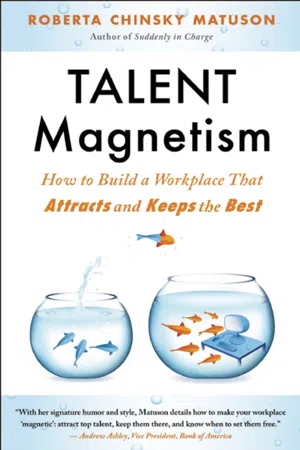
Talent Magnetism
How to Build a Workplace That Attracts and Keeps the Best
- 240 pages
- English
- ePUB (mobile friendly)
- Available on iOS & Android
eBook - ePub
About this book
Information
Topic
Personal DevelopmentSubtopic
CareersCHAPTER 1
Workplace Magnetism
I remember the exact moment I met my dream employer. It was a springlike day in an otherwise dark time in my life. I was coming out of an abusive working relationship that I thought I would never recover from. But I knew that I had no choice but to persevere, as I only had myself to rely upon. I put on my happy interview face, pumped myself up, and prepared myself for what was to be the interview of a lifetime.
The moment I walked in the room, I knew we were destined for one another. The French call it je ne sais quoi, defined by Merriam-Webster Dictionary as “something that cannot be adequately described or expressed.” I call it magnetism—that moment of irresistible attraction.
Our conversation (notice that I didn’t say interview) reminded me of a waltz, where every move was in sync. An offer was made and I accepted it gladly. My boss later confided in me that the hiring committee had invited the other finalist in for one more interview, as they could no longer remember her after meeting me.
This is the power of magnetism—the pull that occurs when two entities are attracted to each other. It’s interesting to note that I took this job even though the compensation being offered was significantly below market. That didn’t matter to me. What did matter was the passion and enthusiasm of every person I met while interviewing. The commitment to being the best in the industry was evident throughout the organization.
Can you attract top talent without magnetism? Sure. But at what cost, and will these people stick around?
The feeling I described when I first walked through my future employer’s door is exactly the feeling that your candidates will have if you are purposeful in the way you create your corporate culture. As you read through this book, keep in mind that every organization has the ability to create an environment where employees are happy and customers love to do business.
The Power of Workplace Magnetism
Being known as a talent magnet has a number of advantages. The first is that you will have your pick when it comes to employees. This is particularly important in tight employment markets, such as IT.
Think about companies like Google and Apple. Do you think they have a hard time getting the talent they need to fuel their growth? Are they out there begging their friends and family members for the names of people who know C++ or Java? Probably not.
Search online and you’ll find dozens of articles about how to land a job at Google or Apple. That’s because there are tons of applicants interested in working for companies with brands like theirs. It can be a hard pill to swallow, knowing that some companies have absolutely no problem finding candidates for jobs that are considered hard to fill, while others go hungry.
Likewise, mediocre employees know other mediocre employees and aren’t afraid to bring them into the fold. This happens particularly in organizations where employees feel threatened. They know that if they bring in people who are better than they are, they may be asked to leave. So they do their best to make sure the status quo is maintained. Which group of employees would your rather have referring people to you?
Magnetic companies attract clients and customers to their brand with considerably less effort than nonmagnetic companies. People want to do business with magnetic organizations because of their stellar reputation, which is usually related to their employees. Examples of this can be found with brands like the Ritz-Carlton Hotel Company, which is known throughout the world for its gold standard of customer service. Many organizations try to emulate this company, which has allowed Ritz-Carlton to enter an entirely new line of business—advisory services and courses offered at The Ritz Carlton Leadership Center.
There are many more ways that magnetism impacts top-line growth, bottom-line profitability, and the overall health of an organization. I’ll discuss this in more detail throughout this book.
Can Magnetism Be Bought?
Many people ask me if magnetism is something that can be bought. I don’t believe it can be, though companies spend millions of dollars on PR firms every year trying to achieve this. Some companies falsely believe that receiving an award from the local chamber of commerce or being named among the “Best Companies to Work For” will magically cover blemishes that others know exist. The truth eventually breaks through.
Magnetism comes from within, and, thanks to the increased transparency afforded by the Internet, prospective candidates know when your company is trying to sell them a bill of goods. Today’s jobs seekers are connected in ways that we could never have imagined. It takes about two seconds to see if you have a LinkedIn connection at a company you are considering. A simple Google search can reveal what really goes on in the bowels of the organization, as many people don’t think twice about going public with their opinions. That can be a good thing if you have a workplace where people are fairly happy, but it can be a nightmare if you don’t.
Roy Ng, senior vice president and head of business operations for the Cloud Business Unit at SAP, headquartered in Walldorf, Germany, believes that benefits, pay, and titles are still important to people. Ng reminds us of the importance of paying attention to all parts of employee packages, not just one factor. He says, “You can’t simply do one well and be a great employer.” He also notes that buying talent won’t necessarily ensure that you’ll be able to keep people. “If you can get to the heart of the person, you can pick up talent that you never thought you could.” You must continuously work on strengthening your connections in order to keep these people. We’ll go into more detail on how to do this in Chapter 13.
Where to Get Some Magnetism
Most companies have magnetism inside their organizations waiting to be released. Sometimes you have to dig down a few layers to find it, and other times it’s on the surface for all to see. Of course, there are those situations where companies are unwittingly blocking the very candidates they are trying to pull in.
In those companies where recruiting top talent is a delegated “task,” we often find a wall that prevents good people from penetrating the organization. Talent may be attracted, but at the same time they are unable to get past the wall put up by recruitment and hiring processes that no longer make sense or by managers who don’t make the hiring process a priority. That’s why it’s so critical that, wherever possible, CEOs and other senior executives drive the recruitment process and check often to ensure any blockage is removed quickly.
Forward-thinking CEOs shop their businesses to make sure they know exactly what their customers are experiencing. I suggest you do the same when it comes to the experience of the job seeker. Begin by trying to apply for work in your own company. Are you tempted to give up along the way? If so, you most likely aren’t alone. This is exactly what happens when highly sought-after candidates or passive candidates tire of the shenanigans that some employers put candidates through before they’ve had a chance to set foot in the door.
Being aware of the frustrations lurking in your application process will give you the opportunity to make necessary changes before you lose great candidates to the competition.
Finding Your Inner Magnetism
If you are having a difficult time determining what really attracts people to your organization, simply ask those who have recently joined your firm what initially drew them to your business. Then ask employees who’ve been with you a while why they choose to stay.
Sometimes people are more comfortable, and therefore more honest, when speaking to a third party about matters related to retention. That’s where outside consultants can be beneficial. A good consultant knows when she is being given a stock answer and can probe further to get at the heart of the matter. She can also alert you to any patterns of unhappiness she may find along the way, which will give you the opportunity to rectify the situation before it’s too late.
You may already know where your magnetism resides. I’m betting it’s with some key leaders in your organization who closely resemble Pawlicki and Ng. Pay close attention to what they are purposely doing, and you may indeed be able to replicate that type of passion throughout your own organization.
What Good Is Attraction If You Can’t Get Talent to Stick Around?
I’ve worked in organizations where we had no problems bringing good people in. That’s because we had so much practice. We were running in place to replenish all the great people who kept leaving. Exhausting? Yes. Effective? No.
I see companies making significant investments in their recruitment programs yet doing little in the way of measuring employee happiness. What’s the point of bringing in all these great people if you can’t keep them? And what’s the point of measuring employee happiness if you are not going to do anything with the data you’ve collected?
In the following chapter, we’ll discuss how the workplace has changed over the past several years and what you can expect things to look like in the not-so-distant future. One thing we do know for sure, it’s going to get a lot harder to keep the talent you have.
Rule of Attraction

Put yourself in the candidate’s shoes and apply for a job with your company. How would you describe the experience? Was it simple and pleasant, or did you walk away frustrated? Take note of what worked and what didn’t, and take action immediately to create an experience that is reflective of a world-class organization like yours.
CHAPTER 2
The Talent Pool Is
Changing—Are You?
I keep hearing from CEOs and other senior executives how difficult it is to find good talent these days. I believe this is true. And you know what? This problem isn’t going away anytime soon. In spite of the high unemployment numbers in some parts of the world, many positions are still going unfilled. In some cases, there appears to be a huge mismatch between the skills that people have and the skills that employers need.
In certain fields, this comes as no surprise. Take the tech industry as an example. It’s estimated that by 2018 there will be some 1.4 million tech-related job openings in the United States, but the country will have only about 400,000 college grads to fill them. Technology is changing so rapidly that workers can’t keep up. They may master one platform while in school only to find that companies require skills in a language that didn’t exist when they began their training.
Even firms that aren’t designing the next tablet are struggling. In a recently released study by recruiting firm ManpowerGroup, nearly half of U.S. employers surveyed said they’re having trouble filling key jobs despite continued high unemployment. In Japan, 81 percent of respondents indicated that this is an issue. Notable shortages are also reported in other Asia Pacific markets, including Australia (50%), India (48%), and New Zealand (48%). In the Americas, the most urgent talent shortage is reported in Brazil, where 71 percent of employers identify difficulty sourcing employees with the relevant profile. The worldwide figure is 34 percent.
We’ve been hearing about the difficulty of filling positions in health care and engineering for a long time now. But many people would be surprised to find that organizations are coming up short when looking to hire sales reps, accounting and finance staff, drivers, and teachers. You may as well hang up your tools if you are looking to hire skilled workers like plumbers and electricians. The trades are losing their attraction among high school students, who are choosing careers that will allow them to stay in bed past 4:00 A.M. This is a huge problem for employers in need, as these jobs cannot simply be outsourced to workers in other countries.
This situation will only intensify as the economy improves and workers have more choices. At the same time, the baby boomers are finally retiring or moving into less demanding second careers. Now is the time to take action, and that’s exactly what Lisa Hook, CEO of Neustar—a trusted provider of real-time information and analysis to the Internet, telecommunications, entertainment, advertising, and marketing industries throughout the world—is doing. Her company is planning for the future, to ensure there is a twenty-first-century workforce that is adequately trained.
In a recent U.S. News Weekly article, Hook wrote about how her company is investing in tomorrow’s talent. She cites Neustar’s heavy involvement in My Digital Life, a digital literacy program that teaches kids about technology and how to use it responsibly, which operates in both Virginia and Kentucky (the two states Neustar calls home). The company also participates in Year Up!, a one-year, intensive training program that provides low-income young adults with a combination of hands-on skill development, college credits, and corporate internships. Neustar also participates in the Anita Borg Institute’s annual Grace Hopper Celebration event, which supports and promotes the advancement of women in technology.
Table of contents
- Cover Page
- Title Page
- Copyright Page
- Dedication
- Acknowledgements
- Contents
- Introduction Talent Magnetism
- Chapter 1 Workplace Magnetism
- Chapter 2 The Talent Pool Is Changing—Are You?
- Chapter 3 The Laws of Attraction
- Chapter 4 Creating a Workplace Where Employees Are Evangelists
- Chapter 5 Creating a Magnetic Employment Brand
- Chapter 6 The Leader As a Talent Magnet
- Chapter 7 Creating a Magnetic Interviewing Process
- Chapter 8 Selecting for Success
- Chapter 9 Retention Matters
- Chapter 10 Warning Signs You May Be Losing Your Magnetic Touch
- Chapter 11 Why Employees Really Leave and What You Can Do to Keep Them
- Chapter 12 The Donut Principle
- Chapter 13 Rules of Engagement
- Chapter 14 Why Low Employee Turnover Isn’t Such a Great Thing
- Chapter 15 Releasing Employees Who Are Tethered to the Organization
- Conclusion
- References
- Index
Trusted by 375,005 students
Access to over 1.5 million titles for a fair monthly price.
Study more efficiently using our study tools.
Frequently asked questions
Yes, you can cancel anytime from the Subscription tab in your account settings on the Perlego website. Your subscription will stay active until the end of your current billing period. Learn how to cancel your subscription
No, books cannot be downloaded as external files, such as PDFs, for use outside of Perlego. However, you can download books within the Perlego app for offline reading on mobile or tablet. Learn how to download books offline
Perlego offers two plans: Essential and Complete
- Essential is ideal for learners and professionals who enjoy exploring a wide range of subjects. Access the Essential Library with 800,000+ trusted titles and best-sellers across business, personal growth, and the humanities. Includes unlimited reading time and Standard Read Aloud voice.
- Complete: Perfect for advanced learners and researchers needing full, unrestricted access. Unlock 1.5M+ books across hundreds of subjects, including academic and specialized titles. The Complete Plan also includes advanced features like Premium Read Aloud and Research Assistant.
We are an online textbook subscription service, where you can get access to an entire online library for less than the price of a single book per month. With over 1.5 million books across 990+ topics, we’ve got you covered! Learn about our mission
Look out for the read-aloud symbol on your next book to see if you can listen to it. The read-aloud tool reads text aloud for you, highlighting the text as it is being read. You can pause it, speed it up and slow it down. Learn more about Read Aloud
Yes! You can use the Perlego app on both iOS and Android devices to read anytime, anywhere — even offline. Perfect for commutes or when you’re on the go.
Please note we cannot support devices running on iOS 13 and Android 7 or earlier. Learn more about using the app
Please note we cannot support devices running on iOS 13 and Android 7 or earlier. Learn more about using the app
Yes, you can access Talent Magnetism by Roberta Chinsky Matuson in PDF and/or ePUB format, as well as other popular books in Personal Development & Careers. We have over 1.5 million books available in our catalogue for you to explore.