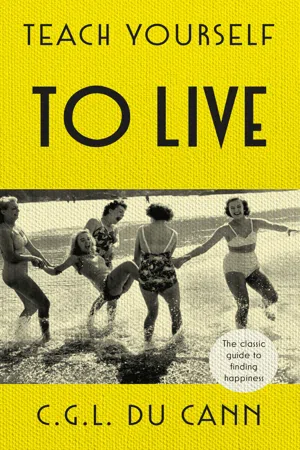
Teach Yourself To Live is a self-help classic from a very distant age. Then, as now, the self-help world was dominated by energetic Americans preaching the secrets of limitless achievement. But from the off this delightfully dry, wise and pragmatic book offers something quite different - a sober, somewhat stern, but ultimately generous guide to living in a world blighted by modernity and taxes.Nostalgic, funny and charming, this book somewhat bad-temperedly insists the reader not get ideas above his or her station - yet it ends up delivering a bracing, empowering guide to knowing yourself and living well (despite it all). Oliver Burkeman called this book "a place of stability and solid ground amid the rushing omnibuses". Full of fascinating and unexpected revelations, Teach Yourself To Live flips self-help on its head and provides a marvellous insight into the way we used to feel about life and how to live it. Since 1938, millions of people have learned to do the things they love with Teach Yourself. Welcome to the how-to guides that changed the modern world.
- 192 pages
- English
- ePUB (mobile friendly)
- Available on iOS & Android
eBook - ePub
About this book
Information
Topic
Personal DevelopmentSubtopic
Mental Health & WellbeingCHAPTER II
PERSONALITY: OR, WHAT YOU ARE
1. Personal Capital
LET us now look a little more closely at the much-misunderstood mystery of Personality or What you are.
“This is an age of cant,” as Stendhal, the great French author, reported as being one of Lord Byron’s great sayings. And about few things is more current cant talked than about “personalities”. Take Dr Johnson’s advice and clear your mind of cant—on this subject as on others.
In popular talk, personality is a special something, a something to be found only amongst the elite, amongst geniuses, tycoons, film-stars, and the like. Not amongst the humble and obscure. If such folk are distinctive they are merely “characters” or oddities, or eccentrics. Or at best, they are ordinary, commonplace persons.
Now the truth is that everyone, however self-effacing, however lowly, however negative, possesses a personality. It may be unpronounced. It may be modest, retiring, or almost negligible. It may be self-effacing or self-sacrificing. It may be of little value or interest to the world. But still it exists and it exists in its own right of existence. Whether others recognise it or not, whether they appreciate or not, it is still there.
A thing indeed to be reckoned with by its possessor and the rest of the world. This is true, whether the personality be a strong and formidable one like that (say) of Milton’s Satan, or such a reality as Hitler or Stalin, or an almost negligible one like Mrs Charles Dickens or the very humblest of human creatures inhabiting London.
For personality is not what you seem to others—a vulgar error. It is not even what you seem to yourself. It is what you, in fact, are.
To use another word, less debased by popular use, it is your individuality. The sum total of it. Or, put another way: what you have in yourself.
And what is this? What have you? Do you really know? Have you even tried to find out—exactly and truthfully?
Let us make the effort to find out, here and now. That effort may be valuable. Indeed, self-knowledge is always valuable. Certainly it will be interesting. For nothing is more interesting than oneself—to oneself!
Goethe, the famous German, asked that question “What have we?” And answered it. “What have we in life but our courage and energy and will-power?” he demanded of his friend, Eckermann.
At first sight this is a pregnant saying. But it is incomplete, a half-truth. As far as it goes it is magnificent as a summary of the mind and its governor, the will. But it takes no account of the other partner, the body, which for good or ill, we equally have in life. Even as a statement of mental possessions, too, Goethe’s answer is incomplete, for even the youngest child has acquired (by the exercise of those qualities) a body of mental wealth, a great treasure.
Look at yourself keenly. Calculate your personal capital. It may be divided into three distinct divisions conveniently, though you are, like the Trinity in theology, three-in-one and essentially a Unity.
There is the body, mind, and—something more important than either. Religious people call it the soul, or the spirit; some philosophers call it the Ego or governing part, others call it simply The Will. This last term will do for us. For its name does not matter: what does matter is that you should recognise its reality and its separate existence.
2. The Will
Your body’s importance is plain enough—every ache, pain, or illness or physical discomfort, however trifling, reminds you of that. Your mind’s importance is also clear—every need to remember, to learn, to understand, reminds you that it counts. The importance—I almost wrote super-importance—of your Will is probably much less clear, for often it functions subconsciously and if it fails to work or works badly, you instantly tend to excuse, rather than to accuse it, because you call it not your “will” but yourself or “I”.
And “I” is the dearest of all created things to you. Do not repudiate this truth, saying that you are not so selfish and self-regarding as all that. It is one of the laws of life, and even sainthood works to that rule, however self-sacrificing the saint may strive to be.
Also do not confuse this will, the governor, with its (i.e. your) servant, the mind. (There is no danger of your confusing it with the body: that, quite plainly, is its mere menial-servant and is constantly obeying with the gladness of a well-trained dog, its master’s peremptory, and sometimes exacting, orders.)
The ‘I’—your governing will-power—can force the mind into servitude and discipline. Your will can apply your mind to any topic or problem or thing at pleasure. True, the mind sometimes, if not often, breaks away, rebels, and seems ungovernable in its behaviour. But it can be brought to heel again, and the will, by constant practice and exercise of its authority, can break the mind into obedience, like breaking-in an unruly horse. Similarly, the body, too, can be controlled to a truly astonishing degree.
Now no doubt you realise how important and how interesting this psychological truth is. For these reasons, the strength of the will is important. Strengthen your will so that it completely dominates both your mind and your body, and you become a thousand times more effective for every purpose in life. You become a man or a woman in a million. Most folk are the slaves of body or mind, or both. Resolve to make both body and mind your servants.
At bottom, it is chiefly by the strength of your will that your fellows estimate your worth. Few people are truly strong-willed. Few people have complete control of their whole selves, though all of course, even the feeblest and flabbiest, attain some measure of control over at least a part of their own selves. Those who are complete masters of themselves, and clearly so, are regarded with a respect bordering on awe by their fellows. They count.
How do you strengthen your will?
It is neither an easy nor a momentary task. Some persons are born strong-willed. But, unlike the achievement of great gifts of body and mind—you cannot make yourself a Goliath in stature or a Mozart in mind if Nature has willed you to be born otherwise, as we have seen in an earlier chapter—you can achieve a strong will. The will, like a physical muscle, grows by exercise. And, again like a physical muscle, it grows flabby and inert by disuse.
Every time your will gains a victory over your body or mind it strengthens itself and its authority. Every time it suffers a defeat by either body or mind it weakens its authority.
Therefore, feed the will with victories and successes. Do not permit it to taste defeats.
To ensure this, take care to set it, especially at first, small and attainable tasks. And exercise it regularly.
Let me illustrate.
Frederick the Great of Prussia, a remarkable King and an equally remarkable man, sensed the all-importance to himself of strengthening his will. As a young man, anxious to study and do more than other men in life, he grudged the time spent in necessary, healthful sleep.
He therefore resolved to do without sleep. To keep awake all night and every night that he might study longer and harder! He resolved to do without sleep over a long period, and with resolute determination set himself so to do.
Alas! strong-willed as the youthful prince Frederick was, he soon found that he had set himself an impossible task. No human will could break the iron law that the human animal must have sleep to live. He tried not to sleep. He fought the tendency to sleep by every means he could devise, by every means in his power.
Useless! He slept.
Inevitably, for Nature forces the living animal to sleep sooner or later. You may do without sleep for a night, for two nights, perhaps even for three. It may be doubted whether there is a single person amongst the toiling millions of London who could keep himself awake for four days and nights. (There are thousands who will tell you that they haven’t “slept a wink for a week or a fortnight”, but you would be deceived, as they are, if you believed them. For if it were true, they would not be alive to tell the tale.) Soldiers have slept on the march or on horseback: the tortured on the rack.
Do not make the mistake of the great Frederick. Let the tasks you set your Will be attainable ones. And by degrees, make them harder.
And do not give up in despair because of failures. Persist. One of the rewards is, besides the all-important control over mind and body in a thousand ways, the enhanced self-respect, the deep inner self-satisfaction that these mental victories, these Waterloos and Trafalgars and Blenheims, of the will give you.
If you asked me whether I would have a strong healthy body, an active, intelligent, powerful, exceptional mind, or unconquerable will, I should say the last. The first two are bounteous gifts, but without the third they may lead to frustration and futility in life. Many broken-down bodies and many mediocre minds have achieved fame, fortune, and happiness because the will, working out its way, has made the best of them and forced them to its goal.
Put, then, the Will first.
3. The Body
Now for the body. Body-capital is of great importance. People who have brains are seriously apt to underrate it or some part of it. A grievous mistake, as indeed it is to underrate any part of your personality.
Few people look at their body-capital realistically. Its main qualities lie in appearance and health. Though the second is of the greater importance, do not let that blind you to the not inconsiderable importance of the former.
Women, especially younger women, are not in such danger of ignoring the importance of their physical body as men are. They know well the inestimable value of a pretty face, a pleasing expression, a good figure, attractive hands and feet. Also they appreciate the value of these not only to themselves but to others. They know that these are assets and advantages.
The youngest, silliest, and most flighty girl often has more sense on this particular point than many clever men. Nature and her own innate instincts teach her this wisdom. She may be vain and foolish in other things—but not in the emphasis she puts on her face, complexion, teeth, hair, nails, figure, dress and the rest.
For the truth is the world judges by appearance. Appeal to its eyes and you gain its heart. And once the heart is gained, the mind goes with it.
Appearance, then, is a genuine part of personal body-capital. If you are born good-looking in face and with an attractive figure, exploit it. If you have neither, make the best of what you have. Improve your personal appearance so far as you may.
Everyone knows that a girl with an ugly face and a squat ungainly figure is handicapped in life. The History of Womanhood is strewn with examples of girls and women, starting life poor and friendless and making their way to power and fortune with nothing but their beauty to help them. This is common knowledge. But what is not so well realised is that often men have done the same thing.
The great John Churchill, Duke of Marlborough, the ancestor of the present-day Winston Churchill, got his first advancement in life through his youthful good looks. He attracted the attention and affection of Barbara, Duchess of Cleveland, who gave him his first £5,000. That shrewd youth, Master Jack Churchill, invested it to bring in an annuity of £500 a year and the famous old man, the Duke of Marlborough, aged 70, was still drawing that annuity—and benefiting as he did to the day of his death from his once youthful good looks, and having prudently capitalised them.
Not every handsome young man can (or wants to) exploit his face and figure like that. But he can still reap advantages, some direct, some indirect, for people tend to be prejudiced in favour of attractive-looking men quite as much as in favour of pretty women.
Nature may, perhaps, not have been over-kind to you in the matter of facial looks and physical appearance. Then remedy Nature so far as you may. Make the best of yourself. Be well groomed. Be clean and neat. Dress well. Take pains to be well turned-out in every way.
Do not be in the least discouraged if you are of insignificant appearance. Napoleon was of dwarfish stature, so was Lloyd George, and King Richard the Third was a hunchback. Men and women, physically insignificant, can always be of real significance in the world, either by mental attainments, success in their calling, or by attractive and pleasing manners. John Wilkes used to boast—with justification, his acquaintances said—that though he was the most hideously ugly man in Britain, no woman could resist his blandishments and would prefer him to any handsome man if he got the chance of ten minutes’ previous conversation with her.
But more important than your appearance is your health and strength. If you have the misfortune to be born sickly and weak that indeed is a heavy handicap in life. A good constitution and a strong frame are incredible advantages—especially to those who know how to preserve them in the temptations of life. The misfortune is that young people never realise the importance of health. They accept it, enjoy it, and too often squander it senselessly.
That is natural. We rarely value what we get for nothing. Healthy youth takes health for granted. Knowing nothing of pain and sickness at first hand, it does not imaginatively realise them. When our eyes, teeth, and stomach function to perfection, we are not in the least sensible of them, nor grateful to them. We just remain unconscious of their very existence.
But get a tiny speck of dust in your eye. Or a toothache. Or griping colicky pains in the stomach. Instantly the afflicted part becomes of paramount importance, and the object, perforce, of its owner’s attention, care, solicitude and interest.
And when men and women, generally in middle-age or later, find that their health, once good or even perfect in youth, begins to go with their teeth, their hair, their eyesight, then—often for the first time—they begin, too late, to take an interest in their health.
But this is trying to lock the stable door after the horse has got out. How strange and sad that most of us only realise the blessing of health when it goes! And health once departed, often, too often, returns no more.
Bodily health and vigour is the basis on which every kind of success in life rests. Then be wise about it betimes. Never risk or injure your health. Give your body its needs: fresh air, good food and drink, sufficient exercise, adequate rest and sleep. Never maltre...
Table of contents
- Cover
- In the same series
- Title Page
- Copyright
- Contents
- Preface
- I. Tenure and Conditions of Existence
- II. Personality: or, What You Are
- III. Property: or, What You Have
- IV. Livelihood and Leisure
- V. The Environment of Others
- VI. The Environment of Place
- VII. The Environment of Period
- VIII. Streamlining Your Days and Ways
- IX. Past, Present and Future
- X. Getting the Best, Second Best—or Worse
- XI. Living the Multiple Life
- XII. Selfishness and Selflessness
- XIII. Teachers of How to Live—Marcus Aurelius; Gracian; Lord Bacon; Lord Chesterfield; Arnold Bennett; Somerset Maugham
Trusted by 375,005 students
Access to over 1.5 million titles for a fair monthly price.
Study more efficiently using our study tools.
Frequently asked questions
Yes, you can cancel anytime from the Subscription tab in your account settings on the Perlego website. Your subscription will stay active until the end of your current billing period. Learn how to cancel your subscription
No, books cannot be downloaded as external files, such as PDFs, for use outside of Perlego. However, you can download books within the Perlego app for offline reading on mobile or tablet. Learn how to download books offline
Perlego offers two plans: Essential and Complete
- Essential is ideal for learners and professionals who enjoy exploring a wide range of subjects. Access the Essential Library with 800,000+ trusted titles and best-sellers across business, personal growth, and the humanities. Includes unlimited reading time and Standard Read Aloud voice.
- Complete: Perfect for advanced learners and researchers needing full, unrestricted access. Unlock 1.5M+ books across hundreds of subjects, including academic and specialized titles. The Complete Plan also includes advanced features like Premium Read Aloud and Research Assistant.
We are an online textbook subscription service, where you can get access to an entire online library for less than the price of a single book per month. With over 1.5 million books across 990+ topics, we’ve got you covered! Learn about our mission
Look out for the read-aloud symbol on your next book to see if you can listen to it. The read-aloud tool reads text aloud for you, highlighting the text as it is being read. You can pause it, speed it up and slow it down. Learn more about Read Aloud
Yes! You can use the Perlego app on both iOS and Android devices to read anytime, anywhere — even offline. Perfect for commutes or when you’re on the go.
Please note we cannot support devices running on iOS 13 and Android 7 or earlier. Learn more about using the app
Please note we cannot support devices running on iOS 13 and Android 7 or earlier. Learn more about using the app
Yes, you can access Teach Yourself to Live by C G L Du Cann in PDF and/or ePUB format, as well as other popular books in Personal Development & Mental Health & Wellbeing. We have over 1.5 million books available in our catalogue for you to explore.