Featuring detailed profiles of the Chinese tech companies making waves, the tech sectors that matter most in China's grab for super power status, and predictions for China's tech dominance in just 10 years. The rise of China's tech companies and intense competition from the sector is just beginning. This will present an ongoing management and strategy challenge for companies for many years to come. Tech Titans of China is the go-to-guide for companies (and those interested in competition from China) seeking to understand China's grand tech ambitions, who the players are and what their strategy is. Fannin, a leading expert on the Chinese tech sector, is an internationally-recognized journalist, author and speaker. Through her company, Silicon Dragon, Fannin hosts 12 live events annually for business leaders, venture capitalists, start-up founders, and others impacted by or interested in the Chinese tech industry.
eBook - ePub
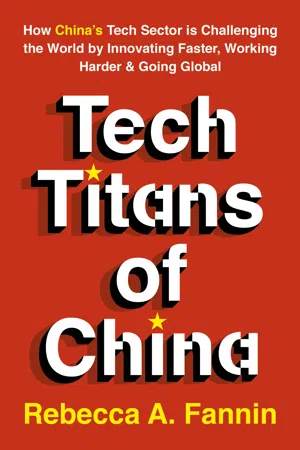
Tech Titans of China
How China's Tech Sector is Challenging the World by Innovating Faster, Working Harder & Going Global
- 256 pages
- English
- ePUB (mobile friendly)
- Available on iOS & Android
eBook - ePub
Tech Titans of China
How China's Tech Sector is Challenging the World by Innovating Faster, Working Harder & Going Global
About this book
Information
part one
HOW CHINA IS WINNING
CHAPTER 1
________________
CHINA’S FACEBOOK, AMAZON, AND GOOGLE: THE BAT’S TECH TEMPLATE
China’s tech titans Baidu, Alibaba, and Tencent (the BAT) own search, e-commerce, and social networking in China and are forging ahead into innovating frontier technologies that will reshape financial, retail, transportation, and mobile communication sectors globally.
The BAT’s Tech Template
The Alibaba-owned supermarket I visited in Shanghai makes the Whole Foods grocery store in my New York City neighborhood look outdated. There’s no cash, cashiers, or checkout lines at Alibaba’s futuristic stores. It’s all digital. You pay by Alipay mobile app at do-it-yourself kiosks equipped with digital cameras that scan and ID your face. Your groceries orders are bagged and clipped to an overhead conveyor belt that runs across the store to be delivered within 30 minutes by scooters within a three-kilometer zone. Aisles with built-in interactive, digital screens let you see the ingredients of each food and its origin. Wi-fi–connected, e-ink price tags change pricing details automatically. Fresh produce and seafood are flown in daily and can be prepared and eaten at the in-store restaurant, where robots travel along a track to bring your freshly cooked meal directly to your table in a sealed compartment.
Alibaba has opened more than 100 self-operated Freshippo grocery retail stores in major Chinese cities, and it plans more. In the United States, Amazon is playing catch-up with its own e-retailing and deliveries that are not as far-reaching or digitalized yet. Amazon’s small, automated Go convenience stores offer much narrower merchandise selections and are only in 10 US metros, while Whole Foods grocery deliveries can take two hours and are limited to select cities, with free service restricted to Amazon Prime members. Neither has the new-fangled tech that I saw in Chinese retail outlets. This is just one example of where the digital future is already here, in China, while the United States lags.
Today, Alibaba stands out as one of China’s three tech kings, along with Baidu and Tencent, collectively known as the BAT. Like the FANGs, namely Facebook, Amazon, Netflix, and Google in the United States, in China Baidu owns search, Alibaba leads e-commerce, and Tencent dominates gaming and social networking—and all are well positioned in artificial intelligence (AI). Their success has come from hard work, ambition, talent, capital, and a home team advantage in China’s newly entrepreneurial markets. In the scrappy, cutthroat Chinese marketplace, these digital innovators seek to own the next new thing and are creating awesome new features and business models that have captured the Western world’s attention. Their next hurdle is breaking through globally.
Alibaba, with a name that conjures up the command “Open sesame,” is universally known due to charismatic leader Jack Ma and his e-commerce treasures. Now the massive power and reach of the BAT is increasingly recognized outside of China. All three are at the vanguard of China’s turbocharged digital economy, which is set to jumbo-size by five times to $16 trillion in 2035.1 They are changing how Chinese consumers connect, socialize, shop, pay, eat, travel, invest, get loans, and monitor their health, and are causing America’s own innovators to sit up and take notice.
The BAT have the best of both worlds. These three companies have scaled up in their protected home markets with little overseas competition, tapped the Western capital markets with IPOs, and used the money to bulk up with billion-dollar acquisitions and chunks of the most promising, innovative tech companies, in effect paying a large tuition to gain knowledge on what makes Silicon Valley tick. They are innovating in ways that are tuned to China’s fast-paced digital culture and slowly filtering into the West. Their sprawling size and take-all competitive thrust has major implications for the US tech industry and for US consumers.
In short, Baidu, Alibaba, and Tencent are upending a long-held and cherished assumption that Silicon Valley companies will dominate the global tech economy in the coming decades. They are leading a high-tech gold rush guided by five key trailblazing strategies:
•snapping up cutting-edge technology startups
•keeping the innovation engines humming day and night
•expanding to high-potential tech hubs around the world
•advancing into artificial intelligence, big data, telemedicine, autonomous driving, facial recognition, mobile payments and lending, and digital entertainment
•constructing moats of many tech sectors in sprawling ecosystems to bulk up and ward off competitive invaders
Li, Ma, and Ma, Oh My
Before taking a closer look at these aggressive initiatives, let’s recap how far this trio of giants has come. Over the past decade, China’s tech heavyweights have entered the rarefied ranks of the world’s largest and most valuable companies. They are sometimes compared with South Korea’s chaebol or powerful conglomerates Samsung, LG, and Hyundai.
Isolated from American competition thanks to the Chinese government ban on Google, Facebook, and Twitter, as well as struggles by Amazon, eBay, Yahoo!, MySpace, and others to crack the Chinese market in the face of government restrictions and support of home-grown, internet warriors, China’s tech titans have logged remarkable double-digit growth rates for several years—and continue to accelerate.
Enormous progress has been made since 2000, when digital China first arrived, thanks to the foresight and leadership of the BAT CEOs: Robin Li of Baidu, Jack Ma of Alibaba, and Tencent’s Ma Huateng, known as Pony Ma (derived from his family name, which means horse in Chinese). It’s hard to imagine they would have come so far, so quickly—and stayed in power for so long. They are regarded as superheroes in the first generation of entrepreneurs since China’s Cultural Revolution of the 1960s and 1970s nearly destroyed the economy, and the later reforms of former leader Deng Xiaoping opened China to a socialist market economy and made it glorious to get rich.
All three founders cranked up their startups soon after the US dotcom bubble burst about two decades ago. They did become very rich—among the richest in the world—initially by copying. Baidu’s quiet-spoken search expert Li, who came to the United States for a computer science graduate degree and jobs at Dow Jones and Disney-owned search company Infoseek before returning home, has a $10 billion fortune made in China. He unabashedly copied Google and won the Chinese market. Alibaba’s dynamic leader, a former English teacher who acted on his entrepreneurial instincts after discovering the internet on a trip to the United States as a translator, has a net worth of $40 billion. His Taobao shopping site was very intentionally modeled on eBay and beat eBay in China with cutthroat pricing and localized features such as instant messaging. Tencent’s CEO, a press-shy engineer born and educated in southern China, has been described as a scorpion who will lie in wait before attacking, has a $44 billion fortune.2 His QQ instant messaging service was based on the Israeli invention ICQ, initially acquired by AOL and then bought by Russia’s largest internet company, Mail.Ru.
Today, China’s titans have left copying behind and are managing broad and deep power bases in tech. With that power comes lots of headaches. Like Mark Zuckerberg, Jeff Bezos, and Larry Page, who confront a tech backlash and constant challenges to their clout, China’s leaders face daunting issues that could weaken them: privacy concerns, counterfeit charges, restrictions on their most addictive products, and competitive threats.
Baidu faces a possible reentry of Google to the Middle Kingdom some 10 years after googling didn’t knock out China’s search leader. Baidu’s bid to own the future for AI with self-driving cars and facial recognition for payments is uncertain after Li lost two experts in a row who were leading Baidu’s AI charge while rivals chip into the sector: Alibaba in smart-city traffic management, Tencent in medical imaging and diagnostic tools, and startups SenseTime and Face++ with AI-enhanced face-matching technologies for IDs and public security.
Alibaba’s lead in e-commerce is challenged too, by social commerce upstart Pinduoduo with an app that combines bargain bin merchandise, prizes, social sharing features, and gaming. Alibaba also must fight a Tencent-funded gang of e-commerce contenders, including giant JD.com.
Tencent has to recapture the entrepreneurial spirit and creative juices that turned WeChat into a multifunctional superapp but missed the short video phenomenon grabbed by newcomer TikTok. Tencent must also reset its main gaming business, which got caught up in Chinese regulations. When I first met and interviewed China’s young tech leaders in the early years of the new millennium, they were just getting started in figuring out the magic of Silicon Valley and had little track record. Little did they know it would get so complex, so fast. And neither did I.
How China’s Net Brands Stack Up
As China’s big three tech companies have forged their paths, they parallel America’s FANGs. They are still far overshadowed in size by Google, Amazon, and Facebook but growing superfast. If their growth continues at a rapid clip, China’s BAT might someday measure up to American companies. See table 1-1. The Chinese threesome already are among the most valuable publicly traded companies in the world. The market capitalizations of Tencent and Alibaba both hover around $400 billion, in the top 10 with Amazon, Apple, Microsoft, Alphabet, and Facebook, while Baidu trails at about $60 billion.3
China’s game-changers are innovating, investing, and commercializing quickly, with many next-generation technologies that the West doesn’t have yet for the home, office, vehicle, and screen. None of these titans is likely to be dislodged from its position soon, but look for shifts. The vortex of China’s techno power is increasingly spinning around the aggressive A and the T of the BAT, Alibaba and Tencent, while Baidu loses ground to its bigger rivals and posted its first quarterly loss in 2019 since a 2005 listing. There’s a new B on the horizon: the world’s highest-valued unicorn, ByteDance, which is taking on Tencent with internationally popular video app TikTok and a new video messaging app.
Table 1...
Table of contents
- Cover
- Praise for: Tech Titans of China
- Title Page
- Copyright
- Dedication
- Contents
- Introduction
- PART ONE: How China Is Winning
- PART TWO: China’s Silicon Valley Venture Capitalists
- PART THREE: Tech Sectors that Matter Most: China’s Grab for Superpower Status
- Afterword
- Acknowledgments
- Notes
- Index
Trusted by 375,005 students
Access to over 1.5 million titles for a fair monthly price.
Study more efficiently using our study tools.
Frequently asked questions
Yes, you can cancel anytime from the Subscription tab in your account settings on the Perlego website. Your subscription will stay active until the end of your current billing period. Learn how to cancel your subscription
No, books cannot be downloaded as external files, such as PDFs, for use outside of Perlego. However, you can download books within the Perlego app for offline reading on mobile or tablet. Learn how to download books offline
Perlego offers two plans: Essential and Complete
- Essential is ideal for learners and professionals who enjoy exploring a wide range of subjects. Access the Essential Library with 800,000+ trusted titles and best-sellers across business, personal growth, and the humanities. Includes unlimited reading time and Standard Read Aloud voice.
- Complete: Perfect for advanced learners and researchers needing full, unrestricted access. Unlock 1.5M+ books across hundreds of subjects, including academic and specialized titles. The Complete Plan also includes advanced features like Premium Read Aloud and Research Assistant.
We are an online textbook subscription service, where you can get access to an entire online library for less than the price of a single book per month. With over 1.5 million books across 990+ topics, we’ve got you covered! Learn about our mission
Look out for the read-aloud symbol on your next book to see if you can listen to it. The read-aloud tool reads text aloud for you, highlighting the text as it is being read. You can pause it, speed it up and slow it down. Learn more about Read Aloud
Yes! You can use the Perlego app on both iOS and Android devices to read anytime, anywhere — even offline. Perfect for commutes or when you’re on the go.
Please note we cannot support devices running on iOS 13 and Android 7 or earlier. Learn more about using the app
Please note we cannot support devices running on iOS 13 and Android 7 or earlier. Learn more about using the app
Yes, you can access Tech Titans of China by Rebecca Fannin in PDF and/or ePUB format, as well as other popular books in Business & Business General. We have over 1.5 million books available in our catalogue for you to explore.