Finance for non-financial managers - succeed with just four numbers. Finance doesn't have to be complicated. This book shows you how to make better, faster, financially sound business decisions using just four numbers.Effective financial management is at the heart of every successful business but it can seem impenetrable to the non-financial manager; littered with spreadsheets, inexplicable charts and intricate formulae, all washed down with swathes of unintelligible jargon. In reality, successful financial management is all about the management of just these four figures.Knowing what these four figures are, how they relate to each other and most importantly, how they can be managed, is the key to financial success. This is what David Meckin calls 'the 4 figure trick'. Almost every major business failure can be pinned down to the ineffective management of at least one of these critical figures.Focusing on just four figures not only makes the world of financial management more accessible to the non-financial manager, it also greatly simplifies the decision-making process. Full of step-by-step guides, examples and illustrations, The 4 Figure Trick reveals a variety of practical managerial strategies that can significantly enhance the financial performance of any business.
eBook - ePub
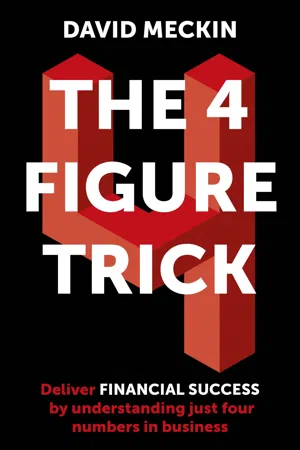
The 4 Figure Trick
The book for non-financial managers - How to deliver financial success by understanding just four numbers in business
- 160 pages
- English
- ePUB (mobile friendly)
- Available on iOS & Android
eBook - ePub
The 4 Figure Trick
The book for non-financial managers - How to deliver financial success by understanding just four numbers in business
About this book
Information
CHAPTER 1
Keep It Simple

‘Imagine you’re presented with the annual report of a company. It doesn’t matter which company; it can be any company of your choosing. There are two things you should note. First of all, there’s the length. A typical report can range from just a handful of pages to a hundred pages or more. Second, there are the numbers. Regardless of the length of the report, one thing you can be certain of is that there are going to be lots of numbers – maybe hundreds, maybe thousands. That’s a great deal of information to take in. I am about to show you how, in under one minute, you can ascertain whether this business is a success or not. In addition, I am going to demonstrate how, in less than five minutes, you can identify all its core strengths and weaknesses.’
I regularly present to audiences from all over the globe on financial management and this is an opening I often use. Something I always notice, as soon as I say this, is that delegates start to sit up. It’s as if I have just announced I am going to prove cows can fly! In a way, though, I have for many people made a statement which appears equally implausible. I’ve intimated that financial management isn’t difficult. Surely that can’t be true?
Finance tends to get a bad press, and to a certain degree that reputation is deserved. Many finance professionals have a knack for making the topic seem well beyond the grasp of the average person on the street. Ask most people what they think of when they hear the word ‘finance’ and the response will often be vast tables of numbers, spreadsheets, inexplicable charts and complex formulae, all washed down with swathes of unintelligible jargon. Indeed, it’s often argued a great cure for insomnia is to attend a presentation by a chief financial officer reviewing the latest set of trading results. It will always involve a PowerPoint presentation, and it will always be packed with numbers. Audiences typically begin to drift off halfway through the second slide, and only the most determined can still keep their eyes open by the end of the third.
As we shall discover, the 4 figure trick turns the popular view of finance on its head. It says effective financial management isn’t about getting engrossed in lots of detail: it’s all about focusing on just a few core figures. Knowing what these figures are and, most importantly, understanding how to manage them, is the key to running a financially successful business.
Before going any further, I need to take you on a journey; a journey I embarked upon that spanned several years. What follows is an evolution of thinking. The 4 figure trick isn’t something that miraculously came to me overnight. I am going to walk you through the early days of my career. Not because you will find it a riveting read, waiting in eager anticipation as you turn over to the next page, but because it highlights many of the challenges that exist within modern-day financial management. It’s only by appreciating what these challenges are that you will be able to fully exploit the opportunities that will be made available to you through the 4 figure trick approach.
When I went to university in the dim and distant past, I spent three years studying economics, and it seemed like a natural progression at the time to move on into the world of finance. I progressed through a variety of roles, eventually working my way up to that of chief financial officer of a multinational business. Something I noticed along the way, regardless of the company I was working for, was that there appeared to be this enormous void between the finance function – who were busy producing lots of reports – and the rest of the management population who were busy making lots of business decisions. What was particularly worrying was that this phenomenon appeared to be commonplace in many businesses.
What was creating this void? It seemed to all come down to communication. Finance teams were generating lots of information, but the management teams didn’t understand it. But it was worse than that. Finance managers love detail – the more the better – whereas most non-financial managers hate detail. So here we had lots of detail being produced for an audience that didn’t want or even understand it. Not surprisingly, given the choice, many managers would avoid the world of finance wherever possible. The trouble is, finance is the very lifeblood of business.
A significant part of my role when I was a chief financial officer was trying to break down these communication barriers and engage the general management population in the financial performance of the business. Indeed, it was this aspect of the job that inspired me to set up my own management consultancy. I wanted to inspire managers in other companies to engage with the world of finance and help them make sound financial decisions; but setting up a new business throws up an immediate challenge. To attract clients I would need a USP – a unique selling proposition that would differentiate my business from the competitors.
At the time there were already many consultancies offering courses targeted at non-financial managers, parading such exciting titles as ‘Finance for Non-Financial Managers’ and ‘Introduction to Finance’. It was almost guaranteed that if you attended one of these courses they would walk you line by line through a financial report and explain what each and every line meant. They might even throw in a few financial metrics to spice things up a bit. In fairness, while on the course, you might well begin to grasp the principles being presented. The problem is that most managers don’t generally tend to spend much of their day studying accounts, so all this understanding gradually dissipates until eventually it’s just a distant memory. What’s the ultimate impact upon business performance? Nil. Indeed, a frequent comment I’ve encountered from delegates attending one of my presentations is, ‘I attended a finance course a few years ago, but I don’t remember any of it’.
Clearly, a different approach to educating non-financial managers in the world of finance was required. But what should this approach be? To answer this question required that I go back to absolute basics.
What is the role of a manager? Regardless of the business, the role of a manager is to coordinate and manage resources, whether these resources be people, machinery or property. It doesn’t matter what function you operate within, whether it be human resources, production, sales, information technology or some other function, you’re there to manage resources, which means by definition you’re impacting upon business performance. Every decision you make, right down to the length of coffee breaks, can have financial consequences.
This provided me with my USP. Unlike many financial management and training consultancies at the time, I decided at the outset I was not going to teach managers about finance. Instead, I would show managers how they could enhance financial performance through the decisions they made. I wanted to provide managers with a skill set they could apply on a day-to-day basis; something they wouldn’t forget. That was the premise on which I set up my consultancy all those years ago.
This was a valuable learning point for me. Managers don’t want to understand all the intricacies of finance, but they do want to ensure they’re making financially sound decisions. This approach clearly had appeal because, within a couple of years, the consultancy had built up a significant client base – but I had another even more valuable lesson to learn.
Inevitably, when commissioning work, every client had specific financial issues it wanted to address and messages it wanted to communicate to its management population. As a result, I made the decision that the content of all engagements should be tailored to meet these specific needs. At the time, this struck me as eminently reasonable: adjust the messages to reflect operations within the client organization. However, as time progressed, a variety of experiences led me to doubt whether this approach was indeed the most effective.
One experience – fairly early on in my new-found career – involved sitting down with a regional manager for a major retail outfit. The company had just installed a new management information system and this individual was clearly very proud of it.
‘Dave, name a product line’, he said.
‘White shirts.’
‘Now pick a date in the last 12 months.’
‘12 February.’
‘Now name a time.’
‘10 am.’
‘Now name another time.’
‘2 pm.’
‘Dave, watch this.’
With a quick press of an enter key, a report appeared on the computer screen, analysing by store the sales of white shirts on 12 February that took place between 10 am and 2 pm.
‘Look, Dave’, said a now very excitable regional manager. ‘You can see what each shirt cost us, what we sold it for, any discounts that were applied and also the profit made on each sale!’
It was at this juncture I raised the inevitable question. ‘This is all very impressive, but how does this help you manage your business?’ There was a long pause at this point. If this was a movie, you probably could have enhanced the atmosphere by having a few tumbleweeds blowing through the office in the background. It was a classic example of providing lots of information without any consideration as to how it could help improve decision making: lots of figures but no management.
This observation was reinforced more dramatically only a few months later. I was working with a client who was managing a diverse portfolio of discrete businesses ranging from distribution to gaming. My brief was to deliver a series of workshops to the general management population, focusing on practical initiatives that could be implemented to enhance commercial performance. At the time I was aware this client had also called in a global management consultancy to conduct an in-depth strategic review of the entire group. It was while this was taking place that I was asked whether I could extend my current brief to include a few extra days with the senior management team. When I was initially told what the nature of these additional days would comprise, I was baffled.
‘Dave, we would like you to take an active role in the ongoing strategic review and we would like you to sit in on the update presentations.’
‘I’m confused. You’re already paying a small fortune to a global consulting group to conduct this review. Why on earth do you want me to sit in on their presentations?’
‘To be honest, Dave, we haven’t got a clue what they’re talking about! We would like you to join us in these meetings, at the end of which you can sit down with our senior management team and explain what the consultants are saying.’
And that is exactly what happened. I would sit in on the presentations, take notes and later in the day would sit down with the senior management team to demystify the presentation. This was a bizarre situation. Here we have a well-respected client hiring a consultant to explain what another group of consultants are trying to tell them!
Even though I was dealing with the senior management team, all this group really wanted was some clarity. They wanted some clear easy-to-understand messages regarding the strategic direction the group should be pursuing. The detailed multicoloured graphs and charts were all very entertaining, but that wasn’t what this senior management team wanted. They were looking for solutions: not heaps of analyses. Once again, lots of figures but no management.
The problem was, and still is, that many finance departments are obsessed with producing reports that are awash with figures. A common comment I have received from accountants is: ‘The Devil is in the detail.’ I’ve lost track of the number of monthly board packs I’ve encountered which laughingly are supposed to ‘summarize’ trading activity over the preceding four weeks; and I couldn’t help noticing that some of these so-called summaries contained over ten thousand figures. This just made no sense at all. Not even the most experienced and astute chief financial officer could digest that level of detail.
The justification I always received was the same: information is key. The general consensus seemed to be that all managers need is information, and that if they get the information, they can use this to make sound decisions. This is why almost every organization is awash with what is called management information. In my experience, the problem is that far too much emphasis tends to be placed on information and not enough on management; simply bombarding managers with numbers will do nothing to help improve business performance. One of the reasons there tend to be so many numbers is they are often used to perform three very distinct functions.
Making decisions in a vacuum is a pointless exercise: there needs to be direction, and this is contingent on there being a clear objective. This is the first key role of figures: numbers can provide tangible, quantifiable objectives. Having an objective is of no use if you’ve no idea when you’ve reached it. Numbers can provide clarity.
Numbers don’t just exist to provide goals to work towards, though. A second extremely important function is to provide information that will aid decision making. A real power of figures is the ability to summarize activity. If I work in a car dealership and during the week I sell 20 cars, I don’t need to detail every individual sale to assess how the week has gone – all I need is a total weekly sales figure. One number has managed to summarize my entire week’s activity; and reviewing weekly sales performance figures can prove invaluable when it comes to planning sales activity for the future. This is the second role of numbers in business – numbers can aid decision making.
Unfortunately, decisions that are made don’t always produce the desired outcomes. It’s at this stage that some form of feedback is required. There needs to be a system for monitoring outcomes, and this introduces the third function of numbers. Just as numbers can be used to summarize data that is relevant to decisions about to made, numbers can also be used to summarize the outcomes of decisions already made.
This suggests, if numbers perform three different functions, then surely three different sets of numbers will be required to satisfy each of these functions. Indeed, in many businesses this is the case. The annual objectives of a business are often encapsulated within some form of medium to long-term strategic plan. To aid in day-to-day decision-making, managers will often be provided with detailed budget reports highlighting areas where performance is deviating from expectations and thereby highlighting where action is required. Then, when it comes to assessing year-to-date performance, there will often be a monthly executive pack. The problem is, each of these documents will typically contain hundreds and, in some instances, thousands of figures. Do managers study all of these numbers? Of course not. So, if people aren’t looking at the ...
Table of contents
- Cover
- Title
- Dedication
- Contents
- About the Author
- 1 Keep It Simple
- 2 Measuring Financial Success
- 3 Making Sense of Trading Data
- 4 The Profit-making Process
- 5 It’s All About 4 Figures
- 6 The Formula For Financial Success
- 7 Improving Performance
- 8 The Investors’ Perspective
- 9 Closing Thoughts
- Copyright
- Back Cover
Trusted by 375,005 students
Access to over 1.5 million titles for a fair monthly price.
Study more efficiently using our study tools.
Frequently asked questions
Yes, you can cancel anytime from the Subscription tab in your account settings on the Perlego website. Your subscription will stay active until the end of your current billing period. Learn how to cancel your subscription
No, books cannot be downloaded as external files, such as PDFs, for use outside of Perlego. However, you can download books within the Perlego app for offline reading on mobile or tablet. Learn how to download books offline
Perlego offers two plans: Essential and Complete
- Essential is ideal for learners and professionals who enjoy exploring a wide range of subjects. Access the Essential Library with 800,000+ trusted titles and best-sellers across business, personal growth, and the humanities. Includes unlimited reading time and Standard Read Aloud voice.
- Complete: Perfect for advanced learners and researchers needing full, unrestricted access. Unlock 1.5M+ books across hundreds of subjects, including academic and specialized titles. The Complete Plan also includes advanced features like Premium Read Aloud and Research Assistant.
We are an online textbook subscription service, where you can get access to an entire online library for less than the price of a single book per month. With over 1.5 million books across 990+ topics, we’ve got you covered! Learn about our mission
Look out for the read-aloud symbol on your next book to see if you can listen to it. The read-aloud tool reads text aloud for you, highlighting the text as it is being read. You can pause it, speed it up and slow it down. Learn more about Read Aloud
Yes! You can use the Perlego app on both iOS and Android devices to read anytime, anywhere — even offline. Perfect for commutes or when you’re on the go.
Please note we cannot support devices running on iOS 13 and Android 7 or earlier. Learn more about using the app
Please note we cannot support devices running on iOS 13 and Android 7 or earlier. Learn more about using the app
Yes, you can access The 4 Figure Trick by David Meckin in PDF and/or ePUB format, as well as other popular books in Business & Corporate Finance. We have over 1.5 million books available in our catalogue for you to explore.