What would a little extra confidence mean to you?
You might do better at work, feel more comfortable in social situations, be more open to new experiences. Confidence can do amazing things for you. If you've ever done anything well you already know how to do confidence. The secret is to know what it looks, sounds and feels like for you, and then replicate it in areas where confidence doesn't come so easily. Instant confidence
Most people are brought up thinking you're either confident or not. That's not the case. Confidence isn't something you have or don't have; it's something you do or don't do. We all have it and can trigger it in an instant regardless of situation, experience or external factors. Get the confidence habit
This book is packed with strategies for increasing confidence. By choosing one or two at a time and using them, your confidence will grow significantly no matter what your starting point. Apply the tools, techniques and principles you are about to read and you will have all the confidence you could ever need in any situation. The 50 Secrets of Self-Confidence was first published as Secrets of Confident People.
eBook - ePub
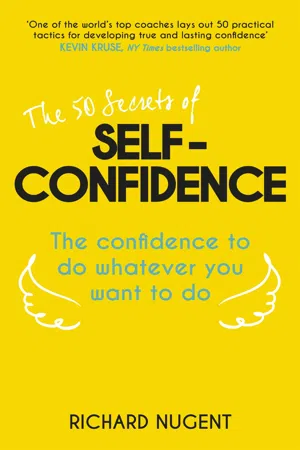
The 50 Secrets of Self-Confidence
The Confidence To Do Whatever You Want To Do
- 272 pages
- English
- ePUB (mobile friendly)
- Available on iOS & Android
eBook - ePub
About this book
Information
Topic
Personal DevelopmentSubtopic
Mental Health & Wellbeing |
THE FUNDAMENTAL SECRET OF CONFIDENCE
|
Confidence is contagious. So is lack of confidence.
Vince Lombardi
If you have bought this book, the chances are that you want more confidence in certain areas of your life. In my work over the last decade I have encountered tens of thousands of people, and confidence is one of the most common development areas. I have been fortunate enough to work with professional footballers and athletes, CEOs and executives from some of the biggest and best-known brands in the world, and many, despite their apparent success, still feel they lack confidence.
By applying the tools, techniques and principles you will read on the following pages, you will have all the confidence you could ever need in any situation. You will be able to share these strategies with colleagues and clients, friends and family and, best of all, be able to trigger instant confidence whenever you need it.
You can choose to use the book in two ways: you can read it from cover to cover, applying the frameworks that are most appropriate for you; or you can use the index to guide you and use it as a toolkit to develop the areas that you feel are most important.
Whichever approach you take, the most important thing is to experiment and practise the concepts that you read. Any change comes from habit and learning it occurs through action.
Each of the secrets in this book are valuable in their own right, but all are built on the foundation of a fundamental understanding of what confidence is. Most people are brought up believing that confidence is something that they have or don’t have. This is not the case; we all have it and can trigger it in an instant.
Confidence is not something you have or don’t have; it’s something that you do or don’t do.
REALIZE THAT IT’S NOT OUTSIDE, IT’S INSIDE
Somewhere back in time someone created some particularly unhelpful language about confidence. We talk about confidence as if it is something that sits outside of us and that we get. We don’t say, ‘If only I could get more happy’, yet we use that language about confidence. This leads to the misperception that we can only have confidence when a specific set of circumstances occur or when we have achieved certain things. We think that we will be confident when we are an expert in something or when we have lost a certain amount of weight, when we have achieved a promotion or gained a qualification. None of this is true.
Confidence is an emotional state. It is something that we feel sometimes and don’t feel at other times. The various chapters outline the numerous ways in which we can feel this state more often, but it is really important to understand these strategies are triggers for the physical, mental and emotional state that we recognize as confidence.
UNDERSTANDING STATES
How long do you think states last? You might think that feelings take time to change. In fact, most emotional states last somewhere between 20 seconds and two minutes. All states are a result of an electrochemical reaction in the brain. These reactions are triggered by a combination of what you are thinking about, what you are doing with your body and your perception of the world around you.
States can be triggered in an instant and changed again in another and the great news is that you are completely in charge of your state at any time. We do, however, have certain states that we hang around in more of the time. I am sure that you can picture someone now who has a default state of miserable. They only seem to notice the negative in their world, they will always focus on what is bad or what could go wrong. They will answer a simple ‘How are you?’ with a low-energy, ‘Oh surviving … just’. These masters of misery will even have a specific posture and way of walking that radiates gloom. It is a state that they can access easily and do so regularly.
Now think of someone who seems to be in a consistently confident state. Think about how they see the world, what do they notice most in situations and who do they surround themselves with? What kind of language do you hear them using most? Now picture them walking across a room or sitting in a meeting. I bet that their physiology is significantly different from our melancholy friend from the first example.
When you remember that confidence is a feeling we get as a result of what we think, do and say, it is easy to see how people who understand this can be confident in any situation and find it easier and easier to get into that state.
FINDING YOUR STATE OF CONFIDENCE
Everyone is confident in some area of his or her life. If you have a job, can drive, have a family, play sport, are part of a club, or if you have ever done anything well – you know how to ‘do’ confidence. The secret is to know what your confidence looks, sounds and feels like and then replicate it in areas where you don’t do confidence as easily.
Try this experiment. Think back to a time when you felt at your most confident best. It can be in any situation. Recall it as if you were there again now. See what you saw at that time, notice what is happening around you. It is important to be in the memory rather than watching it from outside. Keep focusing on the memory and notice the kinds of things you were thinking; if you were speaking remember the words that you were using and how you were saying them. Now, as you remember this time from the past when you were at your most confident best, focus on how you were standing or moving and, most importantly, how you were feeling. Notice where the confident feelings were in your body and how those feelings moved.
Now notice that, even though you were just accessing a memory, you are feeling some of that feeling right now. This is a taste of your confidence.
The brain is an amazing piece of kit that we are gaining a greater understanding of than ever before but the one thing that it doesn’t do well is differentiate between what is real and what is strongly imagined. We will explore much more of the implications and uses of this inability in other chapters; however, the most important consequence of this in relation to confidence is that when we imagine ourselves as confident the brain releases the same chemicals around the body as when we really do feel confident. As you will see in future chapters the debate about ‘we fake confidence’ has no practical value.
Putting it all together |
Confidence is a feeling that we get as a result of what we think, what we do with our body and how we perceive the world around us. These combine to create a neurological and biological response in the body. When the right mix of chemicals has the right receptors in the body we feel confident. This means that confidence can be triggered by us at any time regardless of situation, experience or external factors. |
States are completely transient, changing moment by moment. We can influence these changes through our thinking, our physiology and our language. We can create structures and habits that ensure that confidence is a state that we default to. The more time you spend in any state the easier it is to re-access this state. It is important to remember that lack of confidence, fear and doubt are states that can become habit too. |
You already are confident in many areas of your life even if you don’t realize it. Noticing what confidence looks, sounds and feels like for you and then replicating this in other situations is a great way to build your confidence habit. This is especially useful because the brain processes reality, imagination and memory in the same way. If you imagine or remember confidence it will trigger it in the present. |
These core principles and practices underpin the practical secrets that are shared in the rest of the book. Without this understanding of what confidence is and how it is created it would be much more difficult to apply the techniques presented here. Now that you have this understanding triggering your confidence will be easier than ever before. |
 | THE MYTH OF FEAR |
You can’t make decisions based on fear and the possibility of what might happen.
Michelle Obama
If confidence is a state then what is fear? When people define it they usually refer back to times in the past when they experienced fear, but they don’t define what it actually is. Fear is a feeling, or we would label it a state. As with any other emotional state it is triggered by a combination of what you do with your body, the words and phrases that you use and, importantly, the thoughts that you concentrate most on.
We believe that we get afraid because of other people or because of certain situations but this is not the case. Our fear is triggered because of what we think about certain situations or people.
Take phobias as an example. My younger brother has a phobia of clowns. Even seeing a picture of a clown will trigger an almost overwhelming sense of fear and the physiological reactions that come with it including increased heart rate, body temperature and instant perspiring. If you asked him why he is so afraid of clowns he would tell you it was because they are weird looking and scary and he just is. There was an instant when James was a very small child that he saw a clown at a party and was frightened by it. He can’t actually remember that event, so it isn’t the memory of the clown that triggers fear. He has a connection in his brain that he is scared of clowns. His fear is a result of a thought he has, not an external event.
It is worth remembering that these kinds of thoughts seem real. Because of this the feelings of fear that we experience feel very real. Highly confident people have a way of experiencing this fear and moving on from it quickly and by using the techniques in the rest of this chapter you can too.
LEARN HOW YOU TRIGGER YOUR FEAR
The first step in escaping fear is to be clear about how you create it. In order to create the state of fear you must be imagining whatever you are thinking about going badly. For example, if you are feeling fear about a presentation you are going to do, you must be imagining this presentation going badly. It is this negative future thinking that triggers the sense of fear. Even in what appears to be a live situation it is your thinking about what is going to happen that triggers fear. If someone walks towards you in a way that you consider to be threatening, it is not their walk that creates alarm, it is what you are imagining is going to happen next that triggers those feelings. Next time you feel a sense of fear, spend a moment noticing what specifically you are thinking about. I guarantee you are imagining a situation going badly. The more vividly you are running the mental DVD through your head, the stronger your fear reaction will be. Similarly the more times you repeat these pictures and sounds in your mind, the more real they will become and so will your sense of fear.
TAKE THE ANTIDOTE
It is worth understanding at this stage that it is impossible to feel fear in the moment. Let’s take the example of someone walking towards you in a threatening way. I hope this never happens to you, but if it did your fear is likely to be the result of you thinking that you are going to be attacked. However, if the worst happened you would not be feeling fear – or at least not of being attacked. You may be feeling fear about what is going to happen next – again this is future thinking.
In less extreme circumstances, such as work and social situations, the understanding that fear can’t be felt in the moment is vital in providing an antidote. For example, when mentally rehearsing your presentation, if you notice the state of fear building, stop and consciously rewind the movie that has been running in your head. Now play it through your head in full sounds and colour again but with every element of the situation going brilliantly. You will notice the sense of fear fall away.
It is impossible to feel a real sense of fear while imagining any future situation going well or positively. Positive future mental rehearsal of any situation provides the antidote to fear in any situation.
USE FEAR WHEN IT IS USEFUL
Fear is a survival instinct. It is not useful to reverse every sense of fear we experience. A friend worked closely with a top securit...
Table of contents
- Cover
- Title
- Dedication
- Contents
- About the author
- Introduction
- Acknowledgements
- 1. The fundamental secret of confidence
- 2. The myth of fear
- 3. Understand the power of your thoughts
- 4. What confidence is and what it isn’t
- 5. The official psychology of confidence
- 6. Who are you?
- 7. You and your values
- 8. It’s not all about you
- 9. Escape the prison of your beliefs
- 10. Perfect you
- 11. The detail of your confidence
- 12. Confidence comes from calm
- 13. Innate confidence
- 14. Get more of what you focus on
- 15. Create a confident future
- 16. Make personal development a must
- 17. You won’t get what you want if you don’t know what you want
- 18. Focus on what you can change
- 19. Focus on solutions
- 20. Positivity creates confidence
- 21. Luck and confidence
- 22. Confidence before success
- 23. The physiology of confidence
- 24. The language of confidence
- 25. Creating a confident image
- 26. Confidence from others
- 27. Make confident decisions
- 28. Make more decisions
- 29. Take action
- 30. Financial confidence
- 31. Become the world’s leading expert
- 32. Confidence in confrontation
- 33. Building a confident team
- 34. Building a confident organization
- 35. Confident job applications
- 36. Confidence at work (Part 1)
- 37. Confidence at work (Part 2)
- 38. The confidence to go it alone
- 39. Confidence for introverts
- 40. Confident influencing
- 41. Confident public speaking
- 42. Confidence in sport
- 43. What comedy teaches you about confidence
- 44. Confident teaching
- 45. Confident learning
- 46. Body confidence
- 47. Confident dating
- 48. Confident relationships
- 49. Confident parenting
- 50. Sharing your confidence
- Further reading
- Copyright
Trusted by 375,005 students
Access to over 1.5 million titles for a fair monthly price.
Study more efficiently using our study tools.
Frequently asked questions
Yes, you can cancel anytime from the Subscription tab in your account settings on the Perlego website. Your subscription will stay active until the end of your current billing period. Learn how to cancel your subscription
No, books cannot be downloaded as external files, such as PDFs, for use outside of Perlego. However, you can download books within the Perlego app for offline reading on mobile or tablet. Learn how to download books offline
Perlego offers two plans: Essential and Complete
- Essential is ideal for learners and professionals who enjoy exploring a wide range of subjects. Access the Essential Library with 800,000+ trusted titles and best-sellers across business, personal growth, and the humanities. Includes unlimited reading time and Standard Read Aloud voice.
- Complete: Perfect for advanced learners and researchers needing full, unrestricted access. Unlock 1.5M+ books across hundreds of subjects, including academic and specialized titles. The Complete Plan also includes advanced features like Premium Read Aloud and Research Assistant.
We are an online textbook subscription service, where you can get access to an entire online library for less than the price of a single book per month. With over 1.5 million books across 990+ topics, we’ve got you covered! Learn about our mission
Look out for the read-aloud symbol on your next book to see if you can listen to it. The read-aloud tool reads text aloud for you, highlighting the text as it is being read. You can pause it, speed it up and slow it down. Learn more about Read Aloud
Yes! You can use the Perlego app on both iOS and Android devices to read anytime, anywhere — even offline. Perfect for commutes or when you’re on the go.
Please note we cannot support devices running on iOS 13 and Android 7 or earlier. Learn more about using the app
Please note we cannot support devices running on iOS 13 and Android 7 or earlier. Learn more about using the app
Yes, you can access The 50 Secrets of Self-Confidence by Richard Nugent in PDF and/or ePUB format, as well as other popular books in Personal Development & Mental Health & Wellbeing. We have over 1.5 million books available in our catalogue for you to explore.