In this powerful sequel to his classic bestseller The 80/20 Principle, Richard Koch uniquely makes the connection between the rise of the individual and the 80/20 principle - achieving more with less to create great new wealth. From big business to small, from Hollywood to sport, Richard Koch demonstrates how the innovative individual now has the competitive advantage. The 80/20 Principle showed how individuals could improve their personal lives - but not their professional lives. The 80/20 Individual is different. Koch reveals how innovative individuals are taking over the world and how you can join in the revolution - creating new wealth and wellbeing in a twenty-first century individualism The 80/20 principle enables anyone who is determined, bright or shrewd to stamp their footprint on the world, to become an 80/20 person. 80/20 people cut across all established fields and all walks of life: politics, business, social work and not-for-profits, sports, entertainment and the media.
- 200 pages
- English
- ePUB (mobile friendly)
- Available on iOS & Android
eBook - ePub
About this book
Information
Topic
Personal DevelopmentSubtopic
Personal SuccessTurbo-boost Your Career:
Become an 80/20
Individual
1 How to Become an 80/20 Individual
“As business changes, the individual is the one who brings tools to the company.”
Philip Harris, CEO, PJM Interconnection
“It’s almost as though the village blacksmiths of the world can now build axles in their backyards, and assemble them together and compete with General Motors. And that’s literally what is going on. We have proof through the Linux operating system.”
Paul Maritz, vice-president, Microsoft
“In all of these industries, the key unit of value creation is the individual … the logic of deconstructing value chains is carried to its limit: individual employees (the smallest possible sliver of the business) extract the value that they uniquely create.”
Philip Evans and Thomas S. Wurster, Boston Consulting Group
“Take away our twenty most important people, and I tell you we would become an unimportant company.”
Bill Gates, chairman, Microsoft
“The emperor of the future will be the emperor of ideas.”
Winston Churchill
“If nature has made any one thing less susceptible than all others of exclusive property, it is the action of the thinking power called an idea.”
Thomas Jefferson

This book is about a revolution that is changing the lives of individuals, individuals who are changing the world. I call these revolutionaries “80/20 individuals,” people and small teams who use the 80/20 principle to turbo-boost their careers and build businesses. You may already be an 80/20 individual without knowing it, but if you are not, you have everything to gain by becoming one.
The 80/20 Principle, my earlier book, struck an extraordinary chord by answering two questions:
This book answers a quite different question:
This is a book for individuals at work. I explain how you can become hugely more successful in your career by transforming any business in which you operate. It doesn’t matter whether you are an entrepreneur, a manager, an executive, a worker, or unemployed. You can use the step-by-step method described here to remodel an existing business or create a new one, so that you and your close associates benefit. My objective is to help you as an individual first, customers second, and corporations only if helping them helps you. The world belongs to individuals, not to corporations.
Turbo-boost your career—use the 80/20 principle to accomplish more by doing less.
A brief history of the 80/20 Principle
In 1897, Italian economist Vilfredo Pareto (1848–1923) discovered a regular pattern in distributions of wealth or income, no matter the country or time period concerned. The distribution was extremely skewed toward the top end: A small minority of the top earners always accounted for a large majority of the total. Pareto was eventually able to predict the results accurately before looking at the data.
Pareto was greatly excited by his discovery, which he rightly believed was of enormous importance not just to economics but to society as well. But he managed only to enthuse a few fellow economists. Although he could write lucidly on less momentous subjects, his exposition of the “Pareto principle” lay buried beneath windy academic language and dense algebraic formulae.
Pareto’s idea only began to become widely known when Joseph Moses Juran, one of the two great quality gurus of the twentieth century, renamed it the “Rule of the Vital Few.” In his 1951 tome The Quality Control Handbook, which became hugely influential in Japan and later in the West, Juran contrasted the “vital few” to the “trivial many,” showing how quality faults could be largely eliminated, cheaply and quickly, by focusing on the vital few causes.1 Juran, who went to live in Japan in 1954, taught executives there to improve quality and features at the same time as copying from the US. Between 1957 and 1989 Japan grew faster than any other industrial economy.
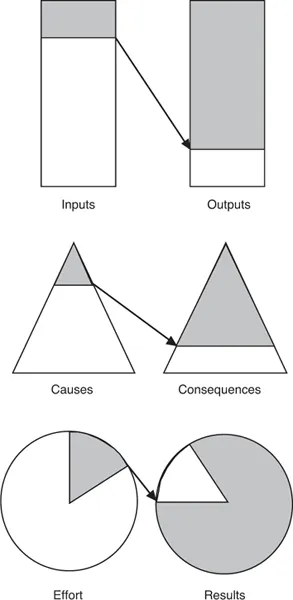
Figure 1 The 80/20 Principle
In the US and Europe in the 1960s, the Pareto principle became widely known as the “80/20 rule” or “80/20 principle.” While it was not wholly accurate, this description was snappy and influential. Engineers and computer experts began to use the principle routinely.
The 80/20 principle observes that 80 percent of results flow from 20 percent of causes. It is an empirical “law” that has been verified in economics, business, and interdisciplinary science. Thus most of what exists in the universe—what we do, and all other forces, resources, and ideas—is of little value and has little result; yet a few things work fantastically well and have tremendous impact. There is no magic in the 80 and the 20, which are merely approximations. The point is that the world is not 50/50. Effort and reward are not linearly related. The universe is wonky.
Most of the universe is meaningless noise, yet a few forces are fantastically powerful and productive. Isolate those powerful, creative forces, within and around us, and, hey presto, we can exert incredible influence.
In 1963, IBM spotted that about 80 percent of a computer’s time is spent executing less than 20 percent of its operating code. The IBM engineers rewrote the code to make the key 20 percent much more accessible and user-friendly, thereby securing market leadership. The software advances of the last 30 years—from Lotus to Microsoft to Linux—have taken this idea very much further.
In 1997 I wrote The 80/20 Principle,2 the first book on the subject. I showed how the principle could be applied not merely to help corporations drive business results, but also to help individuals improve their lives. To become effective or happy, realize the importance of just a few people or things. If you concentrate on the few things that work best for you, you can get what you want. You can multiply your effectiveness, and even your happiness. This was new ground, since nobody had previously linked the principle to individual fulfillment.
I struck a chord. As many readers around the world attested, the 80/20 principle is a fantastically useful way to get more out of life.
This new book, however, has a very different theme. The 80/20 Principle showed how companies could use the principle to drive business results and how individuals could improve their personal lives—but not their professional lives. The 80/20 Individual makes the link between the 80/20 principle and the rise of individuals, which has never been made before. It explains how the world is changing and demonstrates that the 80/20 principle is a liberating and amazingly powerful, practical tool for individuals to create great new things.
Value comes from growth
The most interesting and valuable part of business is not the maintenance of existing operations: doing efficiently today what we did yesterday, how we did it yesterday. Organizations are great at maintaining the status quo, but if this was all we did, the economy would never grow.
Growth is more important. Growth means creating something new and valuable. Growth is ultimately driven by individuals and small, self-selected teams of individuals, operating both within established corporations and in new ventures.
The most formidable weapon for growth in business is the 80/20 principle, creatively applied by individuals and small teams of individuals. With the 80/20 principle, individuals can leverage the most powerful forces around them—tangible, but especially intangible ones—to dazzle the world and provide customers with much more of what they want for much less of what they wish to conserve (money, resources, time, space, and energy).
80/20 individuals in organizations
Individuals are usually only partly aware of what they could do to create wealth and wellbeing. They may also be unaware of what they are already doing. In this book you will encounter several people who are creating enormous wealth for others, but who do not realize it. They are already 80/20 individuals, although they are not yet reaping the rewards appropriate to their creativity. They think they are cogs in a corporate machine, while in reality they are at the heart of wealth creation and economic growth.
Even if you work for a large or prestigious organization, if you create something new that reflects your individuality and your ideas, then you are the primary wealth creator. Usually, however, your corporation keeps most of the wealth that you create. Once you realize the disparity, you can narrow the gap. Whether you leave the firm or stay within it, you should be in control.
Those who can create wealth—and know that they can—are able to dictate their own terms. Money is important, yet what most people want is not wealth but happiness. Wealth is a means to happiness, but it is not the main one. What most people want is control over their lives. They want the ability to choose how they live: what work they do, how they interact with friends and colleagues, the quality of their personal relationships, how they make things better for other people, and how they think about themselves.
What you gain as an 80/20 individual is the right to control your life: your work life, your personal life, and the intervening spaces where they collide or mesh, inducing despair or triumph. For example, you may be able to strike a completely different deal with your current employer. There is a whole range of new mechanisms enabling 80/20 individuals to be “half in and half out,” retaining contact and continuity with colleagues while also having real ownership in a new venture. For many 80/20 individuals these hybrid mechanisms are greatly superior to the traditional alternatives, either staying put and being exploited as an employee, or starting a new business from scratch.
My premise is simple—if you add great value, know you add great value, and can demonstrate that you add great value, you can reasonably insist on setting the agenda and the context in which you provide it. You can set your own material and nonmaterial rewards because, whatever you choose to take, it is less than you give. If this simple view upsets existing arrangements, so much the worse for them. You create—you are in control.
The 80/20 principle is at the heart of creation
People think that creativity is a largely a matter of talent, or experience, or luck. They are wrong. Talent, experience, and luck are all key elements. But there is something more fundamental, something wonderfully accessible and powerful, that you can use to multiply your creative effect.
The 80/20 principle is central to all acts of creation. In business it is behind any innovation, any extra value. It is the entrepreneurial principle, the formula for value creation, not just for entrepreneurs but for managers and organizations generally.
A few powerful forces lie behind any act of creation. Take plant growth, the most efficient source of food, and therefore life, throughout the ages. What makes plants grow? Rain is clearly important. And what causes rain? Clouds—but a few clouds create most rain. They create it at particular times, in particular locations. Fertile land is also important. Land fertility is partly a matter of rain, but there are other influences, for example the variety and number of plants and animals that have used the land before. A few pieces of land are very much more fertile than others—not a little better, not even twice or three times as good, but tens of times better. A few influences are always critical, and a few inputs always lead to a large majority of results.
Creation can either be unconscious, as with clouds, or conscious, as with humankind. Our history, especially that of the past three centuries, demonstrates that people can multiply the effectiveness of the rest of nature many times over—hundreds, thousands, even millions of times. (We can also apply similar multiples to nature’s destructive forces, but let’s pass on that for the moment.) There have been three great human inventions that have driven the number of people on our planet, and our living standards, into the stratosphere.
One was the invention of a...
Table of contents
- Cover Page
- Title Page
- Copyright Page
- Contents
- Part I: Turbo-boost Your Career: Become an 80/20 Individual
- Part II: The Nine Essentials of 80/20 Success at Work
- Index
- Acknowledgments
Trusted by 375,005 students
Access to over 1.5 million titles for a fair monthly price.
Study more efficiently using our study tools.
Frequently asked questions
Yes, you can cancel anytime from the Subscription tab in your account settings on the Perlego website. Your subscription will stay active until the end of your current billing period. Learn how to cancel your subscription
No, books cannot be downloaded as external files, such as PDFs, for use outside of Perlego. However, you can download books within the Perlego app for offline reading on mobile or tablet. Learn how to download books offline
Perlego offers two plans: Essential and Complete
- Essential is ideal for learners and professionals who enjoy exploring a wide range of subjects. Access the Essential Library with 800,000+ trusted titles and best-sellers across business, personal growth, and the humanities. Includes unlimited reading time and Standard Read Aloud voice.
- Complete: Perfect for advanced learners and researchers needing full, unrestricted access. Unlock 1.5M+ books across hundreds of subjects, including academic and specialized titles. The Complete Plan also includes advanced features like Premium Read Aloud and Research Assistant.
We are an online textbook subscription service, where you can get access to an entire online library for less than the price of a single book per month. With over 1.5 million books across 990+ topics, we’ve got you covered! Learn about our mission
Look out for the read-aloud symbol on your next book to see if you can listen to it. The read-aloud tool reads text aloud for you, highlighting the text as it is being read. You can pause it, speed it up and slow it down. Learn more about Read Aloud
Yes! You can use the Perlego app on both iOS and Android devices to read anytime, anywhere — even offline. Perfect for commutes or when you’re on the go.
Please note we cannot support devices running on iOS 13 and Android 7 or earlier. Learn more about using the app
Please note we cannot support devices running on iOS 13 and Android 7 or earlier. Learn more about using the app
Yes, you can access The 80/20 Individual by Richard Koch in PDF and/or ePUB format, as well as other popular books in Personal Development & Personal Success. We have over 1.5 million books available in our catalogue for you to explore.