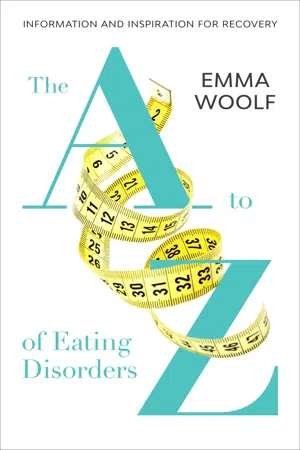
Are you worried about your food intake? Do you weigh yourself most days and feel guilty if you gain half a pound? Do strict rules dominate your mealtimes and life, just so you can feel more in control? The A to Z of Eating Disorders is a road map for anyone who wants a way out of the bewildering world of disordered eating and body-image anxiety.From anorexia, bingeing and clean eating, to social media, yo-yo dieting and size zero, this book explores these complex conditions from a range of angles, offering valuable insights and hope.In this inspiring, impeccably researched book, renowned writer and broadcaster Emma Woolf says, 'Eating disorders cause untold misery and can affect anyone at any time of life. As someone who has lived through anorexia and recovery, I receive emails every day from those desperate for guidance. The A to Z of Eating Disorders helps to demystify disordered eating and sets you back on the path to a happy, healthy relationship with food.' Praise for The A to Z of Eating Disorders 'Detailed but to the point, Emma Woolf provides insight, wisdom and practical solutions: The A to Z of Eating Disorders is a must-have for anyone with or caring for someone with an eating disorder.' Renee McGregor, performance and clinical dietitian I've just been reading your book again for the second time this week, aka The A-Z of Eating Disorders. It's truly an amazing book and its purpose is amazing and I'm just so happy someone has confronted these topics and can educate others because anorexia is such a complex illness which can be hard for 'outsiders' to understand.
Thank you,
Ellie, a reader
- 204 pages
- English
- ePUB (mobile friendly)
- Available on iOS & Android
eBook - ePub
The A to Z of Eating Disorders
About this book
Information
a
ADDICTION
The term ‘addiction’ usually refers to some kind of illegal or damaging behaviour. Food is a completely legal substance and eating is a normal social activity. Food, however, is also a deeply personal issue and disordered eating encompasses a wide range of complicated and individual behaviours. Just like oxygen, food is a fundamental physiological requirement, but we have made eating far more complicated than breathing. We all need food in order to stay alive, but what, when and how much we eat can easily get out of control.
For someone with an eating disorder, food is often both a best friend and a worst enemy. Eating can be a reward and a punishment, consoling and confusing, comforting and guilt-inducing, all at the same time. Starving, purging or bingeing to the point of sickness are painful and pointless behaviours, yet they are self-inflicted (at least at the start). The question is: why would anyone choose such behaviour and how does it become addictive?
Conditions such as anorexia nervosa, bulimia nervosa and BED are highly complex mental illnesses and stubbornly resistant to treatment. Unlike a drug or alcohol addiction, beating an eating disorder is not a simple case of avoiding the substance altogether: you have to learn to eat in order to live.
Eating disorders also bring other problems with them. Alcohol and drug abuse, overspending and even shoplifting (see KLEPTOMANIA) are common co-addictions, or dual disorders, in those with disordered eating. It appears that many of the emotional factors fuelling these problematic behavioural patterns are similar. These factors may include guilt, hunger, boredom or a need to find an escape route from difficult feelings. Drugs or alcohol may be used initially to numb depression or anxiety or help with sleeping problems.
Exercise addiction is also extremely common in those with eating disorders. In recent years, exercise has become more intense than ever before and it has become fashionable to work out really hard, for women as well as for men. A swim or aerobics session no longer cuts it: instead gyms offer a wide choice of ‘bootcamp’ workouts, circuit training and spin classes. Kick-boxing and military-style fitness classes are full of very toned, fit, thin individuals burning hundreds of calories early in the morning or late at night, often on little fuel. Participation in marathons, triathlons and Iron Man competitions has soared as ‘normal’ non-athletes push themselves further and further.
It is difficult for outsiders – friends, family, even medical professionals – to accept that an eating disorder and compulsive exercise can be such powerful addictions, but there is growing evidence to suggest that they really are. While exercising regularly and eating healthily are beneficial for most people, in vulnerable individuals they can easily become dangerous, compulsive and sometimes life-threatening addictions.
ALCOHOL
As we have seen, eating disorders often go hand in hand with other forms of addiction and substance abuse, including alcohol.
Individuals with restrictive eating habits such as anorexia are wary of calories in all forms and many of them avoid drinking alcohol for the ‘empty calories’ it contains. Still, it’s estimated that around 15 to 20 per cent of those with anorexia drink excessive amounts of alcohol. In other eating disorders, however, such as bulimia and BED, alcohol abuse is more common, affecting between 30 and 50 per cent of those with binge–purge behaviours. Just as with food, these individuals commonly drink large quantities of alcohol in sporadic binge sessions.
Occasional overindulgence is part of Western culture – getting tipsy at large social events is considered normal, for example – but repeated binge-drinking is far more serious. Many who have BED and bulimia are also affected by substance abuse disorders. A combination of chemical, psychological and sociocultural factors makes them even more vulnerable to addiction. Just as high levels of sugar and fat in binge-eating cause an initial dopamine surge in the brain, so the first few alcoholic drinks create a feeling of euphoria and confidence. People may find themselves bingeing more and more frequently on food and alcohol because they crave that intense rush of chemicals. If they have low dopamine levels – common in those with slight to moderate depression – the dopamine rush seems to lift their depressed mood.
In situations of stress or anxiety, common in everyday life, individuals predisposed to BED or alcoholism may find themselves turning to alcohol or other drugs as a coping mechanism. As with many aspects of an eating disorder, the initial behaviour sets up a cycle of deprivation, craving, excess and guilt. Low self-esteem and low impulse control contribute to problems with alcohol and other substance abuse.
Alcohol abuse is always a cause for concern, but it’s particularly dangerous in those who are malnourished, underweight, vomiting frequently or drinking on an empty stomach. It can cause alcohol poisoning, memory loss, blackouts, injuries, brain damage and even death. (See also DRUNKOREXIA.)
ALEXYTHYMIA
This describes the generalized difficulties of putting feelings into words seen in some individuals with anorexia. Although often highly intelligent and otherwise articulate, they may struggle to express their emotions and distinguish between facts and feelings. This may be due to specific cognitive deficits associated with anorexia (see COGNITIVE IMPAIRMENT) or it may be due to the many conflicting emotions they experience around food, eating and their own bodies.
ALL-OR-NOTHING MINDSET
See COGNITIVE IMPAIRMENT.
ALTERNATIVE AND COMPLEMENTARY THERAPIES
Many people find alternative or complementary therapies effective for dealing with a range of physical and emotional issues. From acupuncture, aromatherapy, homeopathy and naturopathy to massage, reflexology, meditation and mindfulness, complementary therapies are based on a belief in the body’s ability to heal itself. In general, they adopt an holistic approach to the workings of the body, taking into account the mind–body balance. They are thought to be less invasive than conventional medicine and cause fewer unpleasant side effects.
In theory, eating disorders should respond well to complementary therapies. Anorexia, bulimia and other forms of disordered eating have a significant psychological component, which should make them ideally suited to this more holistic, person-centred approach. Clinical research into complementary therapies in relation to eating disorders is limited, however, and therefore evidence-based data are lacking. As alternative or complementary therapies fall outside mainstream health care, they are generally offered by private practitioners.
Evidence suggests that individuals with severely disordered eating respond best to psychotherapy and other talking therapies, as well as nutritional counselling. Anecdotally, however, many people find complementary, holistic mind–body treatments effective for coping with depression and anxiety, which lie at the root of many eating disorders, or find them beneficial during times of emotional stress and anxiety. Complementary practitioners tailor their treatments to the individual, listening to address specific physical or psychological concerns, and can offer a genuine boost to individuals struggling with eating disorders, but these approaches are not sufficient as stand-alone treatments. They contribute to general health, both mental and physical, and can help with hormonal or nutritional imbalances. They can promote a sense of mental well-being, relaxation and calm. In conjunction with conventional medicines and talking therapies, therefore, complementary therapies can help during the recovery process.
Some herbal treatments can interact with other medications so you should always consult your doctor or counsellor before embarking on complementary or alternative therapies.
AMENORRHOEA
This is a condition in which periods are absent. There are many reasons why periods may be missed, but in the context of eating disorders, we will focus on weight-related causes.
If you are not pregnant, breastfeeding or approaching the menopause, you should be menstruating on a regular ‘monthly’ cycle (cycles shorter or longer than this are normal, however). Missing periods for several months in a row, and certainly for more than six months, is a cause for concern, though, and should be discussed with your GP.
Essential hormones that control the female menstrual cycle are very sensitively balanced and easily upset when body fat, calories, energy or activity levels become imbalanced. Body fat is essential for the female reproductive system to function, and women need adequate stores of body fat in case of pregnancy. Amenorrhoea is common in anorexia, as well as in those who are underweight or have lost a large amount of weight rapidly. This absence of periods may be the first sign that something is wrong.
When calories are being severely restricted, the body’s warning systems go off. The body goes into famine mode, concentrating all its precious resources on keeping it alive. Calories are channelled towards the vital organs and non-essential functions, such as the reproductive system, shut down. To put it simply, with barely enough food for one person, let alone two, the anorexic body cannot risk getting pregnant.
It is generally agreed that body fat needs to be around 17 per cent for menstruation – this explains why female athletes who have a higher than normal muscle-to-fat ratio may miss periods. Even though their calorie intake is high, their energy expenditure is also high and their body fat is low. (See also ATHLETIC TRIAD and EXERCISE.) Some put the figure for body fat lower: the American College of Sports Medicine, for example, gives a range of 8 to 12 per cent essential body fat to maintain menstruation. While low body fat contributes to menstrual dysfunction and amenorrhoea, it’s clear that other factors, such as low calorie intake, inadequate nutrition and excessive exercise, are also highly significant.
In overweight women, there is more than enough body fat, but this can also cause menstrual disturbances, as increased amounts of body fat are related to low levels of sex hormone-binding globulin – a protein that governs the activities of the sex hormones oestrogen and testosterone. Although most oestrogen is produced by the ovaries, some is made in body fat and other sites, and body fat also acts as an oestrogen store. Too much fat therefore causes hormonal imbalance, which disrupts normal egg development and ovulation. Polycystic ovary syndrome is also a common cause of amenorrhoea and can be alleviated by weight loss.
The good news is that, for both overweight and underweight individuals, amenorrhoea is largely reversible. Losing excess weight, or regaining healthy weight, is highly effective at restoring healthy hormone balance. When weight and body fat are at healthy levels – not too high and not too low – hormone levels return to normal, stimulating ovulation and regular periods (see also FERTILITY AND INFERTILITY). However, young girls who have primary amenorrhoea, whose periods never start, may permanently damage their reproductive system and never menstruate as adults.
ANAEMIA
Anaemia occurs when the body’s red blood cell count is lower than normal. The body needs iron to produce red blood cells, which help store and transport oxygen around the body. When red blood cell levels are low, the body’s organs and tissues do not receive as much oxygen as they need. Symptoms of anaemia include fatigue or lethargy, shortness of breath, dizziness or muscle weakness, skin pallor, repeated infections or illness, depression, confusion and poor memory. (See also IRON.)
The most common form of anaemia – iron deficiency anaemia (caused by insufficient or poor absorption of i...
Table of contents
- The A to Z of Eating Disorders
Trusted by 375,005 students
Access to over 1.5 million titles for a fair monthly price.
Study more efficiently using our study tools.
Frequently asked questions
Yes, you can cancel anytime from the Subscription tab in your account settings on the Perlego website. Your subscription will stay active until the end of your current billing period. Learn how to cancel your subscription
No, books cannot be downloaded as external files, such as PDFs, for use outside of Perlego. However, you can download books within the Perlego app for offline reading on mobile or tablet. Learn how to download books offline
Perlego offers two plans: Essential and Complete
- Essential is ideal for learners and professionals who enjoy exploring a wide range of subjects. Access the Essential Library with 800,000+ trusted titles and best-sellers across business, personal growth, and the humanities. Includes unlimited reading time and Standard Read Aloud voice.
- Complete: Perfect for advanced learners and researchers needing full, unrestricted access. Unlock 1.5M+ books across hundreds of subjects, including academic and specialized titles. The Complete Plan also includes advanced features like Premium Read Aloud and Research Assistant.
We are an online textbook subscription service, where you can get access to an entire online library for less than the price of a single book per month. With over 1.5 million books across 990+ topics, we’ve got you covered! Learn about our mission
Look out for the read-aloud symbol on your next book to see if you can listen to it. The read-aloud tool reads text aloud for you, highlighting the text as it is being read. You can pause it, speed it up and slow it down. Learn more about Read Aloud
Yes! You can use the Perlego app on both iOS and Android devices to read anytime, anywhere — even offline. Perfect for commutes or when you’re on the go.
Please note we cannot support devices running on iOS 13 and Android 7 or earlier. Learn more about using the app
Please note we cannot support devices running on iOS 13 and Android 7 or earlier. Learn more about using the app
Yes, you can access The A to Z of Eating Disorders by Emma Woolf in PDF and/or ePUB format, as well as other popular books in Psychology & Abnormal Psychology. We have over 1.5 million books available in our catalogue for you to explore.