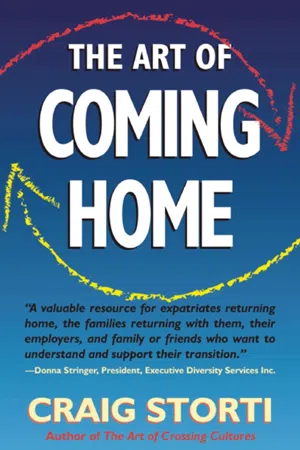
Expecting that the home will be the way it was when you left? Are you instead shocked to discover that both you and home have changed? The Art of Coming Home offers the solid advice you need to reduce the stress of making the transition home. Leave-taking, the honeymoon stage, reverse culture shock, and eventual readjustment - The Art of Coming Home lays out the four stages of the reentry process and details practical strategies for dealing with the challenges you will face each step of the way. Veteran trainer, consultant, and world adventurer Craig Storti sketches the workplace challenges faced by returning business executives as well as the reentry issues of spouses, younger children, and teenagers. He also addresses in detail the special issues faced by exchange students, international volunteers, military personnel and their families, and missionaries and their children. Whether you are a recent returnee or are just now thinking of moving abroad, The Art of Coming Home sets itself apart as it brings the process of returning home right to the heart of the overseas experience.
- 232 pages
- English
- ePUB (mobile friendly)
- Available on iOS & Android
eBook - ePub
The Art of Coming Home
About this book
Information
1
Coming Home
I had to be hungry—starving!—they decided, so they took me to the restaurant first. “So, wild man, tell us about Africa,” they said. “Were you living with savages or what?”
I was really hungry, eating all the bread, and wondering how square pieces of butter had fallen into my dish of extra ice.
—“Bush Pigs” Richard Dooling
Why should coming home be so difficult? You have missed this place and these people, after all, and have looked forward to being back here for months. You’ve always had a wonderful time when you visited on home leave or passed through on business. So why is it so anticlimactic? Why does most of the pleasure seem to have come in the anticipation and not in the reality? Why would you give anything to be back overseas again when you have been home less than a week? What’s wrong with you anyway?
It’s a question often asked by returning expatriates. “I couldn’t have been more excited,” Nancy Koehler, a U.S. Navy spouse, remembers.
After two and one-half years living in Japan, I was on an airplane and on my way home. Blissful thoughts about being back in the U.S.A., long-awaited visits with family and friends outweighed any nostalgia I felt.… My every thought told me everything back home was going to be perfect and problem-free.
This euphoria was short-lived, however. Within a few weeks I found myself, unexpectedly, in the depths of despair instead of at the anticipated peak of ecstasy. Instead of enjoying the company of old friends and neighbors, I couldn’t seem to find anything to talk to them about. Instead of enjoying driving on wide and familiar roads, I was petrified because I often found myself on the wrong side of them. Instead of enjoying supermarket shopping, I was overwhelmed by the quantity and the variety of items available.
What was wrong with me? Here I was truly “back home,” where I had dreamed of being for our entire overseas tour; yet I was miserable—lonely, afraid, confused, depressed, lethargic. I didn’t care whether the moving boxes ever got unpacked, even the ones containing our carefully chosen Japanese treasures. What had happened? (in Austin 1986, 89–90)
As a matter of fact, nothing very unusual. Koehler, like most people who live overseas and then come home, was just going through what is known as reentry, or reverse culture shock. Not only is reverse culture shock quite normal, most returnees say that readjusting after coming home is much harder than adjusting to the “foreign” country ever was. The only difficulty, of course, is that while expatriates expect living overseas to take some getting used to, they imagine coming home to be a matter of course. When it isn’t, when it turns out to be even harder than adjusting abroad, they’re surprised and confused.
But the question persists: Why is it so hard to come home? The answer to this question has many parts, but the biggest by far concerns the notion of home and the expectations it sets up in us. To truly understand reentry, we need to understand what we mean by home, what we want—and especially what we need—home to be. Once we have understood the real meaning of home, we can examine reentry from that perspective. And then we will begin to see why this transition can be so difficult.
The Issues
The Meaning of Home
As it happens, home has several meanings, at least two of which do in fact describe this place you have come back to, but the third and most important of which is rather wide of the mark. In the sense that home is the place where you were born and raised, where people speak your native language and behave more or less the way you do—what we might call your homeland and your home culture—then it is indeed home that awaits you as you step off the jumbo jet. If you should happen to think of home only in this limited sense and expect nothing more of it, then the place you return to will not disappoint you.
But this is not in fact what most people mean by home—which is where all the trouble starts. Most people use the word in a more profound sense, referring to a set of feelings and routines as much as to a particular place. In this formulation home is the place where you are known and trusted and where you know and trust others; where you are accepted, understood, indulged, and forgiven; a place of rituals and routine interactions, of entirely predictable events and people, and of very few surprises; the place where you belong and feel safe and secure and where you can accordingly trust your instincts, relax, and be yourself. It is, in short, the place where you feel “at home.”
“Home is not merely the homestead,” Alfred Schuetz has written in his essay “The Homecomer,”
my house, my room, my garden, my town—but everything it stands for.… “To feel at home” is an expression of the highest degree of familiarity and intimacy. Life at home follows an organized pattern of routine; it has its well-determined goals and well-proved means to bring them about, consisting of a set of traditions, habits, institutions, timetables for activities of all kinds. Most of the problems of daily life can be mastered by following this pattern. There is no need to define or redefine situations which have occurred so many times or to look for new solutions of old problems hitherto handled satisfactorily. The way of life at home governs as a scheme of expression and interpretation not only my own acts but also those of other members of the in-group. I may trust that, using this scheme, I shall understand what the other means and make myself understandable to him.… I have always a fair chance…to predict the other’s action toward me as well as the other’s reaction to my own social acts. We not only may forecast what will happen tomorrow, but we also have a fair chance to plan correctly the more distant future. Things in substance will continue to be what they have been so far. (1945, 370–71)
These are much broader definitions, of course, though much closer to what most people expect and require of home. Needless to say, they are also a much higher standard by which to measure the place you have returned to—a standard, in fact, that any such place cannot possibly meet. As we will see, this very realization, that home is really not home, is at the core of the experience of reentry.
Let us look more closely at this meaning of home, then, and apply it to the place you have returned to. For simplicity’s sake, we can reduce the essence of home as described above to three key elements:
1. familiar places
2. familiar people
3. routines and predictable patterns of interaction
While separate and distinct to some extent, these three elements also have a causal relationship, with routines and predictable interactions depending very much on the presence of familiar places and people. And all three, in turn, make possible most of the feelings we associate with home—security, understanding, trust, safety, and belonging—listed above. How, then, does the place returnees come back to, the place they insist on calling home, measure up to these three criteria?
Familiar Places. One of the first things you notice about home is that familiar places aren’t quite so familiar anymore. While there will be many things you recognize (assuming you return to your previous place of residence), any town or city is bound to have changed in your absence. There will be new streets, new traffic lights, new buildings and shopping centers, perhaps even whole new neighborhoods. Some old buildings may have been torn down or may now be occupied by a different tenant; many shops, restaurants, and other services will have moved or closed; the post office, cinema, bank, or hospital may be in a new location; some old roads go to places they never used to and some new ones turn up in places where they shouldn’t be. There’s a carpark where your doctor’s office used to be and an office building in the city center where you used to park. Clearly, you can’t come back to your town or city and rely only on your instincts to get from one place to another. It may be home, but you are going to have to learn how to get around all over again.
Even your old street may have changed. The house next to you has been renovated and painted a different color, and the house on the other side has a new garage (which makes your dining room dark). The old oak tree in front of your apartment building came down in a thunderstorm last year and your living room is much more exposed than it used to be. Meanwhile, a hedge at the rear has grown so tall that your kitchen no longer has a view of the park. The place just doesn’t feel the same.
There may be other, subtler changes to your neighborhood, as Marcia Miller found out when she came back after teaching a year in China. “It did not take long to notice a marked change in my neighborhood,” she writes,
a change that shocked and alienated me. It had always been an upper-middle-class area; now it was clearly just upper class. Prior to my departure for China, housing prices had been creeping up gradually, but I had not paid attention as that increase was a reflection of overall inflation. However, during the year I had been away, property values had soared.… As an offshoot of this real estate madness, cannibalistic rents had driven out many of the established shops that catered to the residents’ practical needs. Those shops were replaced by expensive clothing boutiques guarded by armed men. Many new people lived in my building who did not say hello to me. These people were clearly in a different income bracket than I. Riding in the elevator with them, I felt like a poor cousin temporarily boarding in a rich aunt’s home. Although I knew we could easily afford the modest increase in our monthly maintenance charges, I did not want to reside there. In a word, I was distinctly uncomfortable in my home environment and I had no hope of changing it. (1988, 14)
The same people aren’t in the same places anymore either. Your next-door neighbors have moved, and you don’t recognize half the faces you meet as you walk down your own street. There’s a new teller at the bank, your old barber has retired, the helpful woman at the bookshop got a new job, your favorite pharmacist moved to another city, and the corner convenience store has all new clerks. A large part of what makes familiar places familiar, that contributes to that underlying feeling of belonging and well-being, is the presence of people who recognize you and whom you recognize; in this regard home is clearly lacking. It’s hard to feel you belong in a place where half the people you meet ask you where you come from.
Even if you recognize many of the places of home, they aren’t going to feel the same to you as they did before you left, not because they have changed but because you have. You will not have the same emotional associations or connections with many of the places that used to loom large in your life, places that used to “mean something” to you for whatever reason. Or you may now see the same places differently. What once seemed clean to you now seems dirty, or vice versa. A place where you liked to jog is now unappealing because of traffic or noise. A lovely park now seems like little more than an urban intersection. Taking your children to the zoo is depressing after visiting the game parks of Africa. The sidewalks feel impossibly crowded or eerily empty. The traffic is overwhelming. Part of what makes a place familiar is the feelings it evokes in you, and now, after a long absence and numerous life-changing experiences, you won’t feel the same about many of the places from your past.
“Wherever it lies, the country is our own,” Malcolm Cowley has written.
Its people speak our language, recognize our values.… This is your home…but does it exist outside your memory? On reaching the hilltop or the bend in the road, will you find the people gone, the landscape altered, the hemlock trees cut down and only stumps, dried tree tops, branches, and fireweed where the woods had been? Or, if the country remains the same, will you find yourself so changed and uprooted that it refuses to take you back, to reincorporate you into its common life? (1991, 117–18)
Some returnees come back to their home country but to a town or city that is different from the one they lived in before going abroad. This place won’t look familiar, of course, but then neither are these people expecting it to, which may actually make their readjustment easier. As we will see throughout this book, much of the sting of reentry is not so much that things are different—we learn to handle the different quite well when we go overseas—but that we are expecting them to be the same.
For all these reasons, then, home is not that collection of familiar places you are expecting and not, therefore, a place where you are likely to feel you belong, at least not in the beginning.
Familiar People. The second expectation of home is that the people, like the places, will also be familiar, not in the sense that you recognize them but in the deeper sense that they have not changed appreciably while you were gone and will not regard you as having changed either. And you expect, therefore, that you will be able to have essentially the same relationships with these people that you had before you went away. In other words, you assume that time stopped while you were abroad.
This is unlikely. The people of home, you will soon discover, have changed almost as much as the places. The changes will be of two kinds: external and internal. The former are the more obvious and the easier to grasp. A few people may have died; some others may have married, divorced, or become parents; still others have become sick or senile; some have moved away, moved across town, or moved in with someone new; some have changed jobs, companies, or careers; some former best friends now have new best friends made in your absence. Everyone is older.
But even people who live in the same place, are married to the same person, and work in the same job are not the same people you knew when you went away. They have had two or three years of experiences that have altered who they are, experiences and alterations you know nothing about. Time hasn’t stopped for them anymore than it has stopped for you, though it has indeed stopped for both of you as far as shared experiences with the other are concerned. Relations with intimates change “entirely for the [person] who has left home,” Schuetz writes.
To him, life at home is no longer accessible in immediacy. He has stepped, so to speak, into another social dimension [isolated from] the scheme of reference for life at home. No longer does he experience as a participant in a vivid present the [events] which form the texture of the home group. His leaving home has replaced these vivid experiences with memories, and these memories preserve merely what home life [was] up to the moment he left it behind. (372)
Home, to be precise, may include many familiar faces, but it contains very few familiar people. You won’t be able to pick up where you left off with loved ones and friends nor take any of your relationships for granted. You won’t be able to relax entirely and be yourself, trusting to your instincts, nor will they be able to relax and be themselves around you. You will all have to come to know each other again. “Having grown personally in another culture,” a New Zealand foreign aid worker remembers,
I found it difficult to adapt back to a situation that now seemed less ideal. This was not a bad thing, and meant in fact that one carved out a new position for oneself, in terms of relationships with people who were significant—but the reassessment on both sides was difficult at times.
Routines and Predictable Interactions. Routines are the third hallmark of home. A routine is anything you do without thinking, without paying conscious attention to your actions and words; indeed, in its purest form a routine is something you do while you are paying conscious attention to something else. A routine can be a sequence of behaviors, like shaving or driving, or a ritual conversational exchange where in a particular setting you always say the same things to the same people and they say the same things back. Many routines are a combination of the two, a predictable and unchanging sequence of behaviors accompanied by a never-varying sequence of conversational exchanges. Some of the things we do are not entirely routines but have certain routine elements. Riding a bicycle would be a routine behavior for most adults—they wouldn’t have to think how to do it—but riding a bicycle on a busy, dangerous highway or during a thunderstorm would contain a number of nonroutine elements. Certain parts of conversations are routine, greetings and leave-takings, for example, but not others. Nor is a greeting always routine, such as the first time you greet someone in French or Arabic.
Routines clearly depend on the familiar and the known, in terms of places and people. Shaving or putting on makeup, for example, may not be quite so routine in a hotel as it is in your own bathroom. Nor is greeting a stranger as much of a routine as greeting your spouse. If it were not for routines, if everything you did and said required your conscious attention, you would be overwhelmed by the minutiae that make up most behavior and therefore could accomplish very little. It is because of routines that the mind can be confronted with the new and the unfamiliar and not fall apart; the unconscious goes about its routines while the conscious attacks the problem of the new (and eventually may turn that into a routine).
Because of routines, the predictability of so much of what you do, you feel in control much of the time and able to relax; you can trust your instincts and be yourself. Routines also enhance your sense of well-being and security and thereby contribute to feelings of self-confidence and self-esteem.
Anyone who has been an expatriate knows that routines get mightily disrupted when you go overseas, where almost everything and everyone is new and unfamiliar. Indeed, during the...
Table of contents
- Cover Page
- Title Page
- Copyright Page
- Contents
- Acknowledgments
- Introduction
- 1 Coming Home
- 2 The Stages of Reentry
- 3 The Return of the Employee
- 4 The Return of Spouses and Children
- 5 Special Populations
- Epilogue
- Useful Resources
- Bibliography
- Index
Trusted by 375,005 students
Access to over 1.5 million titles for a fair monthly price.
Study more efficiently using our study tools.
Frequently asked questions
Yes, you can cancel anytime from the Subscription tab in your account settings on the Perlego website. Your subscription will stay active until the end of your current billing period. Learn how to cancel your subscription
No, books cannot be downloaded as external files, such as PDFs, for use outside of Perlego. However, you can download books within the Perlego app for offline reading on mobile or tablet. Learn how to download books offline
Perlego offers two plans: Essential and Complete
- Essential is ideal for learners and professionals who enjoy exploring a wide range of subjects. Access the Essential Library with 800,000+ trusted titles and best-sellers across business, personal growth, and the humanities. Includes unlimited reading time and Standard Read Aloud voice.
- Complete: Perfect for advanced learners and researchers needing full, unrestricted access. Unlock 1.5M+ books across hundreds of subjects, including academic and specialized titles. The Complete Plan also includes advanced features like Premium Read Aloud and Research Assistant.
We are an online textbook subscription service, where you can get access to an entire online library for less than the price of a single book per month. With over 1.5 million books across 990+ topics, we’ve got you covered! Learn about our mission
Look out for the read-aloud symbol on your next book to see if you can listen to it. The read-aloud tool reads text aloud for you, highlighting the text as it is being read. You can pause it, speed it up and slow it down. Learn more about Read Aloud
Yes! You can use the Perlego app on both iOS and Android devices to read anytime, anywhere — even offline. Perfect for commutes or when you’re on the go.
Please note we cannot support devices running on iOS 13 and Android 7 or earlier. Learn more about using the app
Please note we cannot support devices running on iOS 13 and Android 7 or earlier. Learn more about using the app
Yes, you can access The Art of Coming Home by Craig Storti in PDF and/or ePUB format, as well as other popular books in Business & International Business. We have over 1.5 million books available in our catalogue for you to explore.