Our society is shaped by our media – now more than at any time in history. They play a crucial role in culture, commerce and politics alike. The Ascent of Media is the first book to look at the new digital era in the context of all that has gone before, and to build on the past to describe the media landscape of the future. Roger Parry takes us on a journey from the earliest written story – the Legend of Gilgamesh etched on clay tablets – to the Gutenberg press, and from the theatres of Athens to satellite TV and the coming semantic web. Tracing 3000 years of history, he shows how today's media have been shaped by the interaction of politics, economics and technology. He explains why Britain has the public service BBC whilst America developed the private broadcasting networks ABC, CBS, FOX and NBC. He profiles the people and organizations that have created the media world and reveals the often surprising stories behind such ubiquitous items as the keyboard, telephone dial and tabloid. The book shows that issues of today such as a sensationalist press, piracy, monopoly, walled gardens and balancing advertising and subscription revenue have all happened before. Each upheaval in the media world – the development of moveable type printing in the 1450s; the telegraph network in the 1850s; radio broadcasting in the 1920s; and digital distribution in the 2000s – created huge fortunes, challenged authority and raised fundamental issues of copyright, privacy and censorship. Traditional media then adapt, evolve and go on to thrive in the face of competition. The convergence of the internet, mobile phones and tablet computers is now transforming our culture. Established media giants are struggling, while new firms like Google and Apple are thriving. The superabundance of media, with increasing amounts generated by consumers themselves, means that media professionals are becoming curators as much as creators of content. The Ascent of Media traces the story of media from clay tablets to tabloids to the tablet computer. It relates how we got where we are and, based on the experience of history, where we are likely to go next.
- 406 pages
- English
- ePUB (mobile friendly)
- Available on iOS & Android
eBook - ePub
About this book
Information
PART ONE
Introduction | Media’s Building Blocks

Media channels developed to move content from originator to recipient, from creator to consumer. That content is constructed from the building blocks of speech, music, images, and writing.
For early humans communication was one to one: the drawing, music, or speech was seen or heard directly.
Once writing and documents developed, the content became mediated. The communications capabilities of the originator were extended and remote audiences were able to be reached.
Printing, broadcasting, and the internet then expanded the audience and thus the size of manageable human society by a huge degree.
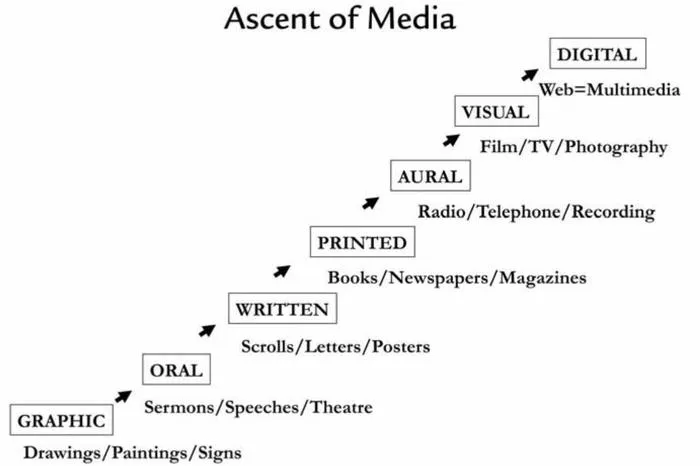
The ascent of media has not been neat and tidy. Successive eras do not have defined start and end dates. When a new medium comes along it does not simply replace the previous ones, it absorbs aspects of its predecessors and causes them to become modified. Old forms of media do not die out, they evolve. New forms adopt and adapt past conventions. Each era provides richer and more extensive communications than the ones before.
The media industry is now undergoing fundamental changes—revolution is not too strong a word—as the internet connects and empowers people and we move to an increasingly screen-based and interactive global communications culture. Digital technology allows information and entertainment to reach us instantly, at any place and any time. Most of us now have the tools to create content as well as to receive it. Media is moving away from the publication or broadcast by the privileged few to the exchange of ideas involving the enabled many.
Although it is less than 20 years since the web emerged, it has been hugely disruptive of conventional media, with the likes of Mozilla, Napster, Google, and YouTube turning traditional economics inside out. It has been wonderful for media consumers but challenging for media managers. However, the initial period of chaos and confusion is coming to an end. The ascent of media is continuing its historical and relentless pattern of growth. We are seeing the start of a dynamic new era in which the convergence of text, audio, and video is creating a rich and compelling media mixture.
The framework of the internet has enabled the medium of the web. Digital technology, combined with new hardware like smartphones and new concepts such as Facebook, is changing the way we live. Notions of privacy and editorial balance are being challenged. The internet is barely adolescent, so it is difficult to predict what sort of media landscape will emerge when it has matured. While it took many decades for the full impact of innovations such as printing, the telegraph, and broadcasting to become apparent, we can now study the lessons from these past media eras to construct a guide to the likely future.
| Key Media Formats | |
| Graphic | |
| c30,000 BC | Cave drawings |
| 1415 | Perspective |
| Oral | |
| c10,000 BC | Speech |
| 534 BC | Athenian drama |
| Written | |
| c3,500 BC | Clay tablets |
| c100 AD | Codex books |
| Printed | |
| 1450 | Gutenberg bible |
| 1843 | Rotary press |
| Aural | |
| 1876 | Telephone |
| 1877 | Phonogram |
| 1885 | Radio |
| Visual | |
| 1839 | Photography |
| 1895 | Cinema |
| 1926 | TV |
| Digital | |
| 1971 | Internet |
| 1993 | WorldWideWeb |
| 2010 | iPad |
Media have come to play a central role in our lives. In the 1960s Canadian writer Marshall McLuhan described media as the extensions of man and talked of the creation of a global village. With the arrival of the internet and the web, his predictions have come true. “We have been hit hard by seismic shifts wrought by the web… Media is profoundly being transformed,” said Steve Forbes, publisher of Forbes magazine, in a memo to his staff in 2009. This emphasizes the magnitude of the economic challenge posed by converting content into digital code.
The alphabet is itself a code that allows the sounds of spoken language to be expressed in simple symbols. Samuel Morse devised another code using dots and dashes to turn the alphabet into electric blips that could be sent down telegraph wires. These wires inspired the telephone and ultimately the internet. Morse created a communications revolution in the 1850s, but that was as nothing compared to what is happening today. Now all forms of content—sounds, pictures, text, and video—are being created, edited, stored, distributed, and consumed in coded digital form. Just 30 years ago this prospect was science fiction; now it is commonplace in every home.
Over many hundreds of years the media has become a huge, wealthy, and powerful industry, but it now faces fundamental issues. Long-established practices such as selling advertising, protecting intellectual property, and expecting consumers to pay for content are all being challenged. The tools and skills of content creation that were, until recently, only available to a small elite are now anybody’s for the using. Expensive and exclusive distribution methods like printing presses and broadcast towers no longer present a barrier to entry. Any teenager has the technology in their bedroom to be William Randolph Hearst or Louis B Mayer.
According to the Financial Times, in the first decade of the twenty-first century the media industry had an annual negative return on assets of more than 4 percent, which compares very unfavorably with plus 7 percent a year 40 years ago.1 Readers, viewers, and listeners are experiencing unprecedented choice and flexibility, but media companies and media professionals have been shocked by the pace of change and overwhelmed by the economic and technical challenges facing them. In the past the development of new media types has enabled or in same cases precipitated major changes in society. It is happening again.
MEDIA EVOLUTION
There is no escaping the all-pervasive influence of media. Whether we want news, information, or entertainment, half of our waking hours are taken up by the consumption of mediated content.2 The mass media have been a feature of life since the 1920s when the term “media” was first coined, reflecting the addition of radio, talking pictures, and the gramophone to what had been the dominant technology of print.
Less than 100 years later the arrival of another new technology is driving change, so extreme that just because a medium is popular does not mean it is profitable. Digital production and distribution are as profound an event for media as were the inventions of Gutenberg, Morse, and Marconi. Nevertheless, the arrival of new forms does not imply the extinction of the old. Traditional media have a remarkable ability to adapt and survive. A thousand years into the future, assuming the asteroids keep missing us and the super-volcanoes stay dormant, human beings will be reading books. That moment is too far removed for us to be sure of the book’s exact format, its subject matter, or indeed its language. But it’s a reasonably safe bet that books of some sort will still be around.
While media are continually evolving, their individual formats have a robust longevity and find new roles even after their period of being the dominant form has passed. Each medium has its golden age: it booms and declines but never disappears entirely. Media types mutate, they influence their successors, and what was once a channel of mass communication often metamorphoses into a niche form of art.
All media channels were once analogue and separate; now they are digital and converging. The typical office in the 1970s reverberated to the sounds of the typewriter, telex, and mimeograph machine. These communication tools are now gone, replaced first by the fax and then by word processing and email. To suggest that total replacement awaits newspapers, magazines, or books is too extreme, but in the face of high-speed broadband and advanced screen technology the status quo cannot possibly be sustained.
Radio was hit by the rise of the iPod and other MP3 players. Sales of music CDs slumped in the face of digital downloading. Newspapers saw classified advertising collapse as people shifted their notices for secondhand cars and houses to the web. And broadcast television has lost audience to cable, satellite, personal video recorders, and internet TV.
Although the traditional media formats are being challenged, most will adapt to operate alongside the new digital media. And the new media themselves are confronting the issues that have cropped up through history such as censorship, privacy, copyright, piracy, and ways of getting paid for content.
THE NEW ERA
The web has been taking over the role of many of its predecessors in terms of both consumers’ time and advertising revenues. That is not to say that a website can reproduce the excitement and impact of a blockbuster movie on a big screen or the relaxation and pleasure of flicking through a top-quality glossy magazine on a beach. But it will radically change the economics of traditional media—indeed, it already has—which now have to find ways to reinvent their value proposition. While some media will continue to operate with a model financed solely by advertising, that pool of time-honored revenue is shrinking as online does a better job of targeting consumers. Some legacy media are e...
Table of contents
- Cover
- Praise
- Title Page
- Dedication
- Table of Contents
- Preface
- PART ONE : Introduction | Media’s Building Blocks
- PART TWO : Evolution | The Media Journey
- PART THREE : Future | Everything that went before… and more
- Acknowledgments
- Sources
- WEBSITES
- Index
- Copyright
Trusted by 375,005 students
Access to over 1.5 million titles for a fair monthly price.
Study more efficiently using our study tools.
Frequently asked questions
Yes, you can cancel anytime from the Subscription tab in your account settings on the Perlego website. Your subscription will stay active until the end of your current billing period. Learn how to cancel your subscription
No, books cannot be downloaded as external files, such as PDFs, for use outside of Perlego. However, you can download books within the Perlego app for offline reading on mobile or tablet. Learn how to download books offline
Perlego offers two plans: Essential and Complete
- Essential is ideal for learners and professionals who enjoy exploring a wide range of subjects. Access the Essential Library with 800,000+ trusted titles and best-sellers across business, personal growth, and the humanities. Includes unlimited reading time and Standard Read Aloud voice.
- Complete: Perfect for advanced learners and researchers needing full, unrestricted access. Unlock 1.5M+ books across hundreds of subjects, including academic and specialized titles. The Complete Plan also includes advanced features like Premium Read Aloud and Research Assistant.
We are an online textbook subscription service, where you can get access to an entire online library for less than the price of a single book per month. With over 1.5 million books across 990+ topics, we’ve got you covered! Learn about our mission
Look out for the read-aloud symbol on your next book to see if you can listen to it. The read-aloud tool reads text aloud for you, highlighting the text as it is being read. You can pause it, speed it up and slow it down. Learn more about Read Aloud
Yes! You can use the Perlego app on both iOS and Android devices to read anytime, anywhere — even offline. Perfect for commutes or when you’re on the go.
Please note we cannot support devices running on iOS 13 and Android 7 or earlier. Learn more about using the app
Please note we cannot support devices running on iOS 13 and Android 7 or earlier. Learn more about using the app
Yes, you can access The Ascent of Media by Roger Parry in PDF and/or ePUB format, as well as other popular books in Social Sciences & Media Studies. We have over 1.5 million books available in our catalogue for you to explore.