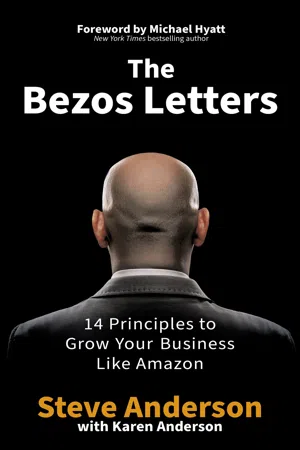
Amazon is the fastest company ever to reach $100 billion in sales and they didn't reach that landmark by staying in their comfort zone. Risk taking is the key that unlocked the door to growth at Amazon, but those risks were (and are) intentional, calculated, and strategic. Thomas Edison believed, "I have not failed. I've just found 10, 000 ways that won't work." and Amazon's founder, Jeff Bezos, has always linked experimentation and failure with growth and success.But "risk taking" can be costly (even disastrous) if you don't know how to use it to your advantage. Fortunately, Bezos has provided every business owner a "hidden in plain sight" roadmap for how he grew Amazon through his Letter to Shareholders (or as he named them, share owners ) that he has written annually for the past 20 years.For the first time, Technology and Risk expert Steve Anderson has analyzed and distilled these letters to reveal the key 14 Growth Principles that unlock the lessons, mindset, and steps Bezos has used to make Amazon the massive success it is today.Now, business owners, leaders, CEOs, employees, and managers can apply these same principles to grow their business to be more efficient, productive, and successful - fast!
- 256 pages
- English
- ePUB (mobile friendly)
- Available on iOS & Android
eBook - ePub
About this book
Information
Growth Cycle: Scale
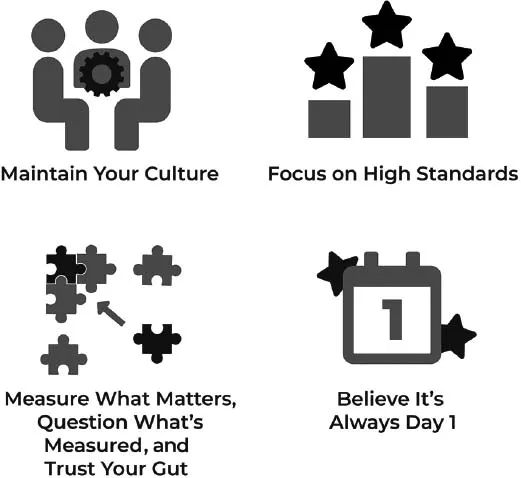
To Amazon, scaling is how you achieve tremendous growth without sacrificing who you are or what you offer. It requires creating and maintaining an innovative culture—a culture that’s willing to take risk on behalf of the customer.
It involves a committed focus on maintaining high standards and not sacrificing quality to achieve greater profitability. It involves measuring only what matters and continuously questioning what you measure to make sure you are always focused on the right metrics—but not ignoring your intuition in the process.
And, finally, it requires you to always—above all things—make decisions as if it is your first day in business, with passion and focus on customers. Be lean, be focused, and remember what mattered on Day 1 still matters.
Scaling makes Amazon able to come full circle—to leverage its successes and begin again the process of testing another offering.
Chapter Eleven

Principle 11: Maintain Your Culture
“… we are working to build something important, something that matters.” —Bezos (1997 Letter)
“We never claim that our approach is the right one—just that it’s ours—and over the last two decades, we’ve collected a large group of like-minded people. Folks who find our approach energizing and meaningful.” —Bezos (2015 Letter)
“We challenge ourselves to not only invent outward facing features, but also to find better ways to do things internally—things that will both make us more effective and benefit our thousands of employees around the world.” —Bezos (2013 Letter)
There are lots of stories out there about what it’s like to work for Amazon. And there’s probably a bell-shaped curve at work—some people love working there, some people hate working there, and most people are somewhere in the middle.
But there are some interesting ways to look at the culture of Amazon from the outside. Two of those are through LinkedIn and the Wall Street Journal/Drucker Institute. LinkedIn looks at overall employee satisfaction and retention, and WSJ/Drucker Institute looks at overall management.
The 2019 LinkedIn Top Companies list revealed the fifty companies where Americans want to work—and stick around once they’re in. Alphabet (Google), Facebook, and Amazon were the top three.
In its post, LinkedIn said, “Every year, our editors and data scientists parse billions of actions taken by LinkedIn members around the world to uncover the companies that are attracting the most attention from jobseekers and then hanging onto that talent. The data-driven approach looks at what members are doing—not just saying—in their search for fulfilling careers.”28
The Wall Street Journal publishes an annual list of the Management Top 250 companies in cooperation with, and compiled by, the Drucker Institute, ranking the most effectively run major U.S. public companies.
The rankings are made up of thirty-seven indicators that fall under five dimensions of performance: customer satisfaction, employee engagement and development, innovation, social responsibility, and financial strength. These ideas represent core values of management expert Peter Drucker, who wrote more than thirty business books over his long career.
In 2017, Amazon was number one on the list for the Best Run Company in the U.S. and number two in 2018, being beaten out for the top spot by Apple. And Amazon’s score for innovation topped every other company by a wide margin.
How has Amazon maintained its culture as it has scaled from a few employees to over 600,000 and growing?
Amazon has done many things to maintain its culture, but two stand out: its focus on personal leadership and its corporate focus on constant and continuous growth.
In his annual Letter to Shareowners, Bezos reminds everyone that it is always Day 1. In the Bush Center interview at the SMU (Southern Methodist University) campus, when asked about Day 1 (given the exponential growth Amazon has had with over 600,000 employees and growing), Bezos acknowledged the difficulty of staying nimble and customer focused as companies grow and layers of bureaucracy are added.
“One of the things that happens is the decision-making velocity slows down. And I think one of the reasons that happens is that people, junior executives inside the big company, start to model all decisions as if they are heavyweight, irreversible, highly consequential decisions. And like two-way doors, if you make a decision, and it’s the wrong decision, you can just back up, back through the door, and try again. But even those reversible decisions start to be made with heavyweight processes.
“And so, you can teach people [about] these pitfalls and traps and then teach them to avoid those traps. And that’s what we’re trying to do at Amazon so that we can maintain our inventiveness and our heart and our kind of small company spirit, even as we have this scale and scope of a larger company.” —2018 Forum on Leadership, “Closing Conversation with Jeff Bezos”
In that context, employees are reminded of what Day 1 means through the Amazon Leadership Principles, which define what Amazon expects from each and every employee, including Bezos. They define how each employee is to treat each other. They also define how each employee is to treat Amazon’s partners and customers.
Amazon’s Day 1 culture and mindset can be felt throughout the organization. It can be observed through what Bezos says in the Letters, how Amazon maneuvers in the marketplace, and through the Amazon Leadership Principles.
14 Amazon Leadership Principles
“We use our Leadership Principles every day, whether we’re discussing ideas for new projects or deciding on the best approach to solving a problem. It is just one of the things that makes Amazon peculiar [a word used by Bezos and most Amazonians].”29
Customer Obsession: Leaders start with the customer and work backwards. They work vigorously to earn and keep customer trust. Although leaders pay attention to competitors, they obsess over customers.
Ownership: Leaders are owners. They think long term and don’t sacrifice long-term value for short-term results. They act on behalf of the entire company, beyond just their own team. They never say “that’s not my job.”
Invent and Simplify: Leaders expect and require innovation and invention from their teams and always find ways to simplify. They are externally aware, look for new ideas from everywhere, and are not limited by “not invented here.” As we do new things, we accept that we may be misunderstood for long periods of time.
Are Right, A Lot: Leaders are right a lot. They have strong judgment and good instincts. They seek diverse perspectives and work to disconfirm their beliefs.
Learn and Be Curious: Leaders are never done learning and always seek to improve themselves. They are curious about new possibilities and act to explore them.
Hire and Develop the Best: Leaders raise the performance bar with every hire and promotion. They recognize exceptional talent, and willingly move them throughout the organization. Leaders develop leaders and take seriously their role in coaching others. We work on behalf of our people to invent mechanisms for development like Career Choice.
Insist on the Highest Standards: Leaders have relentlessly high standards—many people may think these standards are unreasonably high. Leaders are continually raising the bar and drive their teams to deliver high quality products, services, and processes. Leaders ensure that defects do not get sent down the line and that problems are fixed so they stay fixed.
Think Big: Thinking small is a self-fulfilling prophecy. Leaders create and communicate a bold direction that inspires results. They think differently and look around corners for ways to serve customers.
Bias for Action: Speed matters in business. Many decisions and actions are reversible and do not need extensive study. We value calculated risk taking.
Frugality: Accomplish more with less. Constraints breed resourcefulness, self-sufficiency and invention. There are no extra points for growing headcount, budget size or fixed expense.
Earn Trust: Leaders listen attentively, speak candidly, and treat others respectfully. They are vocally self-critical, even when doing so is awkward or embarrassing. Leaders don’t believe their or their team’s body odor smells of perfume. They benchmark themselves and their teams against the best.
Dive Deep: Leaders operate at all levels, stay connected to the details, audit frequently, and are skeptical when metrics and anecdote differ. No task is beneath them.
Have Backbone; Disagree and Commit: Leaders are obligated to respectfully challenge decisions when they disagree, even when doing so is uncomfortable or exhausting. Leaders have conviction and are tenacious. They do not compromise for the sake of social cohesion. Once a decision is determined, they commit wholly.
Deliver Results: Leaders focus on the key inputs for their business and deliver them with the right quality and in a timely fashion. Despite setbacks, they rise to the occasion and never settle.
Inward Innovations: An Approach to Building and Keeping a Workforce
One of the other big areas of innovation at Amazon is the way Amazon builds its workforce, which Bezos refers to as “inward innovations.” Three inward innovations illustrate Amazon’s workplace culture: Career Choice, Pay to Quit, and Virtual Contact Center.
Amazon is also at the forefront of continuing education for its team, implementing a program called Career Choice, where it prepays 95 percent of tuition for employees to take courses for in-demand fields, such as airplane mechanic or nursing, regardless of whether the skills are relevant to a career at Amazon.
For some, Amazon will be their long-term career of choice. For others, Amazon recognizes it might be a stepping-stone on the way to a job somewhere else and they might need new skills to get that job. Amazon is more than willing to help them attain those skills, even if another company will benefit from Amazon’s investment in education.
While Amazon’s claim of being okay with paying for people to train for jobs at other companies sounds altruistic—and it very well might be—a side benefit for Amazon is the type of workforce that program would encourage. Specifically, if people don’t want to be at Amazon, they have ways to leave. If they are taking advantage of the program, they are incentivized to work hard and perform well while at Amazon to not lose the tremendous opportunity of a paid-for education. It is an innovative—albeit counterintuitive—way to build a strong workforce.
Pay to Quit is an example of another counterintuitive program that Amazon supports. Though it came originally from Zappos with Amazon’s acquisition of that company, Bezos touts it as a favorite way to build a strong workforce. Again, as ...
Table of contents
- Cover
- Endorsements
- Title Page
- Dedication
- Table of Contents
- How to Use this eBook
- Foreword by Michael Hyatt
- Risk and Growth
- Why the Bezos Letters?
- The Anderson 14 Growth Principles
- 1997 Letter to Shareholders with The Anderson 14 Growth Principles (highlighted)
- Growth Cycle: Test
- Growth Cycle: Build
- Growth Cycle: Accelerate
- Growth Cycle: Scale
- 2018 Letter to Shareowners with The Anderson Growth Principles (highlighted)
- Amazon Commonly Used Terms
- Acknowledgments
- About the Authors
- Endnotes
- Recommended Books
- Copyright
Trusted by 375,005 students
Access to over 1.5 million titles for a fair monthly price.
Study more efficiently using our study tools.
Frequently asked questions
Yes, you can cancel anytime from the Subscription tab in your account settings on the Perlego website. Your subscription will stay active until the end of your current billing period. Learn how to cancel your subscription
No, books cannot be downloaded as external files, such as PDFs, for use outside of Perlego. However, you can download books within the Perlego app for offline reading on mobile or tablet. Learn how to download books offline
Perlego offers two plans: Essential and Complete
- Essential is ideal for learners and professionals who enjoy exploring a wide range of subjects. Access the Essential Library with 800,000+ trusted titles and best-sellers across business, personal growth, and the humanities. Includes unlimited reading time and Standard Read Aloud voice.
- Complete: Perfect for advanced learners and researchers needing full, unrestricted access. Unlock 1.5M+ books across hundreds of subjects, including academic and specialized titles. The Complete Plan also includes advanced features like Premium Read Aloud and Research Assistant.
We are an online textbook subscription service, where you can get access to an entire online library for less than the price of a single book per month. With over 1.5 million books across 990+ topics, we’ve got you covered! Learn about our mission
Look out for the read-aloud symbol on your next book to see if you can listen to it. The read-aloud tool reads text aloud for you, highlighting the text as it is being read. You can pause it, speed it up and slow it down. Learn more about Read Aloud
Yes! You can use the Perlego app on both iOS and Android devices to read anytime, anywhere — even offline. Perfect for commutes or when you’re on the go.
Please note we cannot support devices running on iOS 13 and Android 7 or earlier. Learn more about using the app
Please note we cannot support devices running on iOS 13 and Android 7 or earlier. Learn more about using the app
Yes, you can access The Bezos Letters by Steve Anderson in PDF and/or ePUB format, as well as other popular books in Business & Business Strategy. We have over 1.5 million books available in our catalogue for you to explore.