"Do you want to have the confidence to talk to anyone in any situation? Or to stand out from the crowd at work or when you're interviewed?
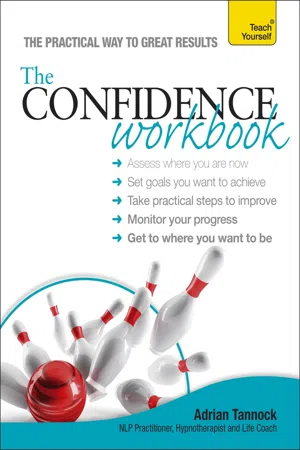
This new Teach Yourself Workbook doesn't just tell you how to be confident. It accompanies you every step of the way, with diagnostic tools, goal-setting charts, practical exercises, and many more features ideal for people who want a more active style of learning. The book starts by helping you identify the factors currently constraining your confidence, and their causes. It then helps you set specific goals to improve on; as you progress through the book, you will be able to keep checking your progress against these goals. Specially created exercises, using the tools of NLP, hypnotherapy and cognitive psychology, will help you to boost your confidence so that you can reach your potential in any situation.
"
- 288 pages
- English
- ePUB (mobile friendly)
- Available on iOS & Android
eBook - ePub
The Confidence Workbook: Teach Yourself
About this book
Information
Topic
Personal DevelopmentSubtopic
Mental Health & Wellbeing | How to use this workbook |

In this chapter:
• You will explore the true nature of confidence, dispelling some myths along the way.
• You will learn how to get the most from this workbook, and discover the key ingredient of a confident life.
• You will need: a pen, an A5 pad and an open mind!
What does confidence mean to you? For some, it means feeling comfortable in their own skin: being able to stand out from the crowd and knowing their place in the world. For others, it means pushing boundaries: believing in their talents and abilities and feeling capable of anything.
How would you define confidence? Write a sentence or two in the space below, describing confidence in your own words:
Confidence is

How did you get on? Let’s compare it with the Chambers Dictionary definition.
Confidence (noun):
• Firm trust or belief (i.e. in someone or something)
• Self-assurance, self-belief (faith in one’s own abilities or attributes)
• Assuredness, especially in the outcome of something
I would sum up confidence with the following statement:
• Confidence is a state, feeling or belief stemming from reliance, appreciation or certainty.
When you feel you can rely on something, you are confident in it. When you appreciate the abilities or qualities of someone, you are confident in them. When you are certain about something, you are confident in that certainty. So, confidence is a positive experience based on your perception at that time.
The question is – how do you get more of it?

As we noted earlier, confidence is multifaceted; it affects us on different levels:
• The cognitive level: our thoughts, memories and beliefs.
• The behavioural level: what we say or do.
• The affective level: our feelings and emotions.
• The physiological level: changes in our body; e.g. heart rate or perspiration level.
How we think, how we feel, how we act, and even how our body behaves reflects our confidence at any given point. It impacts on everything we do:
• Confidence is the difference between retraining for a new career or remaining stuck in a dead-end job.
• Confidence is the difference between feeling positive at the start of the day or just getting through it.
• Confidence is the difference between feeling relaxed or feeling anxious at a party.
• Confidence increases your ability to think, feel, communicate and act in an effective way, even under difficult circumstances.
Confidence affects us in many ways, which is why so many misconceptions about it exist.
Some people believe that confidence is something you are born with; that it’s a special quality, available only to the few. It’s easy to be confident if you’re Tom Cruise or David Beckham! And it is true – being talented or popular makes it easier to be confident... However, even talented or good-looking people sometimes lack confidence. In this, they are no different from the rest of us.
If confidence is solely for the beautiful, why do people often grow in confidence as they age? Confidence can be learnt, it is not a special gift.
And confidence is not the same as arrogance. The difference between confidence and arrogance is simple: arrogance compensates for a lack of genuine confidence. Arrogant people strive to be right while confident people can accept being wrong. Arrogant people put others down, whereas confident people have no need to belittle others. When truly confident, there is no need for arrogance.
We can look at confident people and think, ‘Everything must be so easy for them!’ This is not the case. Confidence does not render us immune to failure or disappointment, nor does it make us perfect.
Still, a life lived with confidence is a life worth living. It galvanizes and energizes; with greater confidence comes a sense of self-reliance, even when challenged. Confident people appreciate their better qualities, and tend to be more relaxed and co-operative with others.
Confidence changes life for the better, and – it feels good!
There are three distinct – but interrelated – factors that contribute towards confidence: a healthy attitude towards yourself, self-efficacy and an optimistic outlook.
A HEALTHY ATTITUDE TOWARDS YOURSELF
Imagine somebody you love dearly. Although your relationship will have been through its ups and downs, you will still treat them with kindness and respect. Do you treat yourself in this way? Anything less and you’re undermining your own confidence.
When our self-judgement is harsh and unfair, we learn to fear the judgement of others. Nothing could be more damaging; confidence means accepting yourself as an individual, living your values and treating yourself well. We will discuss this more in the chapters to come.
SELF-EFFICACY
Earlier, we defined confidence as stemming from reliance. Self-efficacy means feeling capable, and taking action when required.
People with low self-efficacy overestimate the challenges they face, causing stress and procrastination. Confident people tend to believe in their own abilities – they have more control and generally do well in life. Much of this workbook is designed to...
Table of contents
- Cover
- Title
- Dedication
- Contents
- Acknowledgements
- Introduction
- 1 How to use this workbook
- 2 Confidence and you
- 3 Confident thinking
- 4 Overcoming anxiety
- 5 Feeling confident
- 6 Confident action
- 7 Freedom from the past
- 8 Confident beliefs
- 9 Interpersonal confidence
- 10 Overcoming safety behaviours
- 11 Setting your confidence goal
- 12 Your action plan
- 13 A confident future
- Appendix I
- Appendix II
- Copyright
Trusted by 375,005 students
Access to over 1.5 million titles for a fair monthly price.
Study more efficiently using our study tools.
Frequently asked questions
Yes, you can cancel anytime from the Subscription tab in your account settings on the Perlego website. Your subscription will stay active until the end of your current billing period. Learn how to cancel your subscription
No, books cannot be downloaded as external files, such as PDFs, for use outside of Perlego. However, you can download books within the Perlego app for offline reading on mobile or tablet. Learn how to download books offline
Perlego offers two plans: Essential and Complete
- Essential is ideal for learners and professionals who enjoy exploring a wide range of subjects. Access the Essential Library with 800,000+ trusted titles and best-sellers across business, personal growth, and the humanities. Includes unlimited reading time and Standard Read Aloud voice.
- Complete: Perfect for advanced learners and researchers needing full, unrestricted access. Unlock 1.5M+ books across hundreds of subjects, including academic and specialized titles. The Complete Plan also includes advanced features like Premium Read Aloud and Research Assistant.
We are an online textbook subscription service, where you can get access to an entire online library for less than the price of a single book per month. With over 1.5 million books across 990+ topics, we’ve got you covered! Learn about our mission
Look out for the read-aloud symbol on your next book to see if you can listen to it. The read-aloud tool reads text aloud for you, highlighting the text as it is being read. You can pause it, speed it up and slow it down. Learn more about Read Aloud
Yes! You can use the Perlego app on both iOS and Android devices to read anytime, anywhere — even offline. Perfect for commutes or when you’re on the go.
Please note we cannot support devices running on iOS 13 and Android 7 or earlier. Learn more about using the app
Please note we cannot support devices running on iOS 13 and Android 7 or earlier. Learn more about using the app
Yes, you can access The Confidence Workbook: Teach Yourself by Adrian Tannock in PDF and/or ePUB format, as well as other popular books in Personal Development & Mental Health & Wellbeing. We have over 1.5 million books available in our catalogue for you to explore.