"Don't mistake being busy for being productive! Create time to read this important book and start spending your time where it counts." Marshall Goldsmith, New York Times #1 bestselling author How we spend our time is one of the greatest indicators of how successful we will be. We achieve our goals when we ruthlessly prioritise tasks and people that are important to us.This book is for you if:
· You feel unrelentingly busy and overwhelmed.
· 3pm arrives and you've not done any of the tasks you intended.
· When you're not working, you're still 'on' - checking emails and always thinking about what you haven't done.
· You over-commit and find it hard to say no.
· You sacrifice your own priorities for disorganised people's urgent demands.
· Meetings, emails, and constant interruptions suck the life out of you.
· Your HR department's emails about wellness week are the final straw: meditation won't help your wellbeing, less meetings would.If we focus our time, energy and attention on the wrong things we will never achieve the success or happiness that we aspire to. The problem is that the low value, low impact tasks that distract us from our priorities, are hard to ignore. They scream out at us all day: digital distractions, other people's urgent demand for 'five minutes' that's never five minutes, the meetings that you shouldn't be in, the pointless email chains, the reports you write that don't get read. We get a hit from ticking these tasks off a list. It's got us hooked on crazy busyness. But all we are doing is scratching off a layer of fake work on top of the real, valuable work. The Crazy Busy Cure is full of intensely practical tips to save you from this addiction and get productive again. It will show you how to have a laser focus on your priorities, manage others so they can get on with the work and find more head space. With tips for remote working and office working alike as well as productivity hacks for people with learning and thinking differences, this lively read is jam packed with solutions.Zena Everett is executive coach and organisational psychologist and draws from her many thousands of hours and coaching and speaking to people about productivity blockers and how to shift them. Stay energised, find your freedom from distractions and regain your productivity.
eBook - ePub
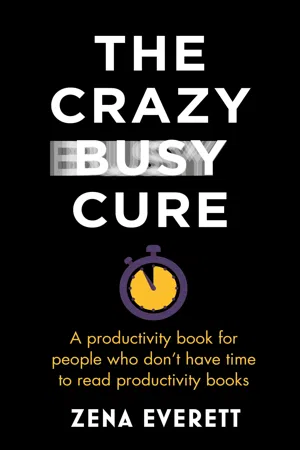
The Crazy Busy Cure
A productivity book for people with no time for productivity books
- 176 pages
- English
- ePUB (mobile friendly)
- Available on iOS & Android
eBook - ePub
About this book
Information
Topic
Personal DevelopmentSubtopic
Time Management
CHAPTER 1
How you became hooked on Crazy Busyness

- Have you always prided yourself on being a hard worker?
- Were you brought up to believe that ‘if a job’s worth doing it’s worth doing well’?
- Has anyone ever called you a workaholic?
Please don’t beat yourself up for being Crazy Busy. It usually comes from very positive intentions and often serves as a defence mechanism.
It’s likely that your work ethic and high standards have catapulted you into a successful career. Unless you recalibrate how you operate, these standards become a problem when the pressure of work means it is impossible to maintain them. You have to relinquish some control over your own impossibly high standards. This probably makes you feel very uncomfortable.
All strengths, when overused, have a shadow side. The traits and behaviours that put you on the fast track become detrimental.
Even if you decide to stay low down the corporate ladder, Crazy Busyness doesn’t make you happy. You wouldn’t be reading this book if it wasn’t a problem.
In the words of best-selling executive coach and author Marshall Goldsmith:
“What got you here, won’t get you there.”
Crazy Busy people usually have one or more personality traits that have developed a shadow side: which is most like you?
1 You need to be perfect
If we go back to school days, you probably got praised for working really hard. You may or may not have been cleverer than most but actually this doesn’t matter so much. Intelligence is a predictor of academic success, but there is limited correlation between IQ and success in the workplace (Richardson and Norgate, 2015). We all know people with extraordinary ambition and drive who get way further in life than their teachers predicted.
You could also have been rewarded for perfect performance. Nowadays parents are taught to praise and reward their kids for effort, which is under their control, rather than grade achievement, which isn’t. You can’t always control the end result.
Like most of their generation, however, my parents praised results and pushed for excellence. They focused on the one spelling I got wrong, not the 19 I got right.
I vividly remember one comment from my school reports. It was from my singing teacher: ‘Zena could look happier when singing.’ (In truth he was being enormously tactful as I can’t hold a note.) However, my mother was so incensed about this ‘ruining’ my otherwise tiptop report that she rang the Headmaster to complain.
What did I learn from this? Life is binary – 100 per cent perfect or 100 per cent failure. No grey. I was tough on myself and focused on the deficit, never the positives. If I got 20/20 on spellings one week, I’d dismiss it as an easy test.
Perfectionists like me deliver perfect results but, of course, as we get more responsibility, we can’t do everything perfectly anymore. That stresses us out. We aren’t in control anymore. We prioritize low-value easier tasks, which we can control perfectly, over high-impact important ones. To delay a potentially less-than-perfect performance, we procrastinate. Plenty on procrastination later, as long as I don’t run out of time.
As we try to keep doing all our tasks perfectly, we become whirling dervish Crazy Busy people, lost in the detail, with over-committed impossible diaries and unachievable to-do lists. Our busyness also stops us facing up to aspects of our lives we aren’t so happy with.
Where perfectionists really hit the skids is that we can’t bear criticism. We take feedback really hard, so we don’t seek it out. Careers get derailed when we can’t ask for help on our blind spots. As we advance into leadership roles, these blind spots are less about skills and more about our relationships with other people, trying to manage their productivity as well as our own.
In one of my favourite leadership books, The Right and Wrong Stuff, Professor Carter Cast of Kellogg School of Management explains that this defensiveness stops us learning and developing. It is a common reason why people’s careers plateau.
2 You like to do things yourself, rather than trust others
You are super strong on execution – the ability to get things done. You are a high performer, trusted to do a good job, to hit targets and work on your own initiative. You take on more responsibilities than your peers, work longer hours and push yourself to do well. You aren’t frightened to get your hands dirty. This reputation is how you built your career and got promoted. No task is too small for you to put your hands up for and excel at.
Success at work comes first from our intrapersonal skills: our character traits and ability to manage ourselves. You are high in motivation, discipline, drive and ambition, but lower in focus, prioritization and organization skills.
As well as intrapersonal skills we also need interpersonal skills: our ability to work with other people and influence them to our point of view. Managing others means you have to get results through other people.
Crazy Busy people don’t have the time to slow down and listen, to take people with them. They often are so focused on delivering the numbers that they don’t have time to lift their head above the parapet and think strategically. They work from the detail up, because that’s where they feel safe, sometimes missing the big picture altogether.
I coached a supply chain manager, Alessandro. He accelerated early in his career because of his outstanding negotiation tactics and forensic knowledge of each contract. But as a leader, he got very poor engagement scores from his team.
It turned out that they were burdened with several time-consuming projects that didn’t justify the effort required in getting them off the ground. Even worse, some of the projects actually conflicted. This is classic cultural Crazy Busyness. The people on the ground knew it, but Alessandro wasn’t listening to them.
When he finally paused to listen, the problem was obvious. ‘What are we trying to achieve here’ was all it took to prioritize some projects, shelve the rest and rebuild momentum.
Crazy Busyness gets in the way of career success. You can, of course, choose to come off the management track and continue as an individual contributor or subject matter expert. But dream on. You’ll always have to influence and collaborate with other people. You can’t be a bottleneck.
You’ll get more and more overwhelmed. You might even reject career opportunities because you assume that they will make you even more tired.
3 You put others’ needs before your own
Most of the Crazy Busy people I coach are exceptionally kind, nice people. They naturally gravitate towards management roles. They often end up involved in good causes, whether in their professional role, some side initiative or in a voluntary capacity.
Inevitably, they have taken on caring responsibilities early in life too, looking after parents or siblings who weren’t able to take appropriate care of themselves, or perhaps were just unusually demanding.
Pleasing people at all costs, subjugating our needs to others, becomes a habit. In some cases, it’s a survival mechanism. This was my situation, both my mother and father had physical and mental ill health. I always felt that I was responsible for my parents, not the other way around.
The world relies on people like us. That’s what we tell ourselves anyway.
It’s no coincidence that many coaches, therapists, medical professionals – anyone that helps others for a living – have had early caring responsibilities. This becomes our reality and we recreate this in our adult lives. That’s the message we internalize about how the world works and our purpose in it.
The problem is we then take on more and more and can’t cope with all the demands. We don’t have boundaries.
Co-dependent people try to make things better for everyone else, even when that’s impossible or unwanted.
Are you the person who remembers everyone’s birthdays, who stays late to finish other people’s work, who volunteers for projects that you don’t really want to do, who even collects the cups at the end of each meeting? Do you feel resentful that your caring isn’t appreciated or reciprocated? Are you praised for your hard work but overlooked for promotion? Do you get stressed easily and sometimes need to take time off? Do you do all the chores at home too? And feel guilty if you don’t run the Parents’ Association at your kids’ school?
I’m not qualified to give a clinical psychological diagnosis, but I’d say this a pretty likely indicator of a co-dependent personality type.
Co-dependent people are always looking for approval but are not good at asking for what they need. Asking for feedback is a big topic in this book, because feedback keeps our performance and productivity on track. Co-dependent people are hypersensitive to critical feedback so avoid asking for it.
Their identity is often tightly embedded into how well they do their job, so they find it hard to be rational when things don’t go well. Stumbles are inevitable and, actually, to be encouraged because we all know that the best lessons come from mistakes. Co-dependents can’t bear failure. They catastrophize: ‘That presentation wasn’t very good, so my entire life is a disaster.’ Rather than take the risk of less-than-excellent performance, they stay well within their comfort zone, repeating crazy busy low-risk, low-value tasks that keep them psychologically safe.
Their mantra is ‘what can I do for you?’ and they are happy to work away behind the scenes. Savvy colleagues take advantage of this, making sure they get the credit, obviously referencing their colleague in their thank-you speech. They always want you in your team, even taking you with them when they move on. This fuels your need to be liked and helpful.
Hell, some of us were even taught by the system that co-dependence is the right way to behave.
When I was a Brownie, many years ago in Bandon, West Cork, Ireland, we were told about helpful little elves that snuck into the house when everyone was asleep, did all the chores, laid the fire (I told you it was a long time ago), made the breakfast and then flew away before anyone saw them. That’s what young girls were encouraged to be like – to never demand thanks for good deeds, to be passive and selfless. Our rewards would come, but not if we asked for them.
Those types of messages stick in our subconscious minds until we boot them out when we are sick of being trampled over.
Please, wake up and smell that coffee you’ve just made for yourself, and probably everyone around you too.
Dial down your urge to over-extend and dial up your boundaries.
In her book Co-dependent No More, Melody Beattie suggests asking ‘what do you need from me?’ instead of ‘what can I do for you?’ It’s a subtle shift but...
Table of contents
- Cover
- Endorsement
- Title
- Dedication
- Contents
- How certifiably Crazy Busy are you?
- Who do you want to be?
- Introduction: Crazy Busyness destroys productivity and happiness
- Part 1: Diagnosis
- Part 2: Cure
- Part 3: Staying productive
- Part 4: Leading others out of Crazy Busyness
- Part 5: Freedom
- References
- About the author
- Copyright
Trusted by 375,005 students
Access to over 1.5 million titles for a fair monthly price.
Study more efficiently using our study tools.
Frequently asked questions
Yes, you can cancel anytime from the Subscription tab in your account settings on the Perlego website. Your subscription will stay active until the end of your current billing period. Learn how to cancel your subscription
No, books cannot be downloaded as external files, such as PDFs, for use outside of Perlego. However, you can download books within the Perlego app for offline reading on mobile or tablet. Learn how to download books offline
Perlego offers two plans: Essential and Complete
- Essential is ideal for learners and professionals who enjoy exploring a wide range of subjects. Access the Essential Library with 800,000+ trusted titles and best-sellers across business, personal growth, and the humanities. Includes unlimited reading time and Standard Read Aloud voice.
- Complete: Perfect for advanced learners and researchers needing full, unrestricted access. Unlock 1.5M+ books across hundreds of subjects, including academic and specialized titles. The Complete Plan also includes advanced features like Premium Read Aloud and Research Assistant.
We are an online textbook subscription service, where you can get access to an entire online library for less than the price of a single book per month. With over 1.5 million books across 990+ topics, we’ve got you covered! Learn about our mission
Look out for the read-aloud symbol on your next book to see if you can listen to it. The read-aloud tool reads text aloud for you, highlighting the text as it is being read. You can pause it, speed it up and slow it down. Learn more about Read Aloud
Yes! You can use the Perlego app on both iOS and Android devices to read anytime, anywhere — even offline. Perfect for commutes or when you’re on the go.
Please note we cannot support devices running on iOS 13 and Android 7 or earlier. Learn more about using the app
Please note we cannot support devices running on iOS 13 and Android 7 or earlier. Learn more about using the app
Yes, you can access The Crazy Busy Cure by Zena Everett in PDF and/or ePUB format, as well as other popular books in Personal Development & Time Management. We have over 1.5 million books available in our catalogue for you to explore.