The 21st century workplace thrives on internet-enabled connectivity and technology and these new applications allow human resource professionals to make the work of developing and managing the workforce faster, easier, and more effective. The e-HR Advantage explores the positive impact of technology upon the workplace: how we work, learn, and manage ourselves and others. With best practices for implementation and case studies from around the world, this complete handbook provides a framework for understanding the significance of technology in the workplace. Human resource professionals who master these technologies will secure their seat at the table.
eBook - ePub
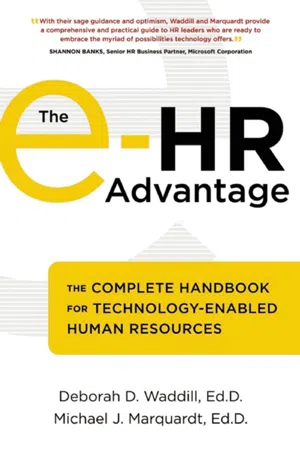
The e-HR Advantage
The Complete Handbook for Technology-Enabled Human Resources
- 320 pages
- English
- ePUB (mobile friendly)
- Available on iOS & Android
eBook - ePub
The e-HR Advantage
The Complete Handbook for Technology-Enabled Human Resources
About this book
Information
Introduction
CHAPTER 1
Technology and its impact on the Human Resources Professional
In the twenty-first century, we are constantly inundated with new ideas, new processes, and new products. The overwhelming onslaught of advertising messages, technical advances, and organizational policy changes influence our choices and behaviors; while these changes generally promise improved quality of life, they don’t always deliver on that promise. Amidst the deluge—and contributing to it—is technology.
Technology permeates every aspect of our lives, and it changes constantly. It seems that “work-saving” technologies emerge almost daily, and, if adopted, they affect organizational policies, practices, and workflow.
There is no denying that technology can impact all facets of society. In the last century we saw radical economic, social, and work-life changes from:
■ Machine/Industrial Age to the Technology/Informational Era
■ National economies to global economies
■ The physical to the virtual workplace
■ Manufacturing to “Mentofacturing” (the production of ideas)
■ Face-to-face interactions to online interactions (Schwandt and Marquardt 2000)
Another obvious fact is that technology contributed to these shifts.
In some ways, technology simplifies work, and in other ways it makes the workplace more complex. Technology offers both obstacles to success (the inevitable computer crashes) and increased opportunities (connections with people to whom we would not normally have access). Technology is neither bad nor good, but neutral. The way in which we use technology increases or decreases its positive net effect on us. Technology is, after all, nothing more than a tool. However, before proceeding any further, let’s define the term.
What Is Technology?
Technology includes any innovation humans have developed, any tool that aids us in extending and interacting with our environment. Each generation has a different tool that qualifies as technology. For example, the primary technological invention of the fifteenth century was arguably the printing press; it revolutionized publishing, communication, and the distribution of knowledge. The key technological advancement of the twentieth century was—undeniably—the computer. Computers forever altered business, leisure, personal lives, and public platforms. Both the printing press and modern-day computers are technologies that radically changed societies. When we talk about technology, then, we are referring to any tool, technique, or system that enables us to control and adapt to our environment.
In the twenty-first century, the emergence of Web 2.0 extends the impact of computer technology. In some measure, our environment is controlled, supported, and influenced by the Internet; businesses, public places, and homes are all affected by the Internet, in developed and developing countries. Whether scientists use Web 2.0 to obtain high-resolution radar images. Based on Web 2.0, we have developed new ways of caring for the old and sick. Trust communities use this secure framework for accessing an unlimited number of online resource providers while maintaining privacy. Business operations require automation and customization, which are enhanced by Web 2.0. It enables vivid images and smooth business videoconferencing, and it supports the use of sophisticated simulations, including avatars, computer-generated graphics that look like people (Steele 2007). The Internet is so pervasive and powerful globally that you could call the twenty-first century the “Internet century” (Doherty 2001).
Human Resources and Technology
In the field of Human Resources (HR)—the learning and human development arm of most organizations—technology has completely altered business processes. This occurred in spite of the fact that HR departments tend to change more slowly than other departments and tend to be reluctant to use technology. It may be HR professionals’ emphasis on workers, rather than the tools used by the workers, that in some cases dampens their enthusiasm for technology. Typically, if you are in Human Resources, you care about people more than about things. There is a reason for that predisposition.
When Leonard Nadler coined the term human resource development, he cited Human Resource professionals’ role within organizations as helping individuals to grow and learn. The role became more sophisticated as human resource development (HRD) became more clearly defined to include the three-fold notion of training, education, and development. In the twenty-first century, Human Resource responsibilities surpassed a focus on individual and organizational development to encompass oversight of learning at the individual, team, and organizational levels.
An interesting phenomenon in this century has been the redistribution of conventional HR functions into the hands of non-HR managers. In this case, the care of employees becomes the responsibility of the employees’ direct supervisors rather than someone in the HR department. In such cases, the “people care” shifted from HR to managers. It is important to note this migration of responsibilities. Consequently, many HR roles and responsibilities appear under the job descriptions of supervisors and managers rather than a bona fide HR department. The impetus for this change can in part be attributed to cost efficiencies offered by HR technologies.
This migration of responsibilities may explain why non-HR professionals often make many of the technology decisions that impact the Human Resource department. As technology has gained in importance, it has begun to support many of the people-care functions that HR professionals previously handled themselves.
Traditionally, HR professionals have performed several key functions, including: HR strategic advisor, HR systems designer and developer, organization change consultant, organization design consultant, learning program specialist, instructor/facilitator, individual development and career consultant, performance consultant, and researcher.
In the past, each of these functions contributed significantly to an organization’s well-being. Interestingly, however, in the twenty-first century the functions have morphed to a new set of competencies, many of which can be enhanced or entirely performed using technology. In a study performed by the RBL Group and the Ross School at University of Michigan (assisted by the Society for Human Resource Management), a new set of competency domains were identified for the HR professional. These include:
■ Credible activist
■ Culture and change steward
■ Strategic architect
■ Talent manager and organization designer
■ Business ally
■ Operational executor (Society for Human Resource Management 2007)
Technology underpins all of these HR competencies and can, at very least, increase the effectiveness of the HR department. In fact, HR-related technologies offer many attractions. In short, technology can be used to enhance performance, quicken decision making, handle administrivia (excessive administrative detail), enable the exchange of knowledge, offer learning to a broader audience, and provide cost savings (Gueutal and Stone 2005).
The Society of Human Resource Management offers current advice on important HR matters in its journal, HRMagazine. Rita Zeidner states, in HRMagazine: “Core administrative responsibilities as diverse as recruitment, oversight of legal and regulatory compliance, benefits administration, and the safeguarding of confidential employee info cannot be carried out effectively without high-tech tools” (2009, 49). Organizations that reject emerging HR technologies are likely to find themselves at a severe disadvantage.
Riding the Wave of Internet-Enabled Technologies
Peter Vaill wrote in his book Learning as a Way of Being (1996) that society is in a perpetual state of turbulence similar to “white water,” which Merriam-Webster’s dictionary defines as a “frothy water (as in breakers, rapids, or falls).” Experience demonstrates that tumultuous, surprising, novel, ill-structured, and obtrusive events that simulate the chaos of “white water” in our everyday lives often involve—or are related to—technology.
Whereas some simply avoid the water—rejecting technology entirely—others participate and become fully engaged. Yet there is a third option: learning survival techniques. There are strategies for coping with technological change that enable the businessperson to find safe harbor amid technology chaos. The key is this: one must prepare, use the appropriate tools, and seek assistance in order to deal with each new technology wave.
The first order of business is to differentiate the technology gimmicks from the effective tools. This requires an understanding of the selection process, the audience, the business, the existing technologies, and the future plans of the organization. Human Resource (HR) professionals must have the technology acumen to participate in and contribute to technology research, selection, and implementation. HR managers must understand technology so that they can gauge its potential impact on the workforce. And Human Resource, managers and leaders must help prepare others for technology-generated change that is occurring in the field of Human Resources.
Technology presents tremendous advantages. Global economies, countries, and organizations can realize cost efficiencies from investments made in Internet-enabled technologies. At the personal level, those who understand Internet-enabled technologies have a business advantage, especially in terms of higher wages (The U.S. Bureau of Labor Statistics 2003). Technology expertise can be a fast track to promotion. In fact, technology may be the key for organizational success, allowing HR staff to manage vast quantities of information and handle the pace of change while maintaining a leading edge. Consequently, to lead at this time in history, the HR professional must understand the technologies that impact HR functions and responsibilities.
Technology and opportunity
In spite of solid evidence to the contrary, there are those who remain unconvinced of the importance of technology and the Internet. There is even a term for these people: neo-Luddites, a term used to describe those who mistrust or fear the inevitable changes brought about by new technology. The original Luddites were named after Ned Lud, an English laborer who was reported to have destroyed weaving machinery around 1779; the Luddites destroyed technological devices that they felt threatened their livelihoods.
Let’s be honest now … Have you ever wanted to take a bat to your computer? We thought so. This negative response, as you know, is ineffective against the advances of technology. Neo-Luddites are unable to halt technological progress, yet they cannot be convinced that the proactive approach of embracing technology is the more sensible plan.
When HR professionals reject technology, they force others—who may or may not understand the responsibilities of Human Resources management—to make decisions about the technology selection appropriateness. Often, those who fill in are not the stakeholders; rather they are information technology (IT) experts. While IT professionals have technical knowledge of hardware and software, they may not know the characteristics and workflow of the target audience; when those who will use the technology are not represented in the decision, they become disgruntled and sometimes frustrated. HR professionals should serve as the liaison.
The sensible, happy medium is for HR professionals to examine proposed technologies for whether or not they will satisfy the stakeholders’ workplace needs. Technology can positively impact organizational, team, and individual development in a variety of areas. There are many instances where technology enhances the learning, effectiveness, and communication within an organization. Consider the examples of online learning, workplace collaboration tools, employee time-tracking technology, and communication by e-mail. These technologies render more efficient everything from internal communication to knowledge management. Technology can streamline employee surveys and certification; assistive technology increases opportunities for those with physical disabilities; and HR information systems and self-service sites enable the free flow of compensation, healthcare, and retirement information. Collaboration increases through the use of listservs, social networking sites, and groupware. Opportunities for new efficiencies in the technology-enabled workplace are endless.
Organizational Readiness
As with any business decision, good sense, research, and an understanding of the organizational climate must prevail when making technology decisions. Technology selection must take into account the business environment and organizational disposition toward new technologies. The organization’s mission and organizational climate indicate its readiness to adopt a new technology; its readiness to accept new technology influences both the type of technology selected and ultimately the technology’s success in that environment.
HR’s Changing Role
Corporate leaders around the world care very much about the integration of technology, learning, and organizational life. In the case of HR functions, it should be the HR executive and her HR managers who select, implement, and evaluate technology options that affect their work. Even those HR professionals who are not technology-savvy can—and should—have significant input. At the very least, HR managers, as stakeholders, should be awar...
Table of contents
- Cover Page
- Title Page
- Copyright Page
- Contents
- Purpose and Uses of This Book
- SECTION 1 Introduction
- SECTION 2 Learning Systems
- SECTION 3 Technologies for Managing Human Resources
- SECTION 4 Communication Technologies
- SECTION 5 Knowledge Management
- Bibliography
- Index
Trusted by 375,005 students
Access to over 1.5 million titles for a fair monthly price.
Study more efficiently using our study tools.
Frequently asked questions
Yes, you can cancel anytime from the Subscription tab in your account settings on the Perlego website. Your subscription will stay active until the end of your current billing period. Learn how to cancel your subscription
No, books cannot be downloaded as external files, such as PDFs, for use outside of Perlego. However, you can download books within the Perlego app for offline reading on mobile or tablet. Learn how to download books offline
Perlego offers two plans: Essential and Complete
- Essential is ideal for learners and professionals who enjoy exploring a wide range of subjects. Access the Essential Library with 800,000+ trusted titles and best-sellers across business, personal growth, and the humanities. Includes unlimited reading time and Standard Read Aloud voice.
- Complete: Perfect for advanced learners and researchers needing full, unrestricted access. Unlock 1.5M+ books across hundreds of subjects, including academic and specialized titles. The Complete Plan also includes advanced features like Premium Read Aloud and Research Assistant.
We are an online textbook subscription service, where you can get access to an entire online library for less than the price of a single book per month. With over 1.5 million books across 990+ topics, we’ve got you covered! Learn about our mission
Look out for the read-aloud symbol on your next book to see if you can listen to it. The read-aloud tool reads text aloud for you, highlighting the text as it is being read. You can pause it, speed it up and slow it down. Learn more about Read Aloud
Yes! You can use the Perlego app on both iOS and Android devices to read anytime, anywhere — even offline. Perfect for commutes or when you’re on the go.
Please note we cannot support devices running on iOS 13 and Android 7 or earlier. Learn more about using the app
Please note we cannot support devices running on iOS 13 and Android 7 or earlier. Learn more about using the app
Yes, you can access The e-HR Advantage by Deborah D. Waddill,Michael J. Marquardt in PDF and/or ePUB format, as well as other popular books in Business & Organisational Development. We have over 1.5 million books available in our catalogue for you to explore.