Longlisted for Management Book of the Year 2021 Forbes #1 Book to Help You Improve Your Performance at Work Based on data and insights from over 100k virtual and in-person coaching conversations conducted by the talented coaches of global coaching company, BTS Coach, comes the first book to take BTS Coach's evidence-based coaching process to a mass audience. In a concise, easy-to-understand manner, readers will discover 4 mindsets - Be, Relate, Think, and Inspire - that are most critical for individuals to experience deep, meaningful change, along with the process and tools for sparking their own powerful conversations to get the best out of themselves and those around them.
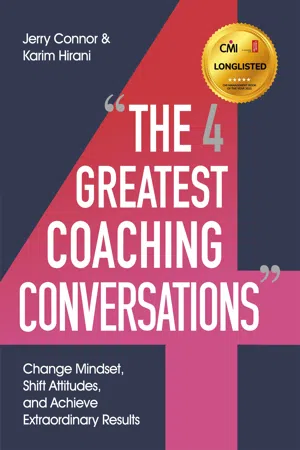
eBook - ePub
The Four Greatest Coaching Conversations
**LONGLISTED FOR MANAGEMENT BOOK OF THE YEAR 2021**
- 224 pages
- English
- ePUB (mobile friendly)
- Available on iOS & Android
eBook - ePub
The Four Greatest Coaching Conversations
**LONGLISTED FOR MANAGEMENT BOOK OF THE YEAR 2021**
About this book
Information
PART ONE
The Four Greatest Coaching Conversations
Introduction
WHAT MAKES A GOOD COACH A GREAT ONE?
Imagine someone you know comes to you feeling really low. “The presentation bombed,” she says, referring to a board-level presentation she’d been preparing for ages. “I’ll never be taken seriously at that level.”
How do you respond? Whether you have a coaching or line-manager relationship, how can you coach her? Does this kind of situation sound familiar?
As a coach it should make your ears perk up. It is a prime opportunity for one of the four great coaching conversations. It is a chance to help this person pick herself up after a difficult meeting and help her learn from this experience and emerge with new confidence in communicating her ideas. It is an opportunity to make a huge difference.
Most good coaches will recognize the chance to be helpful here by listening or offering some time to reflect on what happened—but great coaching is about more than this. Great coaches can turn this kind of situation into an opportunity to shift mindset, a sustainable way to create deep and lasting change in their coachees. That is because they know how to identify and use the four greatest coaching conversations. This common situation of responding to a setback is just one of them.
Discovering the Four Great Coaching Conversations
We started to identify these conversations based on some remarkable data. We are both founders and key leaders of BTS Coach. BTS Coach was the pioneer of affordable coaching, and the company manages around 300 coaches in more than 40 countries, coaching nearly 10,000 individuals a year. To manage quality, our coaches have always been asked to keep anonymized notes on their conversations.
By 2012 we realized that this data was a goldmine. Inadvertently, we had created a record of more than 100,000 conversations in which leaders were at their most open about the challenges they were struggling with and the insights that unlocked change. And, of course, what truly unlocked the change was mindset.
Each coachee was coming in with a live and critical challenge. In each situation, they needed to make a mindset shift in order to change. The power of this data was that through the conversations, we could track what the coaches were doing that created this shift.
Something fascinating emerged from this data. At the root of vastly different situations and scenarios, particular mindset shifts and certain conversations kept recurring. A leader who wants to influence peers, a line manager who wants to coach, or a salesperson who wants greater trust with customers may all need the same mindset shift to achieve their goal, and they may all need a similar conversation to help them.
We grouped our findings into four areas, each related to a mindset:
1. “Be.” These were conversations about the individual’s resourcefulness, confidence, and ability to stay calm, open, and empathetic in any situation. This included authenticity and being yourself when you most need it.
2. “Relate.” These were conversations about relationships with other people. This included influencing, building trust, giving a difficult message, collaborating, or dealing with conflict.
3. “Inspire.” These were conversations about direction, change, and purpose. This included responding proactively to situations of uncertainty, and knowing what you stand for and how to lead for it.
4. “Think.” These were conversations about solving problems in a new way. This included identifying bias and seeking input from diverse sources, having creativity, strategy, innovation, and insight. This was about looking beyond the obvious.
These areas were pervasive. For example, a leader seeking coaching on public speaking and a leader seeking coaching on managing emotions might actually need the same thing when viewed through a mindset lens. In both cases the Be conversation would enable them to choose their attitude or state in critical situations.
Interestingly, the truly great coaches would pick this up and used the right tool for the right mindset. The critical coaching conversation with the individual who wanted to be more confident at public speaking followed the same path as the coaching intervention with the person who wanted to manage their emotions. If the shift is the same, the coaching approach is the same.
And, logically, if you need to match the conversation to the shift, the same technique will not work for Relate, Inspire, and Think shifts. In each case, if you want to change mindset, something very different is required.
These findings are remarkable. Let’s explore further how the shifts are different and why this is important to understand.
Each shift is fundamental and creates a step change in performance. But each shift is different and requires the coach to work in a different way.
Take two examples:
One coachee was a talented marketer. In everyday business, her quality shone through. But when it came to “selling her strategies” to senior leaders or making the case for a course of action with critical peers, she was less effective. The coach focused on what we will discover are classic Inspire questions. He asked the coachee to shape her vision for the difference her strategies might make. He coached her to clarify the change she wanted to lead in the business and build a strong narrative to bring it to life for the board. But it still failed. Why? Because the coach was focusing on the wrong conversation. Our coachee did not lack a clear sense of purpose or the ability to shape a story. The issue here is one of resourcefulness in negotiation with senior leaders. The only way to really address this is with the Be conversation, which will help her understand why she is becoming defensive and losing authority with senior audiences, and help her respond at her best in these negotiations with senior leaders.
Another coachee was an entrepreneur. After early success, he was experiencing a series of losses. Naturally he was starting to question his business idea. In this case, the coach focused on the Be conversation. The coach helped the coachee understand the doubts that began to creep in with the constant failures. The coach then helped the coachee build new, more resourceful responses to enable the entrepreneur to bounce back from disappointment. But the business kept failing. In this case the need was not a Be one. It’s critical for entrepreneurs to notice feedback their products receive in the market and to challenge the way they think about their business. This points to the heart of learning agility. Rather than helping the coachee become more resilient, the need here was to coach his assumptions about the business. This is a classic Think coaching need.
Each of these cases used the wrong coaching conversation, and the coaching ultimately did not create sust...
Table of contents
- Cover
- Praise For The Four Greatest Coaching Conversations
- Title Page
- Copyright
- Contents
- Acknowledgements
- PART ONE: The Four Greatest Coaching Conversations
- PART TWO: Organizations Have Mindsets Too
- PART THREE: Going Deeper: Understanding Mindset Change
- References
Trusted by 375,005 students
Access to over 1.5 million titles for a fair monthly price.
Study more efficiently using our study tools.
Frequently asked questions
Yes, you can cancel anytime from the Subscription tab in your account settings on the Perlego website. Your subscription will stay active until the end of your current billing period. Learn how to cancel your subscription
No, books cannot be downloaded as external files, such as PDFs, for use outside of Perlego. However, you can download books within the Perlego app for offline reading on mobile or tablet. Learn how to download books offline
Perlego offers two plans: Essential and Complete
- Essential is ideal for learners and professionals who enjoy exploring a wide range of subjects. Access the Essential Library with 800,000+ trusted titles and best-sellers across business, personal growth, and the humanities. Includes unlimited reading time and Standard Read Aloud voice.
- Complete: Perfect for advanced learners and researchers needing full, unrestricted access. Unlock 1.5M+ books across hundreds of subjects, including academic and specialized titles. The Complete Plan also includes advanced features like Premium Read Aloud and Research Assistant.
We are an online textbook subscription service, where you can get access to an entire online library for less than the price of a single book per month. With over 1.5 million books across 990+ topics, we’ve got you covered! Learn about our mission
Look out for the read-aloud symbol on your next book to see if you can listen to it. The read-aloud tool reads text aloud for you, highlighting the text as it is being read. You can pause it, speed it up and slow it down. Learn more about Read Aloud
Yes! You can use the Perlego app on both iOS and Android devices to read anytime, anywhere — even offline. Perfect for commutes or when you’re on the go.
Please note we cannot support devices running on iOS 13 and Android 7 or earlier. Learn more about using the app
Please note we cannot support devices running on iOS 13 and Android 7 or earlier. Learn more about using the app
Yes, you can access The Four Greatest Coaching Conversations by Jerry Connor,Karim Hirani,BTS Coach in PDF and/or ePUB format, as well as other popular books in Business & Mentoring & Coaching. We have over 1.5 million books available in our catalogue for you to explore.