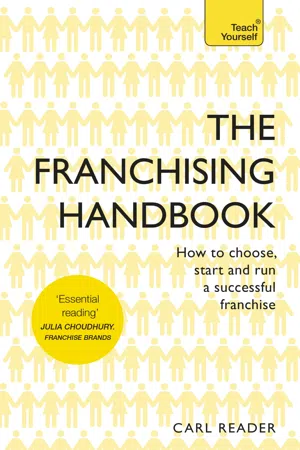
Most small business books focus on what it takes to start a small business, and not what it takes to start a franchise. At best, these books might allocate a single chapter to the concept of franchising, and at worst the author presumes that franchises are the same as any other business start-up. The world of franchising has its own nuances, and advice that works for 99% of start-ups would not apply to franchising. In fact, well-meaning advice can often be detrimental to potential franchisees.This book is focused on making sure that potential franchisees are aware of the specific journey ahead of them. As franchising is a two-way business arrangement, it includes exactly what franchisors are looking for, what can or cannot be negotiated with a franchisor, and how best to present yourself to ensure that you win the franchise you want.
- 352 pages
- English
- ePUB (mobile friendly)
- Available on iOS & Android
eBook - ePub
About this book
Information
Part One
Introduction
1
What is a franchise?

In this chapter you will learn:
• The history of business format franchising, both in the UK and internationally
• The types of business that are franchised
• The key elements of a franchise
• Why a business might decide to franchise.
First, thank you for picking up this book! There is a lot of confusion and mystique around franchising, and due to the way that franchising has developed over the years it’s safe to say that there really are elements of ‘the good, the bad and the ugly’ in the franchise world. Having said that, once you are aware of what to look out for, purchasing a franchise can be a life-changing event for all the right reasons, and can set you on the path towards financial freedom.
Many people have heard of franchised brands, such as McDonald’s and Subway; however, they might be surprised as to the sheer scale of franchising in both the UK and worldwide.
In the UK there are 901 active franchisors and 44,200 franchised outlets (NatWest/bfa 2015 Franchise Survey). The industry is responsible for employing 621,000 people, and makes a £15.1 billion contribution to the nation’s gross domestic product (GDP).
On a worldwide basis, franchising is even more popular, with nations such as the US and Australia embracing franchising as a generally accepted part of their entrepreneurial culture. Even countries coming out of crisis are adopting franchising – for example, I’ve been involved in assisting a contingent of Tunisian professionals who are looking to build a professional approach to franchising following the Arab Spring.
In this book you will find various case studies and advice pieces from experienced franchisors and franchise experts. Some of these cover similar areas, and with good reason; some things are so important that they’re worth hearing several times over.
Everyone who has contributed to this book is someone who I have some experience of working with, and in turn trust to provide ethical, honest and impartial advice. Their input is perhaps the most valuable thing that you can take from this book – consider their tips to be a collection of the best-possible advice that you can follow to ensure that you choose and run a successful franchise!
The history of franchising
The first signs of franchising can be traced back to feudal England, when lords allowed peasants certain rights on part of their land in return for a fee (to perform tasks such as operating wells for water provision or running a market, for example). Components of a franchise system could also be found in the provision of resources for an army by local lords and chiefs in return for tax-collecting privileges.
Many years later, franchising became more entrenched in the UK with the advent of the tied pub system. Following the introduction of legislation making it very expensive to keep and maintain a public house in the 18th century, licensees began to struggle to operate successfully. Recognizing that it was in their interests to have a secure and stable market for their products, brewers began to offer publicans the opportunity of financial support in return for exclusivity over what was sold in the pub. Thus a familiar system – that remains widely used in the licensed trade today – was born.
The origins of franchising as it’s come to be known and defined today can be clearly pinpointed to one man: Isaac Singer. After the American Civil War in the 1860s, Singer had achieved the ability to mass-produce his famous sewing machines, but had no economically viable way of repairing and maintaining them across a country as geographically vast as the United States.
He began to license out servicing and repairs to local merchants around the country, who were later permitted to become regional salesmen for the machines too. Singer’s use of a contract for this arrangement introduced the earliest form of franchise agreements, and the first modern franchise system was born.
Over the following century, forms of franchising became more widely used in the US as a way to standardize products and standards from one coast to another. First was the car dealership model pioneered by General Motors in the early 20th century, granting exclusive rights and territories; then oil companies and grocery stores began to take advantage of a business model that offered them a route of fast growth towards national distribution with reduced risk.
After the Second World War franchising grew rapidly, propelled by companies looking to expand quickly. Soft drinks giants like Coca-Cola and Pepsi couldn’t operate economically US-wide with such a high water content in their products and expensive transportation relative to its cost, so they developed a franchise system whereby franchisees would carbonate and add water to the companies’ centrally manufactured and distributed highly secretive syrup recipes, bottling and selling it locally.
This was the start of ‘business format franchising’ as we now know it; offering a turnkey package from franchisor to franchisee in many instances, it was firmly established as a distinct business model and proven system by the 1950s.
The huge growth in this modern system of franchising is attributed to milkshake machine salesman Ray Kroc who, while visiting San Bernardino in California, frequented a popular and busy drive-thru restaurant that had bought his machines – which was owned and run by the McDonald brothers… He opened the first restaurant in their name in Des Plaines, Illinois and purchased the brand outright in 1961.
In the 1950s and 1960s the popularity of franchising really took off, in tandem with huge growths in population, economic output and social change, and began to appear internationally including in the UK for the first time. Catering companies led the way.
Amongst the earliest practitioners in this country was food giant J Lyons & Co., who franchised the hamburger chain Wimpy in 1955 as well as ice-cream brands Lyons Maid and Mr Softee in the 1950s. ServiceMaster, still a huge international franchise business today, began franchising in the UK in 1959. By the mid-1960s some of the largest fast-food brands had become well-established international franchises, led by McDonald’s and KFC.
This boom period in franchising was not to last long; by the 1970s franchising in the UK had slowed, partly in response to the faltering economy but more as a result of the damage done to its reputation by non-franchise systems such as pyramid schemes describing themselves as franchises; they were based around the handing over of money for a promised lucrative return on investment, which of course rarely came.
Despite still offering some very real opportunities, franchising was unfairly tarred with the same brush by many and its popularity waned.
Eight of the largest franchise brands in the UK at the time decided they needed to do something to differentiate their own ethical business practices from those companies with bad ones, and as a result in 1977 the British Franchise Association (bfa) was formed. The founding member companies were ServiceMaster, Dyno-Rod, Holiday Inns UK, Kentucky Fried Chicken, Wimpy International, Ziebart GB, Prontaprint and Budget Rent a Car.
With no previous set standards in the UK, the industry thus created its own regulatory body and accredited a company’s suitability for membership...
Table of contents
- Cover
- Title
- Contents
- Dedication
- About the Author
- Acknowledgements
- Praise for The Franchising Handbook
- Author’s note
- Part One: Introduction
- Part Two: Shortlisting
- Part Three: Selecting a franchise
- Part Four: Purchasing the franchise
- Part Five: Starting the franchise
- Part Six: Running a franchise
- Part Seven: Finding support
- Part Eight: Leaving a franchise
- Appendix 1: Top Ten Tips
- Appendix 2: Sample Franchise Agreement
- Copyright
Trusted by 375,005 students
Access to over 1.5 million titles for a fair monthly price.
Study more efficiently using our study tools.
Frequently asked questions
Yes, you can cancel anytime from the Subscription tab in your account settings on the Perlego website. Your subscription will stay active until the end of your current billing period. Learn how to cancel your subscription
No, books cannot be downloaded as external files, such as PDFs, for use outside of Perlego. However, you can download books within the Perlego app for offline reading on mobile or tablet. Learn how to download books offline
Perlego offers two plans: Essential and Complete
- Essential is ideal for learners and professionals who enjoy exploring a wide range of subjects. Access the Essential Library with 800,000+ trusted titles and best-sellers across business, personal growth, and the humanities. Includes unlimited reading time and Standard Read Aloud voice.
- Complete: Perfect for advanced learners and researchers needing full, unrestricted access. Unlock 1.5M+ books across hundreds of subjects, including academic and specialized titles. The Complete Plan also includes advanced features like Premium Read Aloud and Research Assistant.
We are an online textbook subscription service, where you can get access to an entire online library for less than the price of a single book per month. With over 1.5 million books across 990+ topics, we’ve got you covered! Learn about our mission
Look out for the read-aloud symbol on your next book to see if you can listen to it. The read-aloud tool reads text aloud for you, highlighting the text as it is being read. You can pause it, speed it up and slow it down. Learn more about Read Aloud
Yes! You can use the Perlego app on both iOS and Android devices to read anytime, anywhere — even offline. Perfect for commutes or when you’re on the go.
Please note we cannot support devices running on iOS 13 and Android 7 or earlier. Learn more about using the app
Please note we cannot support devices running on iOS 13 and Android 7 or earlier. Learn more about using the app
Yes, you can access The Franchising Handbook by Carl Reader in PDF and/or ePUB format, as well as other popular books in Business & Entrepreneurship. We have over 1.5 million books available in our catalogue for you to explore.