Creating a successful global product is complex. Why do some products survive or become reinvented? What makes a product loved by some and despised by others? What key issues were present when some of the most notable inventions and product designs occurred? Through interviews with successful product designers and inventors from around the world, and case studies of products from their local inception to their global success, The Future of Design will answer these important questions and provide a robust framework for activating innovative thinking that goes beyond Western approaches to creativity and innovation.
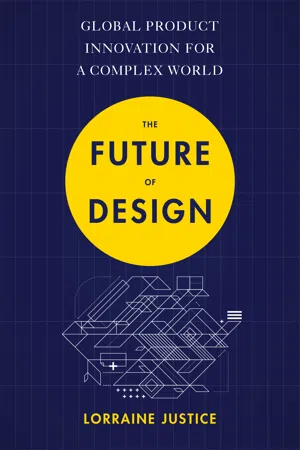
- 256 pages
- English
- ePUB (mobile friendly)
- Available on iOS & Android
eBook - ePub
About this book
Information
Topic
DesignSubtopic
Decision MakingCHAPTER 1
What Will Make a Global Product Successful?
It is not just about sales anymore. While there was a time when revenue was the only important measure of a successful global product, brands today have new corporate missions to do good things for the world, and in many ways their products are used to fulfill this promise. In this chapter, I will discuss the criteria for five of the oldest and most prestigious international product design competitions as an indicator of excellence and what makes a global product successful.
Many companies today have created or rewritten their mission statements to include their positive role in society and commerce. For example, Patagonia, a company that makes sports clothing and outdoor gear, has a mission with a philosophy that is integrated throughout the workplace: “Build the best product, cause no unnecessary harm, use business to inspire and implement solutions to the environmental crisis.”1 Another example is IKEA, a Swedish company that designs and sells furniture, kitchen appliances, and home accessories. IKEA’s mission is “to create a better everyday life for the many people.”2 They do this in part by keeping their prices low so people can afford their products.
Of course, revenue is still essential, but companies are building their brand value through positive social change that consumers appreciate. This trend of positive social change will increase in the future because it is an effective way for companies to build brand loyalty. Company ethics, environmental protection, and other cultural and social issues that affect local and global markets bring great visibility through public relations opportunities as well. Positive actions by companies help you feel good about buying something you want—or at least alleviate some of the guilt from making a purchase you might not need, knowing that someone else may benefit from the purchase.
It’s About the Experience
In their paper “Framework of Product Experience,” Paul Hekkert and Pieter Desmet, professors and pioneers in the area of design and emotion, tell us that user and customer experience is shaped by:
■ The characteristics of the user (e.g., personality, skills, background, cultural values, and motives)
■ Those of the product (e.g., shape, texture, color, and behavior)
■ The context (e.g., physical, social, economical in which the interaction takes place)3
Often a response to a product or service is “natural,” but much of your reaction may be because of our cultural, societal, or even religious values, the product itself, and the context. Hekkert and Desmet break it down so we can see that many aspects go into the user experience. The user, the product, and the context are all laden with beliefs that may sway the experience to satisfactory or unsatisfactory.
Brands rely on repeated satisfactory experiences over time to build brand loyalty. If your experiences with the same product fluctuate from good to bad, you will look for another product experience. Many people feel the same way about a product with embedded technology. The initial experience with the technology may be unsatisfactory or frustrating, so they are not willing to have that experience again.
One of the most significant changes of the past decade, and one that will increase, has been the creation of products and services that can be connected to the internet of things (IoT). These products (software, appliances, electronic devices, etc.) have increased the variety of both hardware and software, the paths of distribution, and the number of international markets in which the technology is sold. Such connectivity is likely to accelerate in the future but the question will be, “Is this useful, or just more superfluous technological application we don’t really need?” Companies in the future will need to explain why they used a particular technology because savvier consumers will want to know.
What are some of the top global brands?
In some ways, product categories established thousands of years ago have not changed. Tea, fruit, and spices (food and beverages); cotton, silk, and fur (clothing); gold and beads (accessories); and blue and white china (housewares) were some of the earliest-traded goods. Today, food and beverages (McDonald’s and Coca-Cola), clothing and accessories (Zara and Cartier), and decor-related items (IKEA) are all reflected within global companies with brands of significant worth.
In 2018, Forbes magazine published a list of the world’s 100 most valuable brands that had a presence in the United States.4 According to this list, the top 10 brands in order of value are Apple, Google, Microsoft, Facebook, Amazon, Coca-Cola, Samsung, Disney, Toyota, and AT&T. Other countries such Sweden, the UK, Italy, Japan, South Korea, and China are on the list with major brands (the US presence requirement meant China’s major brands Alibaba and Tencent were not on this list). Of these top 10, six are classified as technology companies, one is beverage, one is telecommunications, and one is automotive.5
As we will see in the next section, the top 10 brands in China, except for one alcoholic beverage called Moutai, are all heavily technology-based.
Top Chinese Brands
In his 2004 state address, Chinese Premier Hu Jintao spoke about improving the Chinese economy through increased activity in design and innovation, with the intention of creating top Chinese brands.6 This focus instigated activities related to design and innovation in every first- and second-tier city in China. New design programs in universities, innovation parks, design centers, and art enclaves began to emerge, signaling a new era for design and innovation, and serving as a base for brand creation.
By 2017, according to a study by Kantar Millward Brown for Brandz, the most valuable brands in China were:
1. Tencent (online sales), home of WeChat (social software technology)
2. Alibaba (online retail)
3. China Mobile (telecom)
4. ICBC (financial services)
5. Baidu (technology)
6. Huawei (technology)
7. China Construction Bank (financial services)
8. Ping An (insurance services)
9. Moutai (alcohol)
10. Agricultural Bank of China (financial services)7
The Chinese government understands that to increase the value of their national brands, they need to increase the quality of their product and service design. All major cities in China now have design firms and companies, such as China Bridge in Shanghai, which excel at design and consumer research in China. Because of the increase in product and service design companies, and an increase in user research and attention to branding, Chinese companies such as Haier (white goods), Lenovo (computers), and Xiaomi (phones) have increased the attractiveness and usability of their products and have all received global design awards.
Tracking Global Creative Health through Brands
In other parts of Asia, India (Tata automotive), Japan (Sony), and South Korea (LG) have been home to top global brands for decades. Other Asian countries such as the Philippines, Malaysia, and Singapore have popular brands in the food and beverage category.8
Some of the most recognized brands (not rated on revenue) in Africa were in the category of telecommunications (MTN Group, South Africa; Econet Wireless, Zimbabwe; and Globacom, Nigeria). One of the most notable brands in the apparel industry is Anbessa from Ethiopia.9
In Latin America, Corona (beverage) from Mexico is a strong brand. In Brazil, the cosmetics company called natura was mentioned because of its strong commitment to society and...
Table of contents
- Cover
- Title
- Copyright
- Acknowledgments
- Contents
- Introduction: The Future of Design
- Chapter 1 What Will Make a Global Product Successful?
- Chapter 2 Impacts on Product Success or Failure
- Chapter 3 The Design Process, Design Thinking, and Innovation
- Chapter 4 Attributes of Great Product Design
- Chapter 5 Spaces for Innovation
- Chapter 6 Supporting Design Teams
- Chapter 7 How to Evaluate Product Concepts
- Chapter 8 Growing a Global Product
- Chapter 9 Summaries and Conclusions: Design Reasoning with Insights
- Endnotes
- Lorraine's Work with Clients
- Index
Trusted by 375,005 students
Access to over 1.5 million titles for a fair monthly price.
Study more efficiently using our study tools.
Frequently asked questions
Yes, you can cancel anytime from the Subscription tab in your account settings on the Perlego website. Your subscription will stay active until the end of your current billing period. Learn how to cancel your subscription
No, books cannot be downloaded as external files, such as PDFs, for use outside of Perlego. However, you can download books within the Perlego app for offline reading on mobile or tablet. Learn how to download books offline
Perlego offers two plans: Essential and Complete
- Essential is ideal for learners and professionals who enjoy exploring a wide range of subjects. Access the Essential Library with 800,000+ trusted titles and best-sellers across business, personal growth, and the humanities. Includes unlimited reading time and Standard Read Aloud voice.
- Complete: Perfect for advanced learners and researchers needing full, unrestricted access. Unlock 1.5M+ books across hundreds of subjects, including academic and specialized titles. The Complete Plan also includes advanced features like Premium Read Aloud and Research Assistant.
We are an online textbook subscription service, where you can get access to an entire online library for less than the price of a single book per month. With over 1.5 million books across 990+ topics, we’ve got you covered! Learn about our mission
Look out for the read-aloud symbol on your next book to see if you can listen to it. The read-aloud tool reads text aloud for you, highlighting the text as it is being read. You can pause it, speed it up and slow it down. Learn more about Read Aloud
Yes! You can use the Perlego app on both iOS and Android devices to read anytime, anywhere — even offline. Perfect for commutes or when you’re on the go.
Please note we cannot support devices running on iOS 13 and Android 7 or earlier. Learn more about using the app
Please note we cannot support devices running on iOS 13 and Android 7 or earlier. Learn more about using the app
Yes, you can access The Future of Design by Lorraine Justice in PDF and/or ePUB format, as well as other popular books in Design & Decision Making. We have over 1.5 million books available in our catalogue for you to explore.