Do you want to start teaching a language online, be your own boss and be able to work from anywhere that has wifi? Do you want to make a difference in the world by using your language skills to empower people and give them the confidence they need to develop? This timely book covers everything needed to set up a successful online language teaching business, from creating the right mindset, tech and marketing, to designing products and services, finding students online, growing your business and more. More than a manual, it is also a rallying call for language teachers - or language teacher rebels - to share cultural values beyond the traditional classroom and encourage integration on a worldwide scale. An accompanying Language Teacher Rebel Toolkit, containing a comprehensive set of editable, effective and time-saving templates for all the essential documents needed to set up and run an online language teaching business, is available for sale at library.teachyourself.com. Including planners, email scripts and financial templates, this toolkit has everything you need to get organised and get teaching.
eBook - ePub
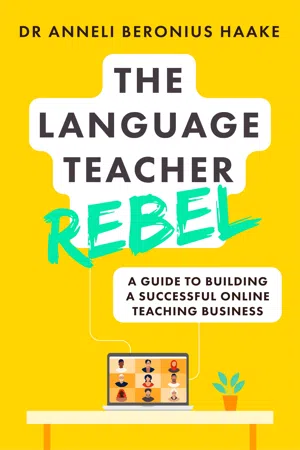
The Language Teacher Rebel
A guide to building a successful online teaching business
- 240 pages
- English
- ePUB (mobile friendly)
- Available on iOS & Android
eBook - ePub
The Language Teacher Rebel
A guide to building a successful online teaching business
About this book
Information
Topic
ÉducationSubtopic
Méthodes pédagogiques1
Why now is the perfect time to become a Language Teacher Rebel
Times have changed
In the past, being a language teacher meant working in a physical school or classroom environment. The school would advertise their courses and students would turn up and enrol in a course. If you were a private tutor, you could put up a note or leave a flyer somewhere, or maybe put an ad in a newspaper. A student would contact you and you would either arrange to go to their home, or they would come to yours, or to another physical place where you would have your lessons. Teaching involved commuting, and you were restricted to finding students in the nearby area that were willing to travel to you, or vice versa.
This also meant that students who lived somewhere remote couldn’t enrol in courses or have lessons with a private tutor. Instead, they were restricted to audio courses (cassettes or CDs) or studying from a book. They were not able to have direct interaction with a teacher. The digital era has changed that. Geographical boundaries have been broken down.
Today, you can sit at home in Spain and teach someone in Canada. You can collaborate with others through the internet, log on to your teaching schedule, send emails, design and post content, check your bank account, record and upload videos, all from your smartphone or laptop.
The Digital Age has given us incredible opportunities to create content. You can publish articles online, create digital images and visual aids, record videos on your smartphone and upload them to the internet, all for free. You can host live shows on social media platforms for free. You can create podcasts and broadcast them for free. As a Language Teacher Rebel, you’re not just a teacher. You’re also a business owner, an artist, a designer and a presenter. By using a smartphone, a laptop or a tablet, together with an internet connection, it’s possible to reach people from almost every corner of the world.
But don’t people just self-study now?
Some think that there’s no place for teachers any more. Anyone can self-study, right?
Students today have endless opportunities to learn a language, compared to before. They can use apps, watch online videos, listen to podcasts and audio books. They can join online community groups and connect with others learning the same language. They can follow hashtags and accounts on social media platforms about the language they’re studying. They can watch TV and movies and listen to radio. They can join language-learning webinars. And they can do all of this from home, while sipping a cup of coffee. Or at their workplace. Or even while travelling. It’s really quite incredible to think about the many opportunities that students have today, even compared to just 10–15 years ago.
Yet, most students still want to be taught by a teacher. Why? The answer can be narrowed down to three things: (1) structure, (2) motivation and accountability, and (3) personal interaction.
Let’s start with structure. Just because we have access to a lot of free information on the internet doesn’t mean we know how to structure a process. This is especially true for a longer process such as language learning. Watching short video clips on a particular grammar point may help to solve a particular problem, but it does not help to structure a learning process to guide a student who wants to go from level A1 to A2, for example. Self-study requires students to essentially create their own study plan, which is a huge undertaking for most people. It also takes a lot of time that most people don’t have.
Self-study can certainly work for some people, but many students struggle with motivation from time to time. Having someone that they can lean on and talk to (whether it’s about their lack of motivation or a particular language challenge) helps maintain interest in their study. It also helps create a sense of accountability. If you self-study, it’s easy to find excuses for not putting in the work needed to reach a goal. Showing up in front of a teacher creates an emotional stake, where the student wants to show that they have ‘done their homework’.
Interestingly, it seems that the more digital our world becomes, the more we crave interaction with others. Perhaps it’s not surprising; human connection is vital for us as a species. Interacting with a language teacher is not only good for developing pronunciation and conversational skills. It also means having a human connection with someone who supports, cheers you on and motivates you. The way I see it, it’s more like having a mentor, a guide and a fellow human being.
Today, we are literally drowning in information. We have access to so much information online at the click of a button that many find it overwhelming to sift through it all. Information is free and easily accessible, yet many people are time-poor and what they want most of all is help with how to implement techniques, rules and skills. This is where you as a teacher, and soon-to-be Language Teacher Rebel, come in.
What if I don’t have an online presence?
You may think that it’s too late to start teaching online. You might not have any social media channels set up. You might not have an email list. You see other teachers on social media platforms with large audiences, but you have never uploaded or posted to any platform, nor run an online live session. Is it too late? No. It’s not too late. In fact, we are only just beginning to see the effects of the digital revolution.
Business expert Daniel Priestley argues that there’s usually a time lag of 20–30 years before technology catches on. TV was invented in the 1930s, but it wasn’t until the 1950s that it became more widely used. The first computers came out in the late 1960s, but it took until the 1980s before people started to buy computers for their home. Tim Berners-Lee invented the World Wide Web in 1989, but it took another 20 years before a significant number of people started to use it.
One in ten households in the UK, USA and the EU region did not have access to the internet at home in 2018–20, and only just over 50 per cent of the world’s population currently has internet in their homes. In 1998, Google made the internet searchable. Social media emerged in 2004, and cloud computing in 2008. We are not yet seeing the full effects of search engines, social media and cloud computing. They will probably not be seen until at least 2030. So no, it’s not too late. Far from it.
So how do you do it?
You might be wondering how you can become a Language Teacher Rebel. Do you need any particular training? Any specific work experience?
The answer is no.
All you need is a language that you can teach, an entrepreneurial mindset (or an interest in developing one), and a passion for helping people.
I come from Sweden. Although I was born in Stockholm, I grew up in rural Sweden, three hours outside of Stockholm. Before I started teaching, I only really had temporary jobs. I worked in over ten different areas, including working as a nanny, picking strawberries, helping set up a youth centre, as a supermarket cashier and as a family planning educator. I studied at university throughout most of my 20s, but not continuously.
My education and job experience are varied, to say the least. Throughout this time, I never really felt that I fit in. I always had an urge to develop, create and change things. It was like an itch that I was rarely allowed to scratch.
I took six months off after completing my bachelor’s degree to ‘go and see about a boy’, so to speak. The problem was that he lived in New Zealand at the time. I managed to land a Swedish project-based job, working remotely. This was in 2003, and the internet connection was appalling, but it gave me the first taste of working remotely while travelling. The enormous sense of freedom of being in a different country while doing a job that I found interesting was worth a lot.
Six months later, my boyfriend and I ended up in the UK. I worked on a temporary basis for a year, but I yearned for freedom again and applied to do a PhD. However, as I got a better insight into the hierarchies of university departments, I began feeling it wasn’t for me. Although I absolutely loved teaching and researching, I found it too restrictive and too fixed geographically. Would I have to apply for a position somewhere in a department, spend most days every week there, and only travel during holidays and for the odd conference?
Two years into my PhD in 2005, I needed a job so I could make some money. I tried my luck at a local betting shop, as I figured the hours were better than working in a pub. I only lasted two months.
A neighbour, who happened to be a German language teacher in a local school, casually said one day when I was complaining about the situation: ‘Why don’t you do something with your Swedish skills?’ The thought had never crossed my mind. I lived in a medium-sized town in central England. Who would want to learn Swedish here?!
I found a website where language teachers could advertise their services, and I gave it a go. I got my very first student, a man living locally who was planning to move to Sweden in the future. I got a couple more students who lived about an hour from me but were happy to travel. I taught them in my house.
Then something happened. A man from Pennsylvania contacted me through the language-teaching website wanting lessons. He said he could phone me, so we started lessons over the phone. At the same time, Skype started to become more popular. I was already using it to contact friends and family in Sweden; what if I used Skype to teach students who didn’t live near me? Could this be an opportunity? I started to suggest Skype in my adverts, and it took off.
In 2010, I had about 15 students a week, and I decided it was time to set up a website. A year later, I found an online booking system that I plugged in to my website and as of now I have taught over 20,000 hours online over 15 years. I have written a new version of Teach Yourself Complete Swedish. I have given talks at language conferences and I have been featured on BBC Two.
What I am trying to say is that your journey does not have to be straightforward. You may be a language teacher. You may have experience with sales, marketing and IT, you may not. You may just find yourself in a situation where you want to start something of your own, where you decide how you want to work. Where you can help people and share culture and language with others. All your past experience will be useful on your new Language Teacher Rebel journey. And you can learn the rest along the way.
A day in the life of a Language Teacher Rebel
So what’s life like as a Language Teacher Rebel? Of course, it completely depends on you and how you design what suits you and your students best. Here is what my work-week looks like at the moment.
On Monday I usually have my first lesson at 7 a.m. I know this is quite early, but it’s a good hour to offer, as it’s 8 a.m. in Sweden and many students like having an hour of language learning before they start work. Because I am often at home, I usually get up at 6.30 a.m. Or sometimes even 6.45 a.m., if I am lazy. I get dressed in something comfortable and go to the kitchen and make myself a cup of tea. At 6.55 a.m. I glance at my booking system on the laptop in my office to see who has booked the first hour, and check their lesson log. This is where I wrote down what we did last lesson and what homework they have been given, so I can seamlessly begin the next lesson. I usually give two lessons, then have an hour’s break at 9 a.m. I might do some yoga and have some breakfast. It’s nice to have already worked two hours at this point, and also to get a break to stretch a bit and exercise.
I then teach again from 10 a.m. to 12 p.m. Afterwards I have a three-hour break until 3 p.m. where I cook food, watch TV or maybe go for a walk into town. In the summer, I often sit outside in the garden, listening to a podcast. I normally teach another two hours, followed by a free hour between 5 and 6 p.m. I round off the day with three more lessons in the evening, finishing at 9 p.m. If I’m fully booked, this is a long day, and I do the same on Tuesdays.
I have chosen this pattern for a reason. I have opted to compress my hours, so I often teach long hours on Mondays and Tuesdays. On Wednesdays, I start at 8 a.m. and finish at 7 p.m. and have a two- or three-hour lunch break. I then spend Thursdays and Fridays doing other projects, admin, or just taking some time off. In the past, I have also taught shorter days five days a week. But I have to admit, I really like how this pattern allows me to focus on my teaching during the first half of the week, and then have lots of freedom and flexibility on Thursdays and Fridays. I may or may not change my schedule in the future. The important thing is that I can choose how I want to work.
If you could choose your own hours, how would you prefer to design your days? When you have your own business, you can choose. You don’t have to work 9–5 Monday to Friday unless you really want to. Would you teach five days a week? Or less? Would you teach during the day? Evenings? Would you teach in longer blocks, or would you space your lessons out? What else would you like to make time for? Family commitments? Exercise? Sleeping? Travelling? Art? Developing new projects? Reading?
Extreme flexibility
When you’re a Language Teacher Rebel, you can set your own hours. You can also choose to move hours around. You might wonder how this works for the students. Won’t they be expecting you to have the same hours available every week? Some do, but many don’t. Flexibility is the reason they come to you for language lessons. Many will come because they can’t attend a traditional language school. They might travel for work. They may live far away from a language school. They may work irregular hours, or work from home. They appreciate the flexibility that you offer, and the vast majority will have no problems with you shifting hours and days around occasionally.
I usually spend a month in California twice a year (because of my husband’s work) and I continue to teach while I’m there. The time difference between Europe and California is 8–10 hours, so I teach afternoons and evenings (CET) during these periods. I would not be able to do this if I wasn’t a Language Teacher Rebel. It would be impossible for me to have this level of flexibility if I was constrained to a classroom or a language school. Many students also find it interesting and it gives us even more to talk about.
A couple of times a year, I spend a week or two in Sweden with family. Again, being a Language Teacher Rebel allows me to take my work with me. Because I have chosen to work compressed hours, I can go to Sweden for a week and work Mondays to Wednesdays. I then have four days off with family and friends without having to take any time off. I can use the fact that I’m in Sweden during these lessons to show where I am staying. Some of my students have never been to Sweden, or rarely visit, so they love seeing the interior of a typical Swedish home. For me, it means a lot to stay connected to my native country and be able to work there. This would be extremely difficult to do if I had to teach in one particular physical location.
At home, my husband and I regularly board dogs. We are both obsessed with dogs, but because we travel regularly, we haven’t had a dog of our own for a while. Because I work from home, we are able to board dogs that need looking after from time to time. As I am writing this, I am sitting on my sofa with a blanket over my legs, a cup of coffee next to me, and a brindle Mastiff-Staffy cross snoozing next to me. It’s my idea of heaven.
Th...
Table of contents
- Cover
- Title
- Table of Contents
- Meet the Author
- Acknowledgements
- How this book works
- Introduction
- 1 Why now is the perfect time to become a Language Teacher Rebel
- 2 Mindset
- 3 Plan and design your products
- 4 Finding your micro-niche
- 5 The Five-step Language Teacher Rebel Roadmap
- 6 The Quick Tech Set Up
- 7 The Quick Marketing Material Creation Blitz
- 8 Early Growth – Evolving and Engaging
- 9 Developing and Investing
- 10 Flourish with Momentum
- 11 Teaching online – Best practice
- Checklist
- Glossary
- References
Trusted by 375,005 students
Access to over 1.5 million titles for a fair monthly price.
Study more efficiently using our study tools.
Frequently asked questions
Yes, you can cancel anytime from the Subscription tab in your account settings on the Perlego website. Your subscription will stay active until the end of your current billing period. Learn how to cancel your subscription
No, books cannot be downloaded as external files, such as PDFs, for use outside of Perlego. However, you can download books within the Perlego app for offline reading on mobile or tablet. Learn how to download books offline
Perlego offers two plans: Essential and Complete
- Essential is ideal for learners and professionals who enjoy exploring a wide range of subjects. Access the Essential Library with 800,000+ trusted titles and best-sellers across business, personal growth, and the humanities. Includes unlimited reading time and Standard Read Aloud voice.
- Complete: Perfect for advanced learners and researchers needing full, unrestricted access. Unlock 1.5M+ books across hundreds of subjects, including academic and specialized titles. The Complete Plan also includes advanced features like Premium Read Aloud and Research Assistant.
We are an online textbook subscription service, where you can get access to an entire online library for less than the price of a single book per month. With over 1.5 million books across 990+ topics, we’ve got you covered! Learn about our mission
Look out for the read-aloud symbol on your next book to see if you can listen to it. The read-aloud tool reads text aloud for you, highlighting the text as it is being read. You can pause it, speed it up and slow it down. Learn more about Read Aloud
Yes! You can use the Perlego app on both iOS and Android devices to read anytime, anywhere — even offline. Perfect for commutes or when you’re on the go.
Please note we cannot support devices running on iOS 13 and Android 7 or earlier. Learn more about using the app
Please note we cannot support devices running on iOS 13 and Android 7 or earlier. Learn more about using the app
Yes, you can access The Language Teacher Rebel by Anneli Beronius Haake in PDF and/or ePUB format, as well as other popular books in Éducation & Méthodes pédagogiques. We have over 1.5 million books available in our catalogue for you to explore.