The global economy—the flattened world—demands a new type of leadership: collective and collaborative, where the solutions and vision are co-created by the team. Yet the practical application of collective leadership remains a mystery to many practicing executives and managers. The Leaderful Fieldbook helps change agents—from managers and trainers to consultants and coaches—create the conditions for transitioning from conventional to more collaborative forms of practice. Everyone is capable of participating in leadership, and not just sequentially, but collectively and concurrently—that is, all together and at the same time. The Leaderful Fieldbook presents a fresh and successful approach to leadership development across organizations.
eBook - ePub
The Leaderful Fieldbook
Strategies and Activities for Developing Leadership in Everyone
- 224 pages
- English
- ePUB (mobile friendly)
- Available on iOS & Android
eBook - ePub
The Leaderful Fieldbook
Strategies and Activities for Developing Leadership in Everyone
About this book
Information
Chapter One
Individual-level Change
THE PREMISE OF STARTING AT THE INDIVIDUAL LEVEL is that selfleadership skills are typically necessary before teams or organizations acquire the readiness for democratic leadership. One must become comfortable first in his or her own inner world and aware of his or her capabilities. When undertaking a process of self-discovery, we need to appreciate the mixture of life experiences that have led to our present way of being. Many of us need to find an inner purpose to guide our everyday activities. Others need to become more aware of the gap between our intentions and our behavior. This requires both an ability and a willingness to retrace our reasoning and the behavioral steps that have led to our actions. It requires the courage not only to examine ourselves independently but also to open our experiences to trusted others.
The work of the coach is to help individuals disclose in private to themselves and in conversation with others who they are and what meaning they bring to the world and to themselves. Coaching thus stems from its practice as a medium for reflection and learning. The parties—coach and learner—commit to exploring the social, political, and emotional reactions that might be blocking an individual’s operating effectiveness. Otherwise confidential issues—such as working relationships with other colleagues, strategic business issues, or the participant’s own growth and development—are given a forum for open consideration. Individuals get a rare opportunity to think out loud and receive constructive feedback on critical and even undiscussable problems.
The six activities in this chapter are designed to help change agents use and improve upon their coaching skills to work with learners to discover their inner selves.
The first activity, Setting My Personal Learning Goals, will help learners acquire a set of challenging development goals for mastering self-leadership as a first step in developing leaderful behavior.
The second activity, Completing the Leaderful Questionnaire, will help learners develop a baseline for their current views about leaderful practice. They score themselves on the “leaderful questionnaire” and are then invited to reflect on their scores with their coaches and mentors.
The third activity, Draw-a-Horse, extends beyond learners’ perceptions of leaderful practice by engaging them in a simulation invoking potential leaderful behavior.
The fourth activity, Squash, gives learners an opportunity to detect their initial mindset about the meaning of leadership by reflecting on a decision they would make in a power-dependent scenario called “Squash.”
The fifth activity, Group Citizenship Behavior, assesses the learner’s citizenship behavior as it relates to his or her commitment to a group or team.
The sixth activity, The Nine Shapes, gives learners a chance to slow down and reflect on a pressing issue by examining it from multiple perspectives.
Personal Learning Goals
Personal learning goals constitute one way to conduct an initial examination of those elements of one’s life that infuse it with meaning or accomplishment. In this activity, coaches work with clients and colleagues to produce a set of meaningful goals that capture the client’s hopes and aspirations for personal self-discovery. Often, a goal concerns a change in some personal circumstances or requires rearranging a situation to be more aligned with one’s intentions.
The development of personal learning goals is an evolving process. The learner’s first goals may be superficial, reflecting others’ expectations or representing aspirations already being accomplished. Over time and with the assistance of a coach and of significant others, the learner can learn to set more challenging goals that may profoundly strike at the heart of what really matters—what can truly motivate him or her to reach for deeper commitments.
The first activity is designed to help learners develop such goals and master self-leadership, a key step in the development of leaderful behavior.
ACTIVITY 1.1
Setting My Personal Learning Goals
The steps in this activity help gradually narrow the selection of meaningful goals, leading ultimately to the preparation of an individual development plan to create ongoing dialogue between the learner and coach or between the learner and others, both in the work environment and elsewhere, who are committed to the learner’s leaderful development.
STEP 1: The first set of questions is designed to establish the context for goal development. Before working explicitly on any goals, learners should be encouraged to reflect on the conditions that prepare them most auspiciously for learning:
1. In what circumstances do you learn best:
• By doing and taking action?
• By talking out loud with others?
• By listening?
• By getting feedback from others?
• By reading?
• By surfing the Web?
• By observing others?
2. What projects or experiences provide you with the greatest opportunity to learn?
3. The concept of a learning style, popularized by the work of peter Honey and Alan Mumford7 and in particular their Learning Styles Questionnaire, refers to one’s preferences in the way to approach learning. What learning style do you tend to use to predispose you to maximal learning? Are you an
• Activist: You are inclined to involve yourself fully in new experiences and are willing to try anything once.
• Reflector: You like to stand back and ponder experiences, observing them from different perspectives.
• Theorist: You prefer to work with logic, concepts, and theory, often using a step-by-step approach, asking if things make sense.
• Pragmatist: You’re interested in trying out ideas to see if they work, thus you tend to act fast and move from one thing to the next.
4. How might you change your script or use role reversal to try a new way to learn? For example, if you tend to use logic to work through most problems, consider examining your feelings or values as a basis to formulate your next decision and examine any differences from what would have been derived from the theoretical perspective.
5. In order to make room for more learning, consider these classic questions:
• What will you stop doing?
• What will you keep doing?
• What will you do differently?
• What will you start doing?
STEP 2: The next set of questions helps learners orient their goal development and, in so doing, will help them select the most challenging and useful goals.
1. Which goals will stretch you the most?
2. Which goals will help you confront your immediate personal, professional, and career challenges?
3. Which goals will take you most out of your comfort zone?
4. Which goals might help you overcome patterns that have interfered in the past with your work and life satisfaction?
5. Which goals will help you increase a needed knowledge or skill area?
6. Can you name goals that are specific, measurable, challenging, and yet attainable?
STEP 3: Now select three to five specific development goals that you would like to work on. They should have personal, professional, and/or career relevance; for example: “I wish to become more sensitive to how I come across to other people, especially to reduce my proclivity to talk over others who wish to get a word in.”
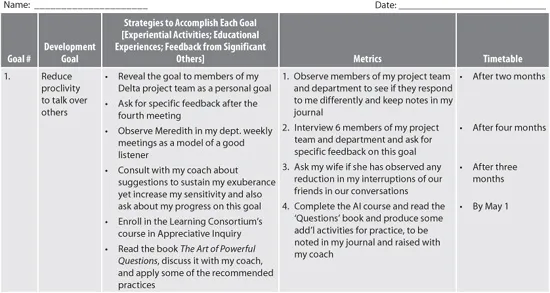
Using the Personal development plan prototype provided in Figure 1.1, list your goals and consider the strategies that can be used to accomplish each goal:
• Experiential activities. Reflect on some challenging experiences, work assignments, or projects that might broaden and stretch your goals. How might particular work tasks or projects allow you to try out new knowledge or behavior and expose you to new challenges, people, or ways of doing things?
• Educational experiences. Supplement your on-the-job activities with formal courses, readings, conferences, or other professional experiences to provide you with foundational and background information or with more advanced knowledge.
• Feedback from significant others. Consult not only with your coach but with others who possess the skills you wish to develop or who can reliably observe you and provide objective feedback on the development of your goal. Find opportunities to observe them. Interview them about their own successes and challenges. Share with them your development goals and periodically solicit their feedback on your attempts to accomplish them.
STEP 4: Incorporate metrics and timetables.
• Metrics represent specific criteria—quantitative and qualitative—to help you and your coach know whether your development goals are or have been achieved. They provide a gauge to accomplishment as well as a basis for feedback exchange. A quantitative metric may be the number of times a new behavior has emerged in one’s communications repertoire. A qualitative metric may constitute the manner—such as through nonverbal expression—by which one augments one’s listening acuity and sensitivity.
• Timetables, where appropriate, point to a target date when the respective goal (or stages of goal accomplishment) may be accomplished and suggest opportune times when coaching sessions may be called for.
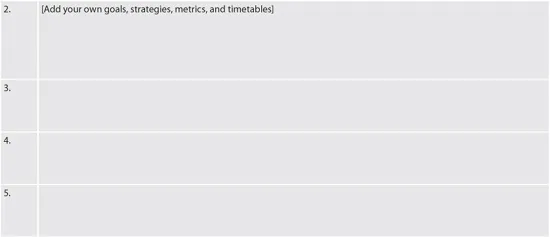
Figure 1.1, the personal development plan, lays out the aforementioned steps. The figure may also be adapted and entered in one’s journal. Note that the first goal has been filled in as an example.
FIGURE 1.1
Personal Development Plan
Leaderful Development
In Activity 1.2, learners are asked to complete the Leaderful Questionnaire to develop a baseline of where they stand on the four tenets of leaderful practice—the Four Cs—concurrent, collective, collaborative, and compassionate leadership. The questionnaire both quantitatively and visually measures one’s tendencies toward either traditional leadership or leaderful practice and preferences in between.
The coach should let learners know that it is impractical to expect high scores on each of the Four Cs. However, lower scores might suggest areas for subsequent goal development, for journal reflection, and for dialogue with one’s coach or learning team. Once a baseline score has been acquired, the learner should be encouraged to return to the questionnaire at a subsequent date to see if and where scores have changed over time, leading to further reflection and dialogue.
ACTIVITY 1.2
Completing the Leaderful Questionnaire
Turning to the questionnaire in Figure 1.2, please mark where you stand on the twelve leadership views presented, using the scale of 1 to 5. Circle the number 1 if you completely agree with the left endpoint, 5 if you completely agree with the right endpoint. Values 2 and 4 suggest you somewhat agree with the endpoints, and 3 would mean that you are in between or neutral. There is no correct answer; the questions merely attempt to characterize your leadership predispositions.
When you have completed each item on the Leaderful Questionnaire, score your answers using this scoring chart.
Scoring Chart
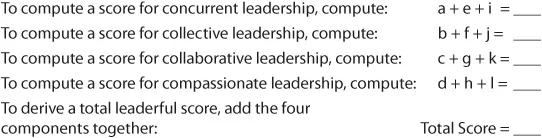
FIGURE 1.2
The Leaderful Questionnaire*
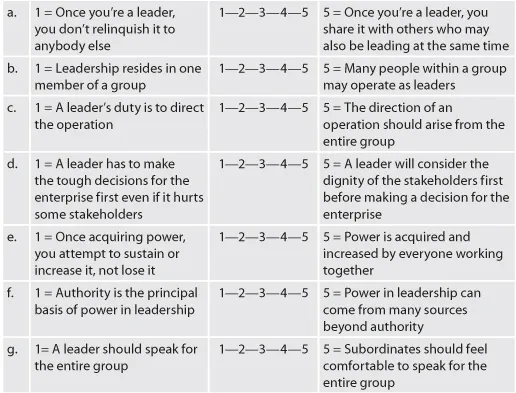
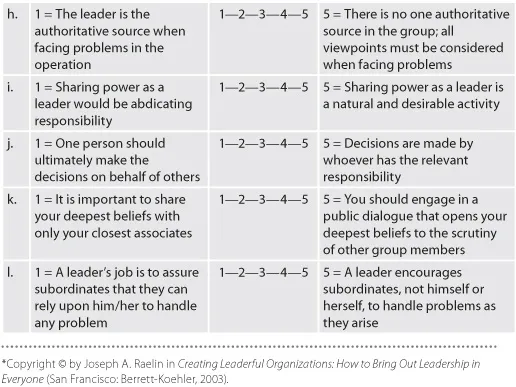
You can draw interpretations for these scores for the individual components as well as for the total score.
For the individual components:
• If your scores are < 9, you are inclined toward traditional leadership.
• If your scores are > 9, you are inclined toward leaderful practice.
For the total scor...
Table of contents
- Cover Page
- Title Page
- Copyright Page
- Contents
- List of Activities & Cases
- Foreword by John Foster
- Introduction
- Chapter 1 Individual-Level Change
- Chapter 2 Interpersonal-Level Change
- Chapter 3 Team-Level Change
- Chapter 4 Organization-Level Change
- Chapter 5 Network-Level Change
- Afterword
- About the Author
- About the Contributors
- Footnotes
Trusted by 375,005 students
Access to over 1.5 million titles for a fair monthly price.
Study more efficiently using our study tools.
Frequently asked questions
Yes, you can cancel anytime from the Subscription tab in your account settings on the Perlego website. Your subscription will stay active until the end of your current billing period. Learn how to cancel your subscription
No, books cannot be downloaded as external files, such as PDFs, for use outside of Perlego. However, you can download books within the Perlego app for offline reading on mobile or tablet. Learn how to download books offline
Perlego offers two plans: Essential and Complete
- Essential is ideal for learners and professionals who enjoy exploring a wide range of subjects. Access the Essential Library with 800,000+ trusted titles and best-sellers across business, personal growth, and the humanities. Includes unlimited reading time and Standard Read Aloud voice.
- Complete: Perfect for advanced learners and researchers needing full, unrestricted access. Unlock 1.5M+ books across hundreds of subjects, including academic and specialized titles. The Complete Plan also includes advanced features like Premium Read Aloud and Research Assistant.
We are an online textbook subscription service, where you can get access to an entire online library for less than the price of a single book per month. With over 1.5 million books across 990+ topics, we’ve got you covered! Learn about our mission
Look out for the read-aloud symbol on your next book to see if you can listen to it. The read-aloud tool reads text aloud for you, highlighting the text as it is being read. You can pause it, speed it up and slow it down. Learn more about Read Aloud
Yes! You can use the Perlego app on both iOS and Android devices to read anytime, anywhere — even offline. Perfect for commutes or when you’re on the go.
Please note we cannot support devices running on iOS 13 and Android 7 or earlier. Learn more about using the app
Please note we cannot support devices running on iOS 13 and Android 7 or earlier. Learn more about using the app
Yes, you can access The Leaderful Fieldbook by Joseph Raelin in PDF and/or ePUB format, as well as other popular books in Business & Management. We have over 1.5 million books available in our catalogue for you to explore.