"THIS IS ONE OF THE MOST POWERFUL BOOKS EVER WRITTEN ABOUT LEADERSHIP." Adam Grant, #1 New York Times bestselling author of THINK AGAIN and host of the TED podcast WorkLife *** THE SUNDAY TIMES HARDBACK NON-FICTION & BUSINESS BESTSELLER ***
*** P ORCHLIGHT AWARDS: BEST LEADERSHIP & STRATEGY BOOK *** The Promises of Giants is for anyone who aspires to make a difference. Over fourteen promises, it intertwines personal anecdotes with the latest research to provide practical, proven tips and strategies to empower you to maximize your own potential and inspire others. It is a how-to guide for winning, rooted in the belief that the most unlikely of people, in the most improbable of circumstances, can become extraordinary. We have never needed people with the skill and will to collaborate to create a better world more than now. We need people who are willing to fill the leadership void. People who will embrace the influence they have. People who believe in improving society and workplace culture - not only because it makes life better, but because it is proven to yield positive results. We need more leaders. SEE WHAT REVIEWERS ARE SAYING ABOUT THE PROMISES OF GIANTS: ????? "A truly outstanding book" ????? "An absolutely wonderful book" ????? " I have no words that would adequately express my gratitude to John Amaechi OBE for writing such an amazing book"
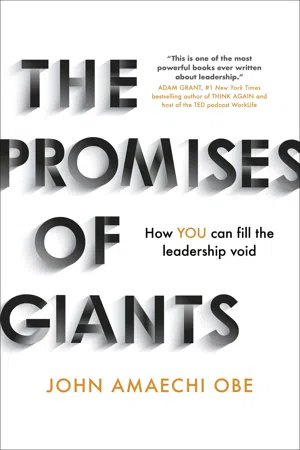
eBook - ePub
The Promises of Giants
How YOU can fill the leadership void --THE SUNDAY TIMES HARDBACK NON-FICTION & BUSINESS BESTSELLER--
- 240 pages
- English
- ePUB (mobile friendly)
- Available on iOS & Android
eBook - ePub
The Promises of Giants
How YOU can fill the leadership void --THE SUNDAY TIMES HARDBACK NON-FICTION & BUSINESS BESTSELLER--
About this book
Information
CHAPTER 1
I Promise to View Myself Critically, But Not Cruelly
When was the last time you were lost? Truly lost, wondering, “Where in the heck am I, and how do I get where I’m going?” Pulled over in the breakdown lane lost, rifling through the road atlas you keep in the glove compartment. Or wandering through an unfamiliar neighborhood, craning your neck to make out unfamiliar names on unfamiliar street signs. That kind of lost.
I suspect it’s been a while—especially if you’re old enough to have experienced a physical road atlas at all! These days, you’re more likely to have your head down in that situation, eyes glued to your smartphone. Keep it charged, and you will never be lost. It always shows the way.
We value our navigation apps because they direct us to wherever we want to go, using the swiftest and most efficient route. But we take for granted their true genius—the ability to, without any effort or input on our part, identify precisely where we are on this Earth. Where am I right now? A paper map will show all of the roads that lead to your destination. But if you don’t know where you’re starting from, that paper map is useless. Knowing your current location is key to routing the path forward.
Likewise, knowing yourself intimately and objectively is a vital first step toward realizing your potential as a person and as a leader. You cannot grow without an accurate understanding of who you are and where you’re starting from, and there is no app for that. Finding your way to the best version of yourself—as an influencer, contributor, colleague, family member, friend, or leader—requires persistent effort and constant introspection. Because, while you may find yourself in familiar and comfortable surroundings today, that can change quickly. The political, cultural, and economic landscape is shifting at a pace that affects us all. Any one of us could wake up to find that our jobs and workplaces have dramatically changed or even disappeared. And if that happens to you, your ability to fully understand yourself will be integral to how you proceed.
I first learned about the power of introspection from my mother, Wendy Amaechi, who remains the greatest influence in my life. In both of her full-time roles—single mother of three and family physician with a community surgery in the north of England—she embodied The Promises of Giants, both in word and deed. And the lessons she shared continue to resonate with me in new and unexpected ways—little Easter eggs of wisdom and benevolence that pop into my consciousness, seemingly whenever they’re needed most. It was Mum who helped chart my course to professional basketball and helped lay the foundation for my work now in the discipline of psychology.
I started playing basketball in 1987 when I was 16, developing basic skills and learning the rules on the fly during pickup at a small community college gym. While you might think it quite predictable that an enormous Black child would eventually gravitate toward sport and basketball specifically, it was not a fait accompli in my case. I was (and am) a nerd and a geek, who knew nothing about sport and cared even less. My introduction to the game was late and accidental, but it didn’t take me long to recognize my potential, given my physical advantages.
I didn’t love basketball per se. In fact, I never loved it and still don’t. But in those first weeks in the gym, I fell in love with the way I felt around the game, being embraced by peers who praised me and believed in me and wanted me on their team. Until then, my height had been a liability and the source of isolation and embarrassment. Suddenly, though, it was an asset. It had a practical value in that it connected me to people who viewed me as special and believed in my potential for greatness. It connected me to people who would laugh with me and not at me, people who pushed me to perform and supported me through failure in a way I had never experienced before. That was the initial allure.
On my first day of practice, I learned about the NBA. Although I didn’t know then what those letters stood for—National Basketball Association—I knew it was a place where I could be seen completely differently than my day-to-day experience suggested. While it was important that the NBA was a place where I could make a living playing basketball, at that time it more represented the idea of being paid to feel like I belonged—like I felt in that gym in Chorlton—rather than some path to riches in and of itself. I will admit to being seduced by the thoughts of eternal sunshine: after all, that’s all you saw in 80s US television—sunshine and heroes—and the notion of cheering crowds rather than jeering passersby was really compelling, but I was not thinking about strangers cheering me on and wearing shirts bearing my name. As a person who spent much of their day wishing to be invisible, I thought that a modicum of fame would be a tolerable exchange for sunshine and belonging, but I never lost sight of the fact that basketball wasn’t an end to itself; it would simply provide an alternative path to what I truly dreamed of as a child—financial security and a career as a psychologist.
My mother understood my early fascination with psychology and the way that people think and behave. But I left her in the dark about my burgeoning interest in basketball and the places it was taking my imagination. She knew I was spending time at the gym, but it could easily have been a passing phase and, frankly, she was probably just relieved that her lonely, chunky boy was finally exercising and alluding to “friends.” How could she know that a year from college and only months after touching a ball for the first time, her bashful bookworm was scheming to play in the NBA? She didn’t even know that there was an NBA.
I presented these intentions to Mum in a deliberate and dramatic fashion. She was lying in bed, where each night before sleep she would listen to The Archers, a long-running BBC radio drama about the trials and tribulations of a rural community. As I had on other occasions when there were important matters to discuss, I stood by Mum’s window and gazed toward the Victorian railway viaduct that dominates my hometown, Stockport. From outside, the industrial lights of a nearby office parking lot cast an amber glow into her room, which was otherwise dark. I enjoyed this spot because the backlighting of my profile created a brooding and serious theatrical effect.
“Mum …” I said, summoning a deep breath. “I’m not sure where I want to go to university.”
She did not rush to respond; for a time the space was filled only by the sounds of sheep bleating from the radio. Eventually, she replied, though with only modest enthusiasm. “Well … There’s Manchester University.”
Yes, I thought, Manchester University. Close to home, that’s fine. Let her go on. I said nothing.
“And then there’s Liverpool. And Leeds. And Birmingham.”
Good yes, perfectly fine institutions. Still, I said nothing. Let her sense my anguish through my silence—let her search for the source of consternation behind this stare.
“There’s even London. There are lots of choices in London.”
Yes, London. I’m moderately terrified of the IRA bombings I keep hearing about, but yes, there’s London. Go on, please.
She didn’t go on. I was still at the window and didn’t want to break character by shifting my gaze from the horizon. But the empty bleating of sheep was again the only sound in the room. The London offering was her last.
It is clear to me now that she was humoring me with these suggestions, buying me time to say whatever it was that I was working up the courage to say.
“But, Mother …”
I gathered myself and pivoted toward her, pausing again for effect.
“I’m not sure what country I want to go to for university.”
Ooh. I nailed it. The energy in the room changed immediately. Mum shifted in her bed and turned off the radio. I had her. And wait till she heard what was coming next!
“I think I’d like to go to university in America so I can play in the NBA. That’s the National Basketball Association.” I clarified the acronym casually as if I hadn’t just learned it myself. “The NBA is where the best basketball players in the world play.”
We sat with that information for what seemed like an eternity but was surely only a second or two. When Mum was sure that I’d finished speaking, she sat up, locked eyes with me, and stated quite plainly and without judgment, “That sounds challenging.” Queen of the understatement she was.
“How are you going to manage that?”
I pointed to the obvious first. I was Black, I was six foot eight, and I was still growing. In my world, which extended no further than Stockport, I had never seen anyone who even approached my size. So it stood to reason that my color and height alone would put me on the fast track. I considered myself a Black unicorn, and as such I would surely be in high demand.
“I’ll do a year of high school in the US first,” I proposed. Even unicorns need to develop their skills, after all. And I was realistic enough to appreciate how far I was behind the competition waiting in America. But it was nothing that couldn’t be overcome by a year playing at any random high school!
“Then I will get a scholarship to a top university”—as one does—“And then I’ll get selected in the draft—that’s what they call it, the NBA Draft—and I’ll make a lot of money.”
It was a watertight plan. Feeling confident, I sweetened the deal.
“And when I make it, I’ll buy you a new house!” Who could argue with that?
Mum was not impressed. She was not impressed. But her expression betrayed nothing, one way or another. I tried not to appear overeager for a response, any response. I looked back out the window, this time toward the office park on the opposite end of the bowl of Stockport.
“Son?”
YES? WHAT? YES?!?
“Would you recognize your soul in the dark?”
Would I recognize my soul in the dark? What a thing to hear. I’d spent days orchestrating this moment and had now laid bare my ambitions, supported by a well-reasoned plan. And she asks about my soul in the dark? What does that have to do with anything? And aren’t we atheists anyway? I’d never been so frustrated with her, but she proceeded before I could reply.
“People who want to do ordinary things,” she said, “They are like sticks in the river. They get thrown in at the top, and they may get stuck for a while in some reeds. Or even temporarily washed to the banks. But eventually, all things being equal, they will make their way to the sea.
“You’ve chosen an extraordinary destination. And as such, you can’t rely on chance or fate to wash you there. People who want to do extraordinary things … they need to be armed with full knowledge of who they are.
“Most people can’t describe their true selves in enough detail that they could recognize themselves without their physical reflection. Would you recognize your soul in the dark?”
Now she had my attention. I moved to her bedside and listened enraptured as she told me about the power and, indeed, the necessity of introspection for those who plan to achieve the unconventional and extraordinary.
“Describe yourself to me,” she said when she was done. “Who are you?”
That question should have been easy enough for a smart kid like me. I prided myself on my intellect and my studies. I spent hours lost in books and my own thoughts. And yet, I struggled to find a meaningful reply to Mum’s question. I resorted to listing the most basic physical and biological descriptors (e.g., Black, tall, British, student, son, older brother), but that wasn’t what she was looking for.
“Let’s take away all of that,” she said. “What happens if you can’t use those things?”
Neither my mother back then nor I today would suggest that such basic characteristics are not vital to personal identity. But it is easy to start and end self-analysis within the territory of the safe or obvious—job title, age, country of origin, gender identity, and so forth. Focusing exclusively on these basic traits, however, sells us short. It diminishes individuality and quashes the nuance of experience. It overlooks intersectionality and our unique idiosyncrasies and limits our access to greater truths. So Mum pushed me to dig deeper. Over the next few days, she peppered me with questions. What is your most common state or mood? What happens when you experience the extremes of emotion? Under what circumstances do you feel peace, and how often does that occur? What agitates you? What inspires joy and lifts your spirits? What types of interactions do you avoid?
“It’s blind spots and self-sabotage that derail most people in pursuit of the extraordinary,” she would say. “Not the competition.”
It was an invaluable study. I had been charting my destination and all that I’d hoped to accomplish. But, in doing so, I had put the cart before the horse; I had not performed a proper inventory of these less-examined spaces. I had not taken stock of what parts of my character might be incompatible with such lofty dreams—the inconvenient truths, for example, that I was lazy, that I loved eating pie, and that I generally avoided physical exertion at any cost.
The fact that I loved pie was not necessarily news. But Mum forced me to confront my indulgences in a serious and methodical way, particularly as they related to the plans I had for myself. The average NBA player carries about 4–8 percent body fat; mine was … higher. What was I going to do about that? Had I considered the sacrifice that would be required to get into that range? Did I have enough inner resolve to overcome the indisputable strength of my appetite? How many pies a week would I have to leave uneaten?
The fact that I...
Table of contents
- Cover
- Dedication
- Title
- Contents
- Foreword
- Introduction
- Chapter 1 I Promise to View Myself Critically, But Not Cruelly
- Chapter 2 I Promise to Commit Fully to Success
- Chapter 3 I Promise to be Bold and Vulnerable
- Chapter 4 I Promise to Act with Vigilance Against My Biases
- Chapter 5 I Promise to Reject Excuses and Embrace Discomfort
- Chapter 6 I Promise to Tend to Mind and Body
- Chapter 7 I Promise to Reflect Your Potential
- Chapter 8 I Promise to See You as an Individual and Not as a Job Description
- Chapter 9 I Promise to Deliver Timely and Effective Feedback
- Chapter 10 I Promise to Be Present, and Not Only When I Need You
- Chapter 11 I Promise to Bear Responsibility for Driving the Culture
- Chapter 12 I Promise to View the Organization Critically and Truthfully
- Chapter 13 I Promise to Promote Everyday Inclusion Based on Earned Disclosure
- Chapter 14 I Promise to Create an Environment That People Never Want to Leave
- Epilogue – Hoover the Landing
- Notes
- Acknowledgments
- About the author
- Copyright
Trusted by 375,005 students
Access to over 1.5 million titles for a fair monthly price.
Study more efficiently using our study tools.
Frequently asked questions
Yes, you can cancel anytime from the Subscription tab in your account settings on the Perlego website. Your subscription will stay active until the end of your current billing period. Learn how to cancel your subscription
No, books cannot be downloaded as external files, such as PDFs, for use outside of Perlego. However, you can download books within the Perlego app for offline reading on mobile or tablet. Learn how to download books offline
Perlego offers two plans: Essential and Complete
- Essential is ideal for learners and professionals who enjoy exploring a wide range of subjects. Access the Essential Library with 800,000+ trusted titles and best-sellers across business, personal growth, and the humanities. Includes unlimited reading time and Standard Read Aloud voice.
- Complete: Perfect for advanced learners and researchers needing full, unrestricted access. Unlock 1.5M+ books across hundreds of subjects, including academic and specialized titles. The Complete Plan also includes advanced features like Premium Read Aloud and Research Assistant.
We are an online textbook subscription service, where you can get access to an entire online library for less than the price of a single book per month. With over 1.5 million books across 990+ topics, we’ve got you covered! Learn about our mission
Look out for the read-aloud symbol on your next book to see if you can listen to it. The read-aloud tool reads text aloud for you, highlighting the text as it is being read. You can pause it, speed it up and slow it down. Learn more about Read Aloud
Yes! You can use the Perlego app on both iOS and Android devices to read anytime, anywhere — even offline. Perfect for commutes or when you’re on the go.
Please note we cannot support devices running on iOS 13 and Android 7 or earlier. Learn more about using the app
Please note we cannot support devices running on iOS 13 and Android 7 or earlier. Learn more about using the app
Yes, you can access The Promises of Giants by John Amaechi in PDF and/or ePUB format, as well as other popular books in Business & International Business. We have over 1.5 million books available in our catalogue for you to explore.