The Real Warren Buffett unveils the secret of how Warren Buffett led Berkshire Hathaway to staggering success. Zeroing in on his original management style and leadership approach, author James O'Loughlin exposes the powerful and practical lessons of Buffett, demonstrating how he became the second richest man in America.
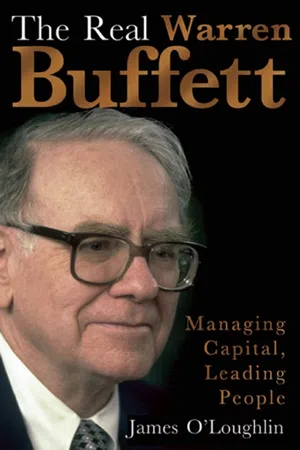
- 272 pages
- English
- ePUB (mobile friendly)
- Available on iOS & Android
eBook - ePub
About this book
Trusted by 375,005 students
Access to over 1.5 million titles for a fair monthly price.
Study more efficiently using our study tools.
Information
1
The Real Warren Buffett
We’re only responsible for two functions… First, it’s our job to keep able people who are already rich motivated to keep working at things… they don’t need to do for financial reasons. It’s that simple. Secondly, we have to allocate capital.
Warren Buffett1
During his 37-year tenure as chairman and chief executive of Berkshire Hathaway, Warren Buffett has grown the market value of this company at a compound growth rate of over 25% per year.
The consequences of compound growth of such long duration can be difficult to imagine. So let’s put Buffett’s record into a perspective that can be more easily visualized. At birth, my son measured 60cm in length. If he were to grow at the same rate as Buffett has managed to grow the value of Berkshire Hathaway, by the time he is 37 he will be taller than the Empire State Building!
Thus, anyone who had the foresight to invest $10,000 in Berkshire Hathaway when Buffett took charge of the company in 1965 would have seen the value of this stake grow to over $40 million today. Indeed, had anyone invested the same sum with Buffett when he began his professional investing career with the Buffett Partnership nine years earlier, and reinvested in the stock of Berkshire Hathaway when the Partnership was wound up, it would now be worth a staggering $270 million—or something like $500 million before fees.2
By comparison, $10,000 invested in 1965 in the S&P 500, a basket of stocks broadly representative of the largest corporations in America, would today be worth only $144,000—a 9m pygmy to Buffett’s towering colossus.
Buffett has not delivered this performance by being a stock picker. He has done it by being a CEO: by leading people and by managing capital.
Nor was he born to such excellence. He had to learn it. In his early years he made mistakes—plenty of them. He still makes mistakes now. In the 1970s and 1980s, however, Buffett underwent an explosion of cognition in which his model of leadership and capital management emerged.
This is the model that has sustained Berkshire Hathaway’s performance as an operating company, as opposed to the investment vehicle it once was. This is the model that has elevated Buffett above all other CEOs. It is also the model that is made available in this book.
Capital markets offer a sophisticated arena in which to emulate Warren Buffett, who, with a personal fortune of $37 billion, is currently the second richest man in America behind Bill Gates. They also offer a thousand opportunities to make the mistakes that will ground your compound returns in the average and stunt your growth. Buffett was, and is, able to identify opportunity. He has been, and is, able to circumvent most errors of decision making, and to learn from those that he does make. He has combined this into a form of leadership that allows him free expression of his talent. And he has endowed managers within Berkshire Hathaway who also allocate capital with the ability to do so on a similarly informed basis.
Warren Buffett appreciates the challenges of attempting to act like an owner of an enterprise when functioning as its manager. He has discovered the difficulties of getting Berkshire’s subsidiary managers to act like owners too.
He has learned the necessity of working with people who have the right mindset. He has uncovered what this is and how to identify it. He has also learned how difficult it is to change behavior in people made of the wrong stuff. Importantly, he has discovered how to attract the one to join Berkshire and how to discourage the other. And he has found a way of fostering enduring loyalty among those who do work for him, of eliciting their compliance with the objectives he sets for Berkshire Hathaway, and of drawing out lasting commitments from his managers to the principles he espouses as a leader.
Buffett has found the instrument of leadership in his own personality: in his belief system, in his attitude toward those who entrust their savings to him, in his honesty, his high-ground ideals, and his fairness. These have become an expression of Berkshire Hathaway’s corporate ideals. Above all, Buffett has learned that people management transcends into personal motivation when the rules of behavior that people are expected to follow are implanted from within, rather than set from above; that compliance and diligence are at their height when these rules are set in sympathy with that small voice that exists inside all of us, which tells us how to behave.
Buffett has found that managerial control comes from letting go—and he adheres to the same philosophy in his management of capital.
Buffett does not believe that the world in which he operates lends itself to the imposition of his will upon it. It only yields itself to those who are prepared, ahead of time, to take advantage of the opportunities that it inevitably throws up, yet that cannot be reliably predicted.
Buffett wants to reduce subjectivity in capital management decisions to a minimum. Correspondingly, he wants to maximize the objectivity that he brings to bear. In the face of a welter of information that would otherwise threaten to overwhelm him, Buffett filters the universe in which he manages capital down to the important and knowable. He wants to make most of his capital management decisions in this realm and it is on the basis of the enlightenment conveyed by what he calls the Circle of Competence that he wants to make all of his capital management decisions.
Oftentimes, this suggests behavior that is deeply unconventional. The emotional consequences of this threaten to distort Buffett’s decision-making process and undo his rationality. Therefore, by putting in the groundwork ahead of time, Buffett ensures that every decision he takes in his management of Berkshire’s capital is taken from a position of utmost psychological security.
The construction of Buffett’s Circle of Competence and the nature of this groundwork are explained at length in this book. The end product allows Buffett to allocate capital where he sees fit, when he sees fit, and at the pace he sees fit. He does so in opportunities that he can qualify as such and is able to evaluate. The accuracy of his cognition is enhanced, his capital management enlightened, and Buffett transports his framework into the art of acting like an owner.
The stock valuation principles that most readers of Warren Buffett crave are in this book. But they have been placed within a framework that makes sense of them for the practitioner. As a professional investor of 20 years’ experience, it is only in writing this work that I found this framework. Prior to this, I too explored Buffett’s approach to investment with the hope of finding the Holy Grail. I was looking in the wrong place and suffered from illusory competence.
It is only when I recognized that a holistic approach was required that I came to appreciate Warren Buffett’s Circle of Competence. Now that I have his framework, I am far closer to Buffett than I ever was when I simply tried to piggyback on his investing style, and I can, at last, put what I know about him into practice as an equity strategist. I have dispelled my illusions.
The financial institution for which I work has found it can do the same. In pursuit of its fiduciary duty of care in the management of other people’s money, it is adopting the framework I have described to extend its investment philosophy and enhance its investment process. This book will provide similar lessons for a wider audience—in particular for corporate managers in their duty of care to their shareholders.
It will explain what Warren Buffett means by saving on behalf of those who place their savings with a manager and elucidate Buffett’s ideals of corporate governance.
The book will illuminate what it means to be an owner; how to use this ideal as an instrument of leadership that leads, rather than drags, kicks, pushes, and corrals; how to attract the right people to the organization; how to effect acquisitions in this regard that do not fail; and how to devise rules of behavior that drive these principles down through an organization at the operational level.
It will elucidate the role of corporate strategy and describe how Buffett prevents prior commitments from becoming blindfolds.
The book will describe Warren Buffett not as a demigod free from error, but as a mortal with human failings. However, it will also inform managers that mistakes need not be tombstones, rather that they can be stepping stones to better decision making.
It will illustrate the psychology and emotion of decision making in order to improve that function. It will also defuse the psychology and emotion of poor decision making.
The book will prescribe a set of rules that a public company can adopt in order to conduct itself according to Buffett’s credo.
It will provide a guide for managers who wish to defy current convention and manage in accordance with reality rather than in its defiance. It will explain how Buffett attracts shareholders who think like owners and how he dissuades those who do not; why he is able to embrace volatility in operating results and how he manages the psychological and emotional consequences of this; how he cultivates the bond of trust that exists between him and his shareholders and how he harvests this to deliver unparalleled returns to them.
Most importantly, whether it be in managing people or in managing capital, this book will show managers how to act like owners. It is a narrative, but it is also a manual of high-ground corporate governance.
Buffett himself advises people to “pick out a few heroes.” “There’s nothing like the right ones,” he says.3 It is in the spirit of this advice that I offer you the real Warren Buffett. A manager of capital. And a leader of people.
A COMPOUNDING MACHINE
We’re like the hedgehog that knows one big thing. If you generate float at 3% per annum and buy businesses that earn 13% per annum with the proceeds of the float, we have actually figured out that that’s a pretty good position to be in.
Charlie Munger4
In 1965, when Warren Buffett officially took charge of Berkshire Hathaway, it operated in just a single line of business—the manufacture of textiles—and generated revenues of around $600 million.
Today, it is enormously diverse, with interests that stretch from the conduct of insurance to shoe manufacturing, from the production of flight simulators to vacuum cleaners, and much more in between—including investments in quoted shares on the stock market. Measured by its $60 billion of book value, it is the second largest corporation in America after Exxon Mobil; by its market capitalization of $109 billion, it is the 19th largest in America and 26th in the world. Revenues now amount to over $30 billion and Berkshire employs approximately 112,000 people.
This is a truly massive undertaking. It is also one that Buffett manages out of a small, unassuming office in Omaha, Nebraska, calling on the help of just “13.8”5 other people.
If Buffett maintains the pace he has set at Berkshire Hathaway, his company will absorb the whole of the US economy within the next 34 years. An interesting concept—not least because, at the age of 72, Buffett says that he plans to retire about 10 years after he dies.
Clearly, Berkshire Hathaway is a compounding machine. How is it constructed?
Buffett’s long-stated objective has been to grow the value of Berkshire at a rate of 15% per year, measured over the long term. Since Buffett attests “the absolute most that owners of a business, in the aggregate, can get out of it in the end—between now and Judgment Day—is what that business earns over time,” he knows that he can only grow Berkshire’s value to the extent that the cash that can be taken out of it exceeds the amount put into it.6 So in order to construct a compounding machine he must do two things.
First, he has to own and operate high-return businesses; that is, those that generate substantially more cash than is required to maintain their respective competitive positions.
Second, he has to find opportunities to reinvest their excess cash at high rates of return so that he can keep the cash machine running. As Buffett says:
When returns on capital are ordinary, an earn-more-by-putting-up-more is no great managerial achievement. You can get the same result personally while operating from your rocking chair. Just quadruple the capital you commit to a savings account and you will quadruple your earnings.7
He recognizes that “if retained earnings… are employed in an unproductive manner, the economics of Berkshire will deteriorate very quickly.”8
His focus in the allocation of capital therefore revolves around this reality. Ideally, he would prefer to find opportunities to reinvest Berkshire’s excess capital in existing businesses—so he wants to own businesses with ample opportunities to grow—but, if this is not the case, he has to find others that possess the desired characteristics.
The key to Buffett’s ability to compound is his ability to harvest the cash from cash-generative businesses and reinvest this elsewhere. As much a...
Table of contents
- Cover Page
- Title Page
- Copyright Page
- Dedication
- Contents
- Preface
- Acknowledgments
- 1 The Real Warren Buffett
- Part I: People Leader
- Part II: Capital Manager
- Part III: To Act Like an Owner
- References
- Index
- Footnotes
Frequently asked questions
Yes, you can cancel anytime from the Subscription tab in your account settings on the Perlego website. Your subscription will stay active until the end of your current billing period. Learn how to cancel your subscription
No, books cannot be downloaded as external files, such as PDFs, for use outside of Perlego. However, you can download books within the Perlego app for offline reading on mobile or tablet. Learn how to download books offline
Perlego offers two plans: Essential and Complete
- Essential is ideal for learners and professionals who enjoy exploring a wide range of subjects. Access the Essential Library with 800,000+ trusted titles and best-sellers across business, personal growth, and the humanities. Includes unlimited reading time and Standard Read Aloud voice.
- Complete: Perfect for advanced learners and researchers needing full, unrestricted access. Unlock 1.5M+ books across hundreds of subjects, including academic and specialized titles. The Complete Plan also includes advanced features like Premium Read Aloud and Research Assistant.
We are an online textbook subscription service, where you can get access to an entire online library for less than the price of a single book per month. With over 1.5 million books across 990+ topics, we’ve got you covered! Learn about our mission
Look out for the read-aloud symbol on your next book to see if you can listen to it. The read-aloud tool reads text aloud for you, highlighting the text as it is being read. You can pause it, speed it up and slow it down. Learn more about Read Aloud
Yes! You can use the Perlego app on both iOS and Android devices to read anytime, anywhere — even offline. Perfect for commutes or when you’re on the go.
Please note we cannot support devices running on iOS 13 and Android 7 or earlier. Learn more about using the app
Please note we cannot support devices running on iOS 13 and Android 7 or earlier. Learn more about using the app
Yes, you can access The Real Warren Buffett by James O'Loughlin in PDF and/or ePUB format, as well as other popular books in Business & Business Biographies. We have over 1.5 million books available in our catalogue for you to explore.