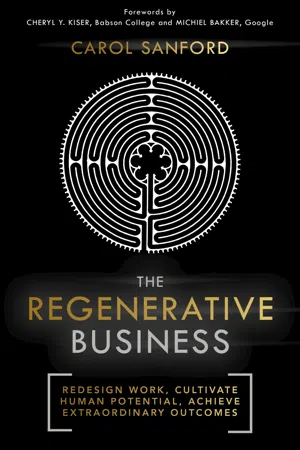
What if leaders stripped away all preconceptions about how business operates, allowing the organization to go back to its core and build itself back up to become something new-something so responsive, so innovative and resilient, it becomes virtually non-displaceable in the market? The Regenerative Business sets the stage for what is now only dreamt of by most of today's forward-thinking leaders and paves the path to make it possible. The book features: -Real stories from companies leading innovation and transformation across the globe including; Google, Colgate Europe, Seventh Generation, Nike and others-A logical, comprehensive approach that factors in the complexities of the modern organization -The work of internationally-recognized leadership expert Carol Sanford, who for decades has been designing and leading systemic business change
eBook - ePub
The Regenerative Business
Redesign Work, Cultivate Human Potential, Achieve Extraordinary Outcomes
- 288 pages
- English
- ePUB (mobile friendly)
- Available on iOS & Android
eBook - ePub
The Regenerative Business
Redesign Work, Cultivate Human Potential, Achieve Extraordinary Outcomes
About this book
Information
CHAPTER ONE
Go Beyond Training and Develop Your People
Between stimulus and response there is a space. In that space is our power to choose our response. In our response lies our growth and our freedom.
Victor Frankl, Man’s Search for Meaning
CREATIVITY AND INNOVATION are inherent in human beings. When people have a place to express these qualities in useful ways, they provide the necessary energy for successful businesses and enduring societies. Regenerative businesses tap into creativity and innovation—fostering them, developing them, and harnessing them to improve life for customers and workers. These businesses inspire employees to use their initiative to create systemic effects that ripple out and improve communities, landscapes, and nations. This becomes possible when businesses change their frames of reference, refocusing their people on understanding the customer’s world so that they can discover unique ways to transform it. It is this focus on transformative effects for customers that enables regenerative businesses to disrupt their industries and markets.
At the same time, businesses that foster initiative and self-management change forever the way employees look at the world and their role within it. When people spend their lives in hierarchical systems, with supervisors making decisions for them, their decision-making capacity and their confidence in their own judgment weaken. They become habituated to ceding control and responsibility to authority figures. In the long run, this undermines not only our businesses, but our democracy and the citizenry needed to make it work. By evolving the natural sources of human creativity and responsibility, a regenerative business builds more than itself. It grows better citizens and, as a result, it builds a better nation and a better world.
The process of developing people must be built into the design of a business and how it works. It is not something that gets bolted on, along with other management practices that have accumulated over the years. Rather, it is fundamental—a necessary part of what it takes to grow a successful, holistic, highly intelligent organization.
Developing People in a Changing World
The way most companies manage their workforces is bad for business. Not coincidentally, it’s also bad for people and for democracy, reinforcing inequity and alienation from social and democratic processes. This is because it draws on outmoded and inaccurate beliefs about human nature and what it takes to create healthy patterns of social engagement. For example, most managers believe that humans need to be stimulated with incentives, rewards, and recognition if they are to become motivated. Such beliefs contradict a growing body of scientific research that points to the direct connection between human agency and personal and collective motivation.1,2 In other words, most businesses are designed to severely limit people’s ability to stay motivated. Clearly, there is plenty of room for innovation.
A host of new discoveries in the fields of neuroscience and psychology have overturned long-held assumptions about human motivation and development, suggesting that we have far more capacity for free will and autonomy than has been generally assumed.3,4 Multiple studies demonstrate that we have a stronger tendency to feel rewarded by altruism than by selfishness. We have the ability to work independently, outside the influence of our peers, if we have the opportunity to develop this capacity. With adequate support, we can learn to manage increasingly difficult and complex situations over our entire lifetime.5 These insights directly contradict many of the core beliefs that have shaped the design and management of businesses for more than a hundred years.
The need to rethink these outmoded beliefs and replace the toxic management practices and work systems that have developed from them is becoming urgent. Automation and artificial intelligence are expected to displace 50 percent of what’s left of blue-collar jobs in the U.S. by the end of this decade, part of a global phenomenon that is rapidly replacing industrial labor with machines.6 At the same time, there is a global shortage of workers with the critical-thinking skills, technical agility, motivation, and independence needed by the emerging economy. Elon Musk, in a joint presentation with Bill Gates at the 2017 Davos World Economic Forum, pointed out that these qualities can and should be developed rapidly within the workplace and that it is in each business’s interest to do so.7
What is urgently needed now is an approach to work design that educates workers to be successful in the twenty-first century.
Not surprisingly, many members of the millennial generation are directly challenging traditional modes of doing business, which increasingly strike them as innately wrongheaded. Because of the open and transparent nature of the Internet, they have grown up with a voice and the ability to question almost anything. They don’t assume that their elders know more than they do, and this is creating tensions and chaos within old-style hierarchical organizations.8
Also, the U.S. is experiencing a profound demographic shift as it moves from several hundred years of white majority to a pluralistic society in which people of color make up the majority. This means that a large percentage of the workforce is growing up in cultural milieus that differ from what has been the white mainstream. As communities of color become more central to the future of businesses, they expect their values to be reflected in the workplace.9
These phenomena are part of a larger social shift toward increasing dissatisfaction with top-down decision making. Across the political spectrum, people are insisting on their own autonomy and resisting the imposition of governmental or corporate institutions. The Tea Party, Occupy Wall Street, Black Lives Matter, and the homeschooling movements are all manifestations of a revolutionary impulse that harkens back to the founding of the U.S., when the colonies shook off the dominance of a British ruling class.
This impulse is creating enormous stresses in both government and business, and organizations of all sorts are scrambling to respond. However, most of the currently available solutions that are focused on creating greater autonomy and less bureaucracy fail to address one essential, underlying problem: our social institutions have fostered an impulse toward greater freedom but have failed to equip citizens with the corresponding criticalthinking capabilities to use that freedom effectively. The good news here is that this failure represents an unprecedented opportunity for businesses. If they can develop these capabilities in their workforces, they will strengthen not only themselves but also democracy as a whole.
Traditional ways of running a business and managing its people act against the development, full expression, and contribution of human beings. As a rule, they are grounded in a belief that human potential is fixed at birth, an accident of genetic or socioeconomic background. People must therefore be slotted into appropriate positions within hierarchical systems, and those who are smarter must naturally make decisions for everyone else.
Recognizing that there is room for innovation, a number of businesses and the consultants who serve them have worked hard to create flat organizations with self-directed employees. But unfortunately, many of these alternative structures are still based on the old belief about motivation—namely, that it is fostered through a system of rewards and punishments. Also, many of them focus on the development of technical skills, rather than on the deep work of growing critical thinking, personal mastery, and business acumen.
In fact, everyone has an inherent capacity not only to develop new skills, but also to become smarter and more capable of taking on larger and larger challenges. Businesses are in an exceptionally leveraged position to develop this capacity because it is in their best interest to do so. Specifically, businesses should strive to provide people with increasingly significant challenges that they can use to grow themselves, along with an unswerving commitment to help them develop the requisite criticalthinking skills and ability to manage themselves.
The technology for developing people in this way has been around for more than fifty years, the result of a lifelong collaboration between my mentors James V. Clark and Charles G. Krone. Krone was a philosopher with a degree in chemical engineering, while Clark was a Harvard-trained specialist in educational psychology. Their pioneering work at Proctor and Gamble in the 1960s helped introduce the world to the practice of regenerative business design.10 Their work, and the work of their students and colleagues, has demonstrated time and again that the development of people is a powerfully effective way to build successful businesses and healthy communities.
Yet although regenerative business design is powerful and proven, it has not been widely understood or adopted. This is because it requires the deep examination of a business’s starting premises and what it is willing to undertake. It also requires embracing the internal destabilization and discomfort that come with responding creatively to the unknown. The payoff is a motivated and innovative workforce that is prepared to take a company to the top of its industry.
By tapping into the inherent, self-organizing, creative energies of your workforce, you will improve margins, cash flow, and earnings. As an added bonus, you will contribute to making better lives for the people your business affects and more enduring democratic institutions for society as a whole.
Building the Capacity for Disruptive Thinking
Disruption, in the context of business, refers to the introduction of a new product or way of working that has the effect of overturning existing patterns within an industry. Disruptive innovations arise when a company looks beyond what currently exists to what wants to exist. Such a company learns to see what others can’t see—the emergent patterns and tendencies of an evolving world.
Disruption bypasses existing dysfunctional patterns in a system, patterns that produce more negative side effects than they do benefits. It sets out to create an alternative prototype that is consistent with the system’s deeper intentions or aspirations. Elon Musk describes intentional disruption as “going back to first principles.”11
Going back to first principles allows people to make a new start. Perhaps the simplest way to describe a regenerative process is to say that it breaks a familiar pattern by going back to the original source in order to start down a different path. From this new path, people are able to make connections that they haven’t made before because they’re seeing the world in a new way. By disrupting the old view and its attendant certainties, by questioning ...
Table of contents
- Cover
- Title
- Copyright
- Contents
- Foreword
- Foreword
- Acknowledgements
- Also by Carol Sanford
- Introduction: Pursue Disruptive Innovation
- Chapter 1: Go Beyond Training and Develop Your People
- Chapter 2: The Evolution of Work Design
- Chapter 3: Source Work Design from First Principles
- Chapter 4: Build Innovation into How Work Is Done
- Chapter 5: Eliminate Thirty Toxic Business Practices
- Chapter 6: Design a Developmental Organization
- Chapter 7: Phase One—Evolve into Strategic Disruption
- Chapter 8: Phase Two—Evolve a Courageous Culture
- Chapter 9: Phase Three—Evolve People and Thinking Processes
- Chapter 10: Phase Four—Evolve Business Work Systems
- Chapter 11: Phase Five—Evolve Work Structures Last
- Chapter 12: Epilogue: The Regenerative Paradigm
- Notes
- Carol Sanford Regenerative Business Offerings
Trusted by 375,005 students
Access to over 1.5 million titles for a fair monthly price.
Study more efficiently using our study tools.
Frequently asked questions
Yes, you can cancel anytime from the Subscription tab in your account settings on the Perlego website. Your subscription will stay active until the end of your current billing period. Learn how to cancel your subscription
No, books cannot be downloaded as external files, such as PDFs, for use outside of Perlego. However, you can download books within the Perlego app for offline reading on mobile or tablet. Learn how to download books offline
Perlego offers two plans: Essential and Complete
- Essential is ideal for learners and professionals who enjoy exploring a wide range of subjects. Access the Essential Library with 800,000+ trusted titles and best-sellers across business, personal growth, and the humanities. Includes unlimited reading time and Standard Read Aloud voice.
- Complete: Perfect for advanced learners and researchers needing full, unrestricted access. Unlock 1.5M+ books across hundreds of subjects, including academic and specialized titles. The Complete Plan also includes advanced features like Premium Read Aloud and Research Assistant.
We are an online textbook subscription service, where you can get access to an entire online library for less than the price of a single book per month. With over 1.5 million books across 990+ topics, we’ve got you covered! Learn about our mission
Look out for the read-aloud symbol on your next book to see if you can listen to it. The read-aloud tool reads text aloud for you, highlighting the text as it is being read. You can pause it, speed it up and slow it down. Learn more about Read Aloud
Yes! You can use the Perlego app on both iOS and Android devices to read anytime, anywhere — even offline. Perfect for commutes or when you’re on the go.
Please note we cannot support devices running on iOS 13 and Android 7 or earlier. Learn more about using the app
Please note we cannot support devices running on iOS 13 and Android 7 or earlier. Learn more about using the app
Yes, you can access The Regenerative Business by Carol Sanford in PDF and/or ePUB format, as well as other popular books in Business & Business Strategy. We have over 1.5 million books available in our catalogue for you to explore.