The world often falls short of how we'd like it to be, and our ability to make even just a little difference can seem limited. Sometimes it feels like you need to be a super-hero to achieve anything meaningful. But what if by re-conceiving what you do, you could change the world for the better?In THE REGENERATIVE LIFE, Carol Sanford shows you how to fundamentally change the roles you play in society, enabling you to do more than you ever believed possible; grow yourself and others, provide astounding innovations for your clients, children and students, generate extraordinary social returns, become more creative, and bring new life and opportunity to everything around you. THE REGENERATIVE LIFE teaches you to see your roles differently: stripping away all preconceptions of how it should be done, understanding what your role is at its core, and building yourself back up to become something new; something so grounded, inspiring, and resilient, it can change the world.
eBook - ePub
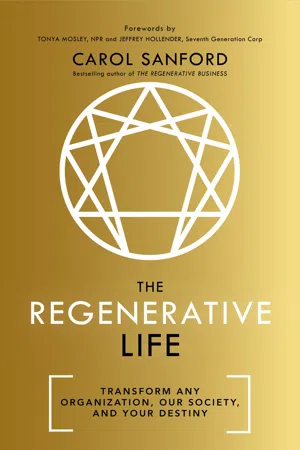
The Regenerative Life
Transform any organization, our society, and your destiny
- 256 pages
- English
- ePUB (mobile friendly)
- Available on iOS & Android
eBook - ePub
About this book
Information
CHAPTER ONE
Beyond the Heroic
AS I PROPOSED in the introduction, the heroic hypothesis assumes that systemic change requires visionary leaders who expend huge amounts of energy and will in order to make a difference in the world. The heroic path sees change as a matter of scale: if it isn’t big, then it’s not making a difference. In other words, change is quantitative and outwardly focused. But what if the most powerful change processes depend on qualitative rather than quantitative shifts? What if who we’re becoming has more influence than how much stuff we’re doing?
The non-heroic path seeks a way to create profound and enduring change, not through large-scale movements or fighting the good fight, but by enabling people to transform themselves. When people learn how to evolve their own thinking—their beliefs, perspectives, aspirations, and thought patterns—they become change catalysts in all parts of their lives and with everyone they touch. Social movements are built on the power of certain compelling ideas. But regenerative change is built on the power of taking conscious charge of our thinking processes and helping others to do the same.
When we choose this path, we function like a helpful virus, one that fosters the vitality and immune system of the host (for example, by supporting healthy intestinal bacteria) while at the same time protecting against harmful viruses. By helping its host to thrive, a helpful virus is able to spread as a beneficial symbiont.
Medical science is becoming more and more appreciative of the internal populations of bacterial and viral species in the human body, the cooperation among them, and their role in the maintenance of human well-being. This is an ecosystem perspective that brings new sophistication to our overall understanding of health.
Compare this to the practice of developing drugs to fight unfriendly viruses. When we use an antiviral drug, we trigger a biochemical arms race, with nasty viruses racing to out-survive the latest pharmaceutical invention. In contrast, nurturing a community of helpful viruses builds the systemic ability of host organisms as a whole to manage attacks.
This example is intended to illustrate a critical shift in our approach to social change. Current political and social discourse has become polarized, at times to such an extent that we are immobilized, unable as a society to take necessary or beneficial actions even in dire emergencies. As long as we continue to dig our feet in, holding strongly to our own beliefs or political positions, we reinforce this situation of social stasis. Regardless of where we are on the political spectrum—left, right, center, or none of the above—as long as we make ourselves right and the others wrong, we have no choice but to battle it out at the ballot box, through demonstrations, or in the media. We are trying to function like an antiviral drug, while our opponents are figuring out ways to make end runs around us. What a huge expenditure of energy just to make incremental and often temporary changes!
Levels of Perspective
The irony is that when we are in this situation, we become victims of our own lack of perspective. We can see the merits of our own point of view, but we struggle to understand and accept the merits of the opposition’s. This metaphor of point of view is apt: our perspective has collapsed into a single point.
In the late 1800s, a British philosopher named Edwin Abbott wrote a witty little book, Flatland, to illustrate this problem.1 In it, the residents of a two-dimensional world struggle to imagine a world of three dimensions. Their two-dimensional perspective means that they can see a sphere only as a circle. When they visit a one-dimensional world, the problem gets even worse. Residents of a one-dimensional world see everything as points.
Abbot vividly illustrates the influence of our perspective and thinking patterns on how we perceive reality. More important, he shows that there are different levels of perspective. When we collapse our vision, we lose our ability to see the full range of possibilities that lie hidden in plain view. To access these possibilities, we only need to recover our ability to explore multiple points of view from a level of perspective that sees their potential relatedness.
The problem is that we tend to become attached to the things we really believe in. For example, we may passionately reject the exploitation of people and natural systems. But as soon as we set ourselves up as opponents to those we see as exploiters, we end up in heroic battles over everything from Supreme Court nominations to fishing practices. We still find ourselves trying to stop the nasty viruses instead of introducing beneficial viruses to create an environment of balance and healthy function.
Understanding the Idea of Levels
So what exactly do I mean by levels? Before I talk about them in the context of perspective, here’s an example from sports.
Parents often encourage their children to play a sport, such as soccer, as a way to gain basic functional skills. As children play, they develop their coordination, learn teamwork, and grow the ability to handle setbacks. At this stage in their lives, they are in the game for what it can give to them rather than what they can give to it.
By the time they’re in high school, on a school team competing in intramural games, they have progressed to dedicating themselves to the sport. Teenage athletes focus on refining their performance and eliminating weaknesses or bad habits; they play for the team, as well as for themselves. They are at a different stage of development, playing at a completely different level than young children.
Players at the college level have usually been recruited for their soccer skills. At this level, they are expected to work on improving themselves—the discipline, intelligence, and integrity with which they play—as well as to work on their skills. With the eye of the public on them, they understand that their performance is a reflection of the character of the team and possibly of the college as a whole.
At the professional level, if soccer players are to achieve the apex of their potential, they must dedicate themselves not only to their own development, but also to expressing the essence of their teams and of the game itself. When professional players join a great team, they are trained in its distinctive game or approach. They also learn strategy, reading the games of other teams in order to figure out how to use their own strategizing to prevail in competition. For a really great team, all this work plays out on a world stage, where the game becomes a visible metaphor for courage, grace, honor, and beauty—inspiring its fans and thereby securing the future of the sport.
This example of the development of soccer players suggests what I mean by levels. At each stage of their development, players shift to a new level of performance, as well as a new scope with regard to what they take into consideration. These changes in level correlate to a corresponding growth in maturity. A simple glance at the headlines will show that there are plenty of professional athletes who behave badly, but this can be understood as a failure to mature fully through all of the levels and take on the responsibilities that come with them.
Additionally, the soccer example also suggests that higher levels of engagement, corresponding to more advanced stages of development, don’t replace the need for the lower levels. Even as a professional player, it’s necessary to maintain and evolve basic skills and coordination. Ideally, the different levels work together and complement one another, so long as they are informed by the highest level the athlete has attained.
Levels of Paradigm
My soccer example is a special case of a more general framework that I call “Levels of Paradigm.” Paradigms provide context for our lives and work; they determine our perspectives and shape the choices we make and the actions we take. They are often unconscious, which means that it rarely occurs to us to examine them. It’s even rarer to recognize that our paradigms operate at different levels and that these levels have very different implications in terms of the quality of the effects that flow from our choices and actions. (Note that the following framework is read from bottom to top—from lower to higher level.)
| Regenerate Life |
| Do Good |
| Arrest Disorder |
| Value Return |
In the case of a soccer player, we can see that an upward shift in level enables a greatly expanded scope for development, accomplishment, and impact. Children play soccer for the value it generates in terms of strength or controlled reflexes. Teenagers play it as an arena to hone their skills and correct the flaws in their performance. College athletes play it to express their potential and gain accolades. Professionals on teams that achieve greatness evolve the game and encourage millions of fans to pursue aspirational lives.
The foundational paradigm in this framework is Value Return. Within this paradigm, we expect that when we invest money, time, or effort into something, it will generate a useful return. We seek out and adopt patterns that have been proven to deliver similar results in the past. For example, teachers use tried-and-true pedagogical methods to ensure that students will learn what is required of them. Investors follow proven models for generating financial returns. Engineers apply best practices to designing highways, airplanes, or software. The idea is to reliably reproduce a pattern of behavior or action in order to achieve predictable results.
The next paradigm, Arrest Disorder, shifts us to managing entropy in a continuously changing world. It’s not enough to focus on a specific action, assuming that if we do it well, we’ll always achieve the same result, because the context within which the action is occurring is changing. For example, a soccer player needs to know not only how to kick the ball down the field, but also how to do so in relationship to all of the other players who are in motion and pursuing their own strategies. In the same way, a software or computer engineer is designing within a field that is evolving from one day to the next.
When we work from this level of paradigm, we are seeking ways to manage both our own actions and the context within which they occur, usually by addressing gaps and problems that are showing up. For example, we might become more strategic about how our actions fit with what’s happening in the marketplace (coming up with a smartphone app that fills a need no one else seems to see, let’s say). Or we might choose to improve flawed practices within a profession or an industry that consistently lead to waste or inferior results. However we approach it, we need to stay abreast of changes happening in our field and in the world, taking them into account in our decisions and seeking to ensure that the end results are beneficial to those who will be impacted.
When we begin to work within the Do Good Paradigm, we operate from a faith in the potential of things and people to improve and make more meaningful contributions to the world. This allows us to look at more than the immediate consequences of our actions. We’re motivated by a desire to manifest the potential we can see, to make the world a better place. Not only do we need to pay attention to our actions and their context, but also we need to build our own character, so that we’re able to be consistent and honorable with regard to these motivations.
Adopting this level of paradigm will have the effect of stretching us, enlarging our compassion and touching us personally. For example, we might join the board of a nonprofit agency that’s seeking to make life better for children, or we might volunteer to mentor children directly. The work is no longer at arm’s length. It requires giving ourselves fully to something other than ourselves and absorbing the lessons that will inevitably arise from the uncertainty inherent in working with real, living beings facing real-life challenges.
The Regenerate Life Paradigm focuses on how to build the capacity in people and other living systems to be self-determining in the world. At this level, we make a profound shift in perspective. We commit to seeking what’s essential in each person and every sort of thing that is the subject of our work. We become radically particular. We are no longer willing to pigeonhole people, places, groups, or materials because we see each as unique. When we make this shift, we’re able to enter into deeply respectful relationships, where the full expression of the unique potentials of others is our primary objective.
As the highest level of paradigm in our framework, regenerate life incorporates and transforms how we work on all of the others. We’re still willing to do good, but not in a generic or abstract way. The good we seek starts from an essence that wants to be expressed. We may still wish to reduce waste and dysfunction by arresting disorder in a system, but we never allow this to distract us from the overall creative purpose we’re pursuing. And we certainly need to achieve a value return from our efforts if we’re to be able to continue them, but value return includes the fulfillment that arises from realizing the potential of someone or something other than ourselves.
As a general rule, these different levels correspond to different phases of our development. We can see this reflected in the soccer player example earlier, where the players advance from child to adult by steadily enlarging and deepening the scope of their conscious awareness. But these phases often reassert themselves when we take on a significantly new endeavor or role in our lives. I know in my own life, whenever I push myself to take on something new (for example, teaching myself to be a writer!), I feel like a child again, awkward and struggling to make things work (value return). But little by little I develop enough basic competence to start working on self-improvement (arresting disorder), aspiring to excellence (doing good), and ultimately contributing to a better world (regenerating life).
Of course, it takes consciousness and will to move ourselves through all four of these developmental phases or levels. Because our modern world and culture place such emphasis on analytical dissection, problem solving, individualism, and compartmentalization, we have to exert extraordinary effort to move ourselves up to paradigms of dynamism and development. The first step is to become aware that the levels exist and that it is possible to make choices with regard to them.
Paradigms in Action
If our intention is to live a regenerative life, then we need to learn to recognize which paradigm we’re currently working from and which paradigms are driving the decisions and actions of the people around us. This ability enables us to become more conscious of our thinking and behavioral patterns, setting the stage for our own development while growing our capacity to help others in their development.
To accomplish this, we bring dimensionality to each of the paradigms, showing how it shapes the way we think and act. The framework for this work is the four-pointed tetrad, which describes the particular forces at work within each paradigm. Generically, these forces are described as the ground on which our thinking is based, the goal that it is directed toward, the instruments we characteristically use to reach the goal, and the direction that guides the overarching way we stay on track. Let’s look at each paradigm in action, with the aid of the tetrad.
Value Ret...
Table of contents
- Contents
- Acknowledgments
- Foreword: From the Boardroom
- Foreword: From the News Desk
- Introduction: We Need a Better Theory
- Chapter 1 Beyond the Heroic
- Chapter 2 Seven First Principles of Regeneration
- Chapter 3 Regenerative Roles
- Chapter 4 The Regenerative Parent Role
- Chapter 5 The Regenerative Designer Role
- Chapter 6 The Regenerative Earth Tender Role
- Chapter 7 The Regenerative Citizen Role
- Chapter 8 The Regenerative Entrepreneur Role
- Chapter 9 The Regenerative Economic Shaper Role
- Chapter 10 The Regenerative Educator Role
- Chapter 11 The Regenerative Media Content Creator Role
- Chapter 12 The Regenerative Spirit Resource Role
- Epilogue: Take It Personally. Take It to Work.
- Notes
- Index
Trusted by 375,005 students
Access to over 1.5 million titles for a fair monthly price.
Study more efficiently using our study tools.
Frequently asked questions
Yes, you can cancel anytime from the Subscription tab in your account settings on the Perlego website. Your subscription will stay active until the end of your current billing period. Learn how to cancel your subscription
No, books cannot be downloaded as external files, such as PDFs, for use outside of Perlego. However, you can download books within the Perlego app for offline reading on mobile or tablet. Learn how to download books offline
Perlego offers two plans: Essential and Complete
- Essential is ideal for learners and professionals who enjoy exploring a wide range of subjects. Access the Essential Library with 800,000+ trusted titles and best-sellers across business, personal growth, and the humanities. Includes unlimited reading time and Standard Read Aloud voice.
- Complete: Perfect for advanced learners and researchers needing full, unrestricted access. Unlock 1.5M+ books across hundreds of subjects, including academic and specialized titles. The Complete Plan also includes advanced features like Premium Read Aloud and Research Assistant.
We are an online textbook subscription service, where you can get access to an entire online library for less than the price of a single book per month. With over 1.5 million books across 990+ topics, we’ve got you covered! Learn about our mission
Look out for the read-aloud symbol on your next book to see if you can listen to it. The read-aloud tool reads text aloud for you, highlighting the text as it is being read. You can pause it, speed it up and slow it down. Learn more about Read Aloud
Yes! You can use the Perlego app on both iOS and Android devices to read anytime, anywhere — even offline. Perfect for commutes or when you’re on the go.
Please note we cannot support devices running on iOS 13 and Android 7 or earlier. Learn more about using the app
Please note we cannot support devices running on iOS 13 and Android 7 or earlier. Learn more about using the app
Yes, you can access The Regenerative Life by Carol Sanford in PDF and/or ePUB format, as well as other popular books in Business & Business General. We have over 1.5 million books available in our catalogue for you to explore.