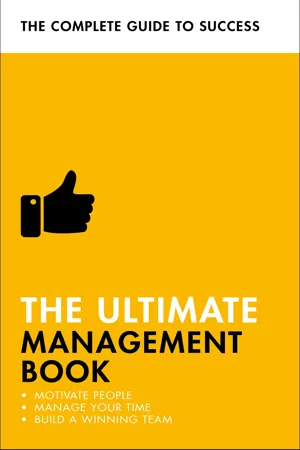
If you want to be the best, you have to have the right skillset. From managing and motivating people and teams to performance management and appraisals, THE ULTIMATE MANAGEMENT BOOK is a dynamic collection of tools, techniques, and strategies for success. Discover the main themes, key ideas and tools you need and bring it all together with practical exercises. This is your complete course in modern management. ABOUT THE SERIES
ULTIMATE books are for managers, leaders, and business executives who want to succeed at work. From marketing and sales to management and finance, each title gives comprehensive coverage of the essential business skills you need to get ahead in your career. Written in straightforward English, each book is designed to help you quickly master the subject, with fun quizzes embedded so that you can check how you're doing.
eBook - ePub
The Ultimate Management Book
Motivate People, Manage Your Time, Build a Winning Team
- 464 pages
- English
- ePUB (mobile friendly)
- Available on iOS & Android
eBook - ePub
The Ultimate Management Book
Motivate People, Manage Your Time, Build a Winning Team
About this book
Information
PART 1
Your Introduction to Management Masterclass
Introduction
Congratulations! You’ve made it! Your bosses have seen your potential. They have noticed your hard work and the skills you have and have promoted you to a manager.
How do you feel? Excited? Thrilled at the prospect of showing your abilities and skills even more? Exhilarated at the opportunities that will open up for you to shine even further? Perhaps a little overawed at some of the responsibilities that will come your way? Concerned, even anxious, about some of the burdens that the management role will bring?
Part 1 will guide you through what can feel like the maze of tasks of a manager. Principles are clearly explained with case studies giving examples of how – and sometimes how not – to manage.
Chapter 1
Becoming a manager
In this chapter we’re going to look at:
• what managing is
• some challenges you will face
• the differences between managing and leading
• the qualities of a successful manager.
Dictionaries give different definitions of the verb ‘to manage’. Our main concern is with organizing other workers and making decisions about how a business or department is run. In practice this will mean that you usually tell other people what to do rather than doing it yourself. The italic text shows the crucial differences between what you have done up to now and what you will do now you are a manager. You will:
• organize other workers
• make decisions about how a business or department is run
• tell other people what to do rather than doing it yourself.
You are not uninformed, however. You will have had experience. In the past, you will have been organized by your boss who made decisions about how the business or department should be run. So you have thoughts about how well or badly that management was undertaken. Also, be assured that your bosses have identified potential in you that can be developed successfully.
What is managing?
We can usefully divide managing into separate tasks:
• Plan: know your goals and work out how to achieve them.
• Organize: do what is necessary to make the plan happen. Bring structure and make arrangements. Allocate the necessary resources to your team. Assign work to your team members; if necessary, recruit or train your team. Coordinate with others. Delegate work, responsibility and authority. Work efficiently, with minimal waste of time, money and other resources.
• Lead: motivate, encourage and, above all, communicate with members of your team to show them they are valued and get the best out of them so they work effectively.
• Control: not in the control-freak or manipulative sense, but being direct, making decisions about how to work most effectively to see that your goals are met. Monitor actual timings and costs against planned goals and take steps to ensure that the agreed outputs, standards and so on are met.
Looking at the four points above, think about which of these come naturally to you and which you will need to work harder at to cultivate. Think about your new role and analyse it in terms of each of these task points.
What goals will you need to plan? How will you organize the necessary resources to achieve that plan? How will you lead – motivate – your team members to get the best out of them, controlling and giving direction to make decisions to see that your goals are met?
Challenges you face
Challenges you face as a manager may include:
• hiring the right staff
• making the most of scarce financial resources
• training your staff
• managing difficult members of your team
• motivating and encouraging your team
• communicating well with your team
• making better use of your time
• managing budgets
• managing projects
• managing yourself better.
We will deal with these, and more, in this text.
Becoming a manager
When Karen first became a manager, she was in charge of people who had previously been on the same level as her. She was once one of them but was now senior to them.
She had lots of ideas when she became team leader, such as introducing new daily briefings and performance targets. However, rather than implementing these changes gradually, she tried to introduce them all at once. Unfortunately, the team did not cope well with this and their attitude to her became negative. She decided to have one-to-one meetings with each colleague to find out their thoughts on the changes and hear their suggestions. These sessions proved to be opportunities for them to understand that the changes were for the good of the team, and gradually Karen was able to introduce all the changes successfully.
Managing and leading
What is the difference between managing and leading? Roughly speaking, managing is turning leadership into action.
Let’s consider this in more detail. Leaders set a particular course: ‘We’re going to expand into the Chinese market.’ Managers put that into action, for example: ‘We’re going to understand the culture, build a base, recruit staff there and implement a whole range of other activities to make the basic idea of “expanding into the Chinese market” a reality.’
So leaders set the overall direction and give vision; managers work out the detail in terms of organizing people, planning and budgeting. You will probably have agreed with this last sentence, but noticed that it includes a crucial aspect: that of emotions. Leaders appeal to the emotions to set a course of change, wanting to inspire people to follow a vision. Managers, in contrast it seems, have the less exciting task of ensuring that the work, in all its detail, is completed.
In practice, however, the distinction between ‘leader’ and ‘manager’ may not be so clear-cut. Your role may be ‘team leader’ and your responsibilities will concentrate on the detailed tasks, systems and processes to ensure that the work is completed. You will also, however, need leadership skills to motivate the members of your team to achieve these goals.
Proving your capabilities
Louise first joined the help desk at the hospital’s IT department via an agency. She’d always been interested in computers and was good at explaining things to other people in a pleasant and clear manner. She was quickly taken on to the permanent staff at the hospital.
Colleagues gradually noticed that she was quick to pick up knowledge and that she had good organizational skills – from arranging rotas to organizing the staff ’s Christmas meal. She also often deputized for the team leader when he was unavailable. She was promoted to acting team leader when the team leader was on sick leave. Louise proved her capabilities so well that when the team leader’s job became vacant she applied and was offered this role. Her work skills, linked with her dedication, hard work and commitment to the role over a period of years meant that she was an ideal person to manage the team.
Qualities of a successful manager
What kind of a person makes a successful manager?
• Someone who is self-motivated – a good manager will have initiative and determination; he or she will not need external persuasion in order to work.
• Someone with good directional and organizational skills to organize people, processes and resources.
• Someone who is able to plan ahead and set clear goals.
• Someone who is focused on the important aims of achieving goals and improving performance.
• Someone who has vision and is able to inspire others by their words and their example.
• Someone who is proactive in looking ahead, rather than reacting to changes as they happen.
• An effective communicator, able to communicate clearly in spoken and written forms (e.g. emails, reports).
• Someone who is able to think strategically, taking a view above the detailed.
• Someone who is good with finances, setting budgets and establishing systems that monitor and control expenditure.
• Someone who is good at analysing information, both in words and numbers, text and financial data, and is at home with both text documents and spreadsheets.
• Someone who is decisive, with the ability to take the initiative and make decisions. Sometimes even making the wrong decision can be better than making no decision at all!
• Someone with good interpersonal skills: open and approachable, trustworthy. Someone who respects others.
• Someone who is able to motivate others, coaching, supporting and facilitating their staff.
• Someone who is good at networking with others to develop trusted relationships.
• Someone who is able to delegate to members of their team.
• Someone who is able to work well under pressure.
• A good team player – one who works well, establishing clear roles and encouraging personal responsibility.
• Someone who is able to recruit (a...
Table of contents
- Cover
- Title
- Contents
- Part 1: Your Introduction to Management Masterclass
- Introduction
- Chapter 1
- Becoming a manager
- Chapter 2
- Managing people
- Chapter 3
- Managing a team
- Chapter 4
- Managing your work
- Chapter 5
- Communicating effectively
- Chapter 6
- Managing a project
- Chapter 7
- Managing yourself
- Surviving in tough times
- Part 2: Your People Management Masterclass
- Introduction
- Chapter 8
- What is people management?
- Chapter 9
- What do people managers do?
- Chapter 10
- Motivating people in the workplace
- Chapter 11
- People management styles
- Chapter 12
- Tools for people management
- Chapter 13
- How people managers manage performance
- Chapter 14
- How people managers develop their teams
- 7 × 7
- Part 3: Your Leading Teams Masterclass
- Introduction
- Chapter 15
- Getting started with your team
- Chapter 16
- Alignment and goal-setting for your team
- Chapter 17
- Delegating and managing the work within your team
- Chapter 18
- Optimal communication within your team
- Chapter 19
- Motivating poor performers in your team
- Chapter 20
- Inspiring high performers in your team
- Chapter 21
- Creating and maintaining a culture of excellence
- 7 × 7
- Part 4: Your Appraisals Masterclass
- Introduction
- Chapter 22
- Setting the context: why appraise?
- Chapter 23
- Formulating an effective appraisal
- Chapter 24
- The appraiser’s role, I: setting the framework
- Chapter 25
- The appraiser’s role, II: attitudes and approaches
- Chapter 26
- The interview, I: reviewing achievement
- Chapter 27
- The interview, II: looking ahead
- Chapter 28
- 7 × 7
- Answers
- Copyright
Trusted by 375,005 students
Access to over 1.5 million titles for a fair monthly price.
Study more efficiently using our study tools.
Frequently asked questions
Yes, you can cancel anytime from the Subscription tab in your account settings on the Perlego website. Your subscription will stay active until the end of your current billing period. Learn how to cancel your subscription
No, books cannot be downloaded as external files, such as PDFs, for use outside of Perlego. However, you can download books within the Perlego app for offline reading on mobile or tablet. Learn how to download books offline
Perlego offers two plans: Essential and Complete
- Essential is ideal for learners and professionals who enjoy exploring a wide range of subjects. Access the Essential Library with 800,000+ trusted titles and best-sellers across business, personal growth, and the humanities. Includes unlimited reading time and Standard Read Aloud voice.
- Complete: Perfect for advanced learners and researchers needing full, unrestricted access. Unlock 1.5M+ books across hundreds of subjects, including academic and specialized titles. The Complete Plan also includes advanced features like Premium Read Aloud and Research Assistant.
We are an online textbook subscription service, where you can get access to an entire online library for less than the price of a single book per month. With over 1.5 million books across 990+ topics, we’ve got you covered! Learn about our mission
Look out for the read-aloud symbol on your next book to see if you can listen to it. The read-aloud tool reads text aloud for you, highlighting the text as it is being read. You can pause it, speed it up and slow it down. Learn more about Read Aloud
Yes! You can use the Perlego app on both iOS and Android devices to read anytime, anywhere — even offline. Perfect for commutes or when you’re on the go.
Please note we cannot support devices running on iOS 13 and Android 7 or earlier. Learn more about using the app
Please note we cannot support devices running on iOS 13 and Android 7 or earlier. Learn more about using the app
Yes, you can access The Ultimate Management Book by Martin Manser,Nigel Cumberland,Norma Barry,Di Kamp in PDF and/or ePUB format, as well as other popular books in Business & Management. We have over 1.5 million books available in our catalogue for you to explore.