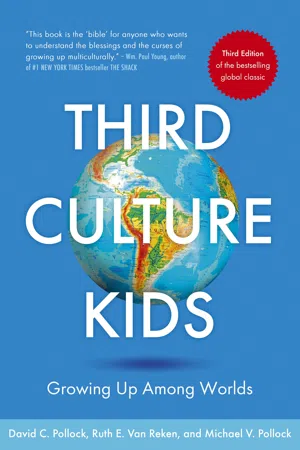
For more than a decade, Third Culture Kids has been the authority on "TCKs" - children of expatriates, missionaries, military personnel and others who live and work abroad. With a significant part of their developmental years spent outside of their passport country, TCKs create their own, unique "third" cultures. Authors Pollock and Van Reken pioneered the TCK profile, which brought to light the emotional and psychological realities that come with the TCK journey, often resulting in feelings of rootlessness and grief but also an increased confidence and ability to interact with many cultures. Through interviews and personal writings, this new, expanded edition explores the challenges and benefits that TCKs encounter, and also widens the net to discuss the experiences of CCKs, cross-cultural kids, who are immigrants, international adoptees or the children of biracial or bicultural parents. Highlighting dramatic changes brought about by instant communication and ever-evolving mobility patterns, Third Culture Kids reveals the hidden diversity in our world and challenges traditional notions of identity and "home" - and shows us how the TCK experience is becoming increasingly common and valuable.
eBook - ePub
Third Culture Kids
The Experience of Growing Up Among Worlds: The original, classic book on TCKs
- 306 pages
- English
- ePUB (mobile friendly)
- Available on iOS & Android
eBook - ePub
Third Culture Kids
The Experience of Growing Up Among Worlds: The original, classic book on TCKs
About this book
Information
Part I

Understanding the World of TCKs
This first section of the book looks in detail at who a third culture kid (TCK) is and why the two major realities of this experience—growing up among many cultural worlds and high mobility—have such a significant effect on TCKs. We will also consider how (and why) lessons learned from the TCK journey can be applied to other types of cross-cultural childhoods, even when the details of these other experiences may be quite different from the traditional TCK lifestyle.
CHAPTER 1
Where Is Home?
Erika’s Story

As the Boeing 747 sped down the runway, Erika sat with her seat belt secure, her chin propped against a clenched fist, staring out the window until the final sights of her beloved Singapore disappeared from view.
How can it hurt this much to leave a country that isn’t even mine? Erika closed her eyes and settled back in the seat, too numb to cry the tears that begged to be shed. Will I ever come back?
For nearly half of her twenty-three years, she had thought of Singapore as home. Now she knew it wasn’t—and the United States hadn’t felt like home since she was eight years old.
Isn’t there anywhere in the world I belong? she wondered.
Countless people of virtually every nationality and from a great variety of backgrounds identify with Erika’s feeling of not fully belonging anywhere in the world. Like her, they may be North Americans who grew up in Singapore. But they may also be Japanese children who grew up in Australia, British kids raised in China, Turkish youth reared in Germany, African children currently living in Canada, or the child of a Norwegian father and a Thai mother growing up in Argentina. All of them have one thing in common: like Erika, they are spending, or have spent, at least part of their childhood in at least one country and culture other than their own. They are third culture kids (TCKs) or, by now, adult TCKs (ATCKs)—those who have grown up as TCKs.
Children are TCKs for many reasons. Some have parents with careers in international business, the diplomatic corps, the military, or religious missions. Others have parents who studied abroad. While these were the groups or sectors researchers initially named and studied as TCKs, an increasing number of children now grow up (or grew up) outside their parents’ passport country and culture for many different reasons. Understanding their story is important for three reasons:
1. To help these individuals recognize and use well the gifts such a childhood provides;
2. To help them recognize and deal successfully with the challenges that are also inherent in this experience; and
3. To help normalize the third culture experience for this growing population.
TCKs are raised in a “neither/nor” world. It is neither fully the world of their parents’ culture (or cultures) nor fully the world of the other culture (or cultures) in which they were raised. Contrary to popular misconceptions, however, this neither/nor world is not merely a personal amalgamation of the various cultures they have known. Instead, it is a way of life shared by others who also grow up living first in one culture and then moving to another one—maybe even two or three more—and often back and forth between various cultures. For reasons we will explore, through this particular lifestyle TCKs often develop common characteristics that differ in various ways or degrees from characteristics of those who are basically born in and live their entire childhoods in one place. Most TCKs learn to live comfortably in this in-between space they share with other TCKs, whether they stop to define it or not.
Why TCKs Are More Visible
TCKs are not a new phenomenon. Children have traveled into other countries with their parents throughout history, or at least for several centuries, in various patterns of migration including accompanying their parents with international careers (e.g., colonial officers, diplomats, missionaries, military personnel). Until the end of the twentieth century, however, they were largely invisible as a recognized entity. How and why is that changing?
THE NUMBER OF TCKS IN THE WORLD IS INCREASING
Carolyn Smith gave some historical perspective on the changes taking place in one of the earliest books written on this topic, The Absentee American.
Since 1946, therefore, when it was unusual for Americans to live overseas unless they were missionaries or diplomats, it has become commonplace for American military and civilian employees and businesspeople to be stationed abroad, if only for a year. The 1990 Census counted 922,000 federal workers and their families living overseas, and the total number of Americans living abroad either permanently or temporarily is estimated at 3 million.1
By 2015, this estimated number had grown to 8 million, with no end in sight of how high this tally might rise.2 That’s a lot of people—equivalent to the combined populations of Chicago, Los Angeles, and Philadelphia!
But these figures only account for U.S. citizens. Australia has more than 1 million citizens living outside its borders on either a long- or short-term basis.3 In 2013, Japan disclosed that 1,258,263 of its citizens were living for longer than three months as expatriates all over the world.4 Add to these figures the burgeoning number of citizens from every other country working and living outside their home cultures and we can only imagine the total number of expatriates worldwide.
Of course, as more adults have international careers or live abroad for whatever reason, there are more children accompanying parents into new lands. In the days of early explorers, traders, colonial governors, or pioneer missionaries, children often remained in the home country to avoid the rigors of travel and disease or for educational purposes. It is now normal for children to accompany their parents overseas rather than to stay in the homeland or go to boarding schools in another part of the host country (or a different country), as was common in those earlier days. Traveling between home and a host country now rarely takes more than one day—an easy trip compared to the three months it used to take on an ocean liner. International schools exist everywhere. Advanced medical care is an airlift away (and even more immediate with telemedicine). In fact, the International School Consultancy reports that in 2016 there were more than 8,257 international schools teaching 4.53 million K–12 students (in English) worldwide. The estimate is that by 2026 this number will have more than doubled to 10 million students in international schools using English as the language of instruction.5 Consider how many more there are if you add all the students in non-English-speaking international schools and TCKs being home-schooled by parents while living outside their passport culture. The growth of this population is astounding.
THE PUBLIC VOICE OF TCKS HAS GROWN LOUDER
As these increasing numbers of TCKs become adults, they are becoming more vocal. Through alumni associations or online communities (such as www.tckidnow.com), TCKs and ATCKs have formed visible, identifiable groups. The proliferation of blogs; countless memoirs published by ATCKs; popular and scholarly articles in various online and print magazines; and anthologies such as Unrooted Childhoods, Writing Out of Limbo, or The Worlds Within have also created higher visibility of this cohort. Visual media such as Rahul Gandotra’s Oscar-nominated short film The Road Home, Mira Nair’s movie The Namesake, and Pico Iyer’s TED talk Where Is Home? bring the reality of the TCK story to life on our screens. Many ATCKs have become well-known politicians, newscasters, actors, actresses, sports figures, and authors. The election of President Barack Obama in 2008 made the entire world aware that this type of childhood exists, whether or not they knew there was a name for how he grew up. As these TCKs and adult TCKs share their stories, they encourage others to do the same, and their voices are being heard.
BEING A TCK OR ATCK HAS BECOME SIGNIFICANT
The TCK experience is a microcosm of what is quickly becoming normal throughout the world. In 1984, sociologist Ted Ward said that TCKs were the prototype citizen of the future,6 and it seems that day is nearly, if not already, here. Few communities anywhere will remain culturally homogeneous in this age of easy international travel and instant global communication. Growing up among cultural differences is already, or soon will be, the rule rather than the exception—even for those who never physically leave their home country. Experts are trying to predict the outcome of this cultural juggling. Looking at the TCK world can help us prepare for the long-term consequences of this new pattern of global cultural mixing. We look at these new trends in depth when we focus on the broader group of cross-cultural kids (CCKs) in chapter 3.
The benefits of the TCK lifestyle are enormous. Many TCKs and ATCKs are maximizing the potential of these benefits in their lives, both personally and professionally. In part II we look in detail at what these benefits are. Unfortunately, for some TCKs and ATCKs, the challenges of their experience have seemingly canceled out the many benefits—a sad waste for both the TCKs and the world around them. It is our hope that a better understanding of some of these benefits and challenges will help TCKs and ATCKs everywhere use the gifts of their heritage well. That’s why, throughout this book, we examine the paradoxical world of the TCK and other cross-cultural experiences during childhood from a variety of perspectives.
We return to Erika for a better look at one young woman’s true story. Only the names and places have been changed.
Back to Erika’s Story
Erika didn’t notice that the captain had turned off the “fasten seat belt” sign until a flight attendant interrupted her reverie.
“Would you like something to drink?” he asked.
How many Cokes and miniature pretzels have I eaten on airplanes? she wondered. Far too many to count. But today her grief outweighed any thought of food or drink. She shook her head, and the attendant moved on.
Erika closed her eyes again. Unbidden memories flashed through her mind. She remembered being eight years old, when her family still lived in upstate New York, Erika’s birthplace. One day her father entered the playroom as she and her younger sister, Sally, performed a puppet show for their assembled audience of stuffed animals.
“Wanna’ watch, Dad?” Erika asked hopefully.
“In a few minutes, sweetie. First, I have something special to tell you.”
Puppets forgotten, Sally and Erika ran to their dad, trying to guess what it could be.
“Are we gonna have a new baby?” Sally began jumping up and down in excited anticipation.
“Did you buy me a new bike?” Erika inquired.
Erika’s dad shook his head and sat in the nearby rocking chair, gathering one daughter on each knee. “How would you like to take a long airplane ride?” he asked.
“Wow!”
“Sure.”
“I love airplanes.”
“Where, Daddy?”
He explained that his company had asked him to move from the United States to Ecuador to start a new branch office. The family would be moving as soon as school ended that June.
A flurry of activity began—shopping, packing, and saying ...
Table of contents
- Cover
- Title
- Copyright
- Contents
- Acknowledgments
- Introduction by Ruth E. Van Reken
- Guide for Using This Book
- Part I: Understanding the World of TCKs
- Part II: Describing the TCK Profile
- Part III: The TCK Journey
- Part IV: Maximizing the Benefits; Overcoming the Challenges
- Epilogue
- Remembering David C. Pollock
- A History and Evolution of Third Culture and Third Culture Kids Concepts: Then and Now
- B Our Tribal Elders and the Global Nomad Medicine Wheel (Excerpts) by Paul Asbury Seaman
- C Hidden Diversity of TCKs by Danau Tanu
- Notes
- Resources
- Index
Trusted by 375,005 students
Access to over 1.5 million titles for a fair monthly price.
Study more efficiently using our study tools.
Frequently asked questions
Yes, you can cancel anytime from the Subscription tab in your account settings on the Perlego website. Your subscription will stay active until the end of your current billing period. Learn how to cancel your subscription
No, books cannot be downloaded as external files, such as PDFs, for use outside of Perlego. However, you can download books within the Perlego app for offline reading on mobile or tablet. Learn how to download books offline
Perlego offers two plans: Essential and Complete
- Essential is ideal for learners and professionals who enjoy exploring a wide range of subjects. Access the Essential Library with 800,000+ trusted titles and best-sellers across business, personal growth, and the humanities. Includes unlimited reading time and Standard Read Aloud voice.
- Complete: Perfect for advanced learners and researchers needing full, unrestricted access. Unlock 1.5M+ books across hundreds of subjects, including academic and specialized titles. The Complete Plan also includes advanced features like Premium Read Aloud and Research Assistant.
We are an online textbook subscription service, where you can get access to an entire online library for less than the price of a single book per month. With over 1.5 million books across 990+ topics, we’ve got you covered! Learn about our mission
Look out for the read-aloud symbol on your next book to see if you can listen to it. The read-aloud tool reads text aloud for you, highlighting the text as it is being read. You can pause it, speed it up and slow it down. Learn more about Read Aloud
Yes! You can use the Perlego app on both iOS and Android devices to read anytime, anywhere — even offline. Perfect for commutes or when you’re on the go.
Please note we cannot support devices running on iOS 13 and Android 7 or earlier. Learn more about using the app
Please note we cannot support devices running on iOS 13 and Android 7 or earlier. Learn more about using the app
Yes, you can access Third Culture Kids by David C. Pollock,Ruth E. Van Reken,Michael V. Pollock in PDF and/or ePUB format, as well as other popular books in Social Sciences & Emigration & Immigration. We have over 1.5 million books available in our catalogue for you to explore.