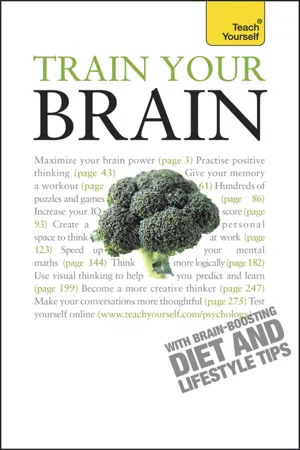
Train your brain to be quicker, fitter and brighter than it's ever been! This book gives you everything you need to get a mental edge, featuring hundreds of puzzles, quizzes and problem-solving games. It also gives you some great advice on how to maximise your mental agility through diet, exercise and the right lifestyle choices, as well as showing you how to put your new, more powerful brain to the test at work, home and play.NOT GOT MUCH TIME?One, five and ten-minute introductions to key principles to get you started.
AUTHOR INSIGHTSLots of instant help with common problems and quick tips for success, based on
the authors' many years of experience.
TEST YOURSELFTests in the book and online to keep track of your progress.
EXTEND YOUR KNOWLEDGEExtra online articles at www.teachyourself.com to give you a richer understanding of how to train your brain.
FIVE THINGS TO REMEMBERQuick refreshers to help you remember the key facts.
TRY THISInnovative exercises illustrate what you've learnt and how to use it.
- 320 pages
- English
- ePUB (mobile friendly)
- Available on iOS & Android
eBook - ePub
Train Your Brain: Teach Yourself
About this book
Information
Topic
Personal DevelopmentSubtopic
Personal SuccessAt home
1
Powering up your brain
In this chapter you will learn:
- to eat the food your brain needs, when it needs it
- to minimize damage to your brain from alcohol, tea, coffee, cannabis, cola, ticks and cigarettes
- to use sleep, exercise, smart drugs, dark chocolate and sex to rejuvenate your brain.
The state of your brain is as much a lifestyle choice, as a genetic inheritance.
Terry Horne, 2003
Introduction
Your brain can change in response to the way you exercise and the way you breathe. It can also change in response to what you eat, drink and smoke. It is changed by what you do and don’t do. Your brain, it appears, can change its structure in response to your lifestyle. Your brain is able to adapt in this way because, according to Colin Blakemore, Chief Executive Officer (CEO) of the UK Medical Research Council, your brain is not only a chemical factory, it is an extremely busy chemical factory. Your brain needs energy for more than 1 million chemical reactions every second!
Your brain can be changed by what you do with it – hence we have designed exercises for you to do and puzzles and problems for you to solve. However, your brain is not only changed by what you do with it, it is also changed by what you do to it. Here, in Chapter 1, we look at what you do to your brain when you feed it, and what you can do to revive it. We will look at diet, exercise, sleep, sex and the effect of dark chocolate.
The need for vitamins and minerals
At least ten different B vitamins can affect the neurotransmitters in your brain. The B vitamins help in the formation of new neurotransmitters. Anderson found that people had difficulty in thinking and concentrating when their vitamin B1 levels were low.
VITAMINS: TO SUPPLEMENT OR NOT?
Any beneficial effects from vitamins C, B1 and B5, and the minerals boron, zinc and selenium, are better obtained through a long-term adjustment to the diet than through taking supplements. You can usefully increase the proportion of berries such as blackcurrants, redcurrants, bilberries, strawberries and especially blueberries in your diet. Also try increasing the proportion of spinach, green cabbage, broccoli and watercress. Do not take iron tablets unless your doctor has investigated possible causes of anaemia other than iron deficiency. Although in general your body will tell you what’s good for you, when in doubt, you should consult your doctor.
Insight – Better than popping pills
Many of the chemical reactions involved in thinking are sensitive to traces of certain minerals and vitamins. Chronic deficiencies of these minerals and vitamins can seriously impair performance. Taking action on what you routinely eat and drink is a more effective remedy for deficiency than taking tablets or vitamin supplements.
FOOD FOR THOUGHT
1 Under normal circumstances, the brain uses mainly glucose for energy. With the aid of oxygen, B vitamins and minerals, the glucose is oxidized to produce water, carbon dioxide and energy – enough to fuel a million chemical reactions a second!
2 Neurons, and the sheaths surrounding their axons, need to be kept in good condition and phosphatidyl choline is essential for that maintenance. But to work, Maguire discovered that phosphatidyl choline needs certain B vitamins.
The dangers of fat-free diets!
By all means eliminate solid, saturated transfats from your diet. Transfats have no unsaturated bonds in them and so it is very hard for your body to break them down and get rid of them. They tend to hang around in your body, eventually clogging up your arteries and destroying your waistline. Transfats also deprive your muscles and your brain of the oxygen they need to work effectively. They also interfere with two unsaturated fats, omega-3 and omega-6 that your brain really needs. Without unsaturated fats in your diet, your brain can’t produce acetylcholine and without this, your brain cells will become ‘stiff’ and brittle. You will suffer memory loss and your thinking speed and accuracy will deteriorate. Such a fat-free diet will not only kill your brain cells, it may also kill you! De Angelis found that low-fat diets increased death rates from depression, suicide and accidents. Of course, obesity and heart disease also threaten your life and so it is understandable that you might want to diet to reduce your weight, but a very low-fat diet is not a safe way to do it.
3 Folic acid and selenium have been found to boost cognitive functioning. Folic acid is found in dark leafy green vegetables. Selenium is a mineral found in seafood, wholegrain breads, nuts and meat.
4 Connors reported that boron, iron and zinc improve mental activity. The mineral boron is found in broccoli, pears, peaches, grapes, nuts and dried beans. Zinc can be found in fish, beans and whole grains. The vitamin C in citrus fruits and salads enhances the absorption of iron. Iron helps to form ferroxyhaemoglobin, which is used to carry oxygen in the blood, through the body, to the brain.
5 In humans, neurotransmitters like dopamine and norepinephrine are essential for mental alertness and acuity, and for high speed calculation, evaluation, and critical thinking. Eating protein increases the supply of neurotransmitters. The implication is that we should eat more protein if we wish to be mentally alert and quick-thinking. (Some of the lowest rates of dyslexia in the world are found in Japan, which has the highest per capita consumption of fish.)
Breakfast clubs and other myths
While it is true that children at school will find it hard to concentrate, think (and therefore learn) if they feel hungry, it matters crucially what it is that you insist they eat for breakfast. School breakfast clubs often offer toast (and jam) – often white toasted bread at that. This will rapidly metabolize into glucose and produce insulin-driven pangs of hunger well before lunch. Even milk and cereal (especially if sugary) will burn up within two hours. To work, breakfast clubs must serve protein and complex carbohydrates.
6 In 2004, Steve and Burgess found that children with higher scores in mathematics had higher amounts of long-chain fatty acids omega-3 and omega-6 in their blood (although this may also correlate with the IQ and economic and social status of their parents!).
7 Eating blueberries, strawberries and spinach can reverse deterioration in thinking ability, but dark chocolate has ten times the level of the flavonols that are responsible for this beneficial effect.
Insight – ‘When’ is as important as ‘what’
From the point of view of mental performance, even more important than what you eat seems to be when you eat it. Speed and accuracy of thinking are favoured by eating protein and complex hydrocarbons for breakfast and lunch and leaving simple carbohydrates, like sugary cakes, puddings and biscuits (if you must), until later in the day.
Your daily bread
On days when you are involved in mainly mental, not physical, activity, try to eat complex carbohydrates, like fruit, salad and raw vegetables, and proteins, like fish or poultry, during the daytime. Keep grain carbohydrates, like bread and cereal, and fats, like avocado, cheese, milk, liver and red meat, until after work in the evening. Homemade banana or mango ice cream before bed (but never before driving) will help you to sleep (see Chapter 2, ice cream recipe, p. 53).
For enhanced thinking speed and accuracy
If you can face protein first thing, start with it. Try eggs – boiled, scrambled, poached or, especially good, a Spanish omelette. Any kind of fish, especially smoked oily fishes, like kipper, mackerel or salmon are an excellent addition. The Dutch, the Scandinavians and some Germans serve up wonderful platters of cold meat for br...
Table of contents
- Cover
- Title
- Copyright
- Dedication
- Acknowledgements
- Contents
- Meet the authors
- Only got a minute?
- Only got five minutes?
- Foreword by Professor Susan Greenfield
- First thoughts
- Part one: At home
- Part two: At work
- Part three: At play
- Final thoughts
- Epilogue
- Appendices
- Glossary
- Answers
- Taking it further
Trusted by 375,005 students
Access to over 1.5 million titles for a fair monthly price.
Study more efficiently using our study tools.
Frequently asked questions
Yes, you can cancel anytime from the Subscription tab in your account settings on the Perlego website. Your subscription will stay active until the end of your current billing period. Learn how to cancel your subscription
No, books cannot be downloaded as external files, such as PDFs, for use outside of Perlego. However, you can download books within the Perlego app for offline reading on mobile or tablet. Learn how to download books offline
We are an online textbook subscription service, where you can get access to an entire online library for less than the price of a single book per month. With over 1.5 million books across 990+ topics, we’ve got you covered! Learn about our mission
Look out for the read-aloud symbol on your next book to see if you can listen to it. The read-aloud tool reads text aloud for you, highlighting the text as it is being read. You can pause it, speed it up and slow it down. Learn more about Read Aloud
Yes! You can use the Perlego app on both iOS and Android devices to read anytime, anywhere — even offline. Perfect for commutes or when you’re on the go.
Please note we cannot support devices running on iOS 13 and Android 7 or earlier. Learn more about using the app
Please note we cannot support devices running on iOS 13 and Android 7 or earlier. Learn more about using the app
Yes, you can access Train Your Brain: Teach Yourself by Simon Wootton,Terry Horne in PDF and/or ePUB format, as well as other popular books in Personal Development & Personal Success. We have over 1.5 million books available in our catalogue for you to explore.