Trigonometry: A Complete Introduction is the most comprehensive yet easy-to-use introduction to Trigonometry. Written by a leading expert, this book will help you if you are studying for an important exam or essay, or if you simply want to improve your knowledge. The book covers all areas of trigonometry including the theory and equations of tangent, sine and cosine, using trigonometry in three dimensions and for angles of any magnitude, and applications of trigonometry including radians, ratio, compound angles and circles related to triangles. Everything you will need is here in this one book. Each chapter includes not only an explanation of the knowledge and skills you need, but also worked examples and test questions.
•the meanings of ‘opposite’, ‘adjacent’ and ‘hypotenuse’ in right-angled triangles
•how to solve problems using tangents.
1.1 Introduction
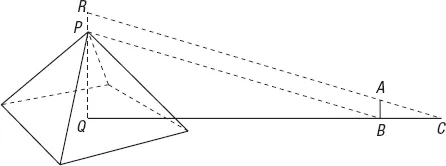
The method used by Thales to find the height of the pyramid in ancient times is essentially the same as the method used today. It is therefore worth examining more closely.
You can assume that the sun’s rays are parallel because the sun is a long way from the earth. In Figure 1.1, it follows that the lines RC and PB, which represent the rays falling on the tops of the objects, are parallel.
Figure 1.1
Therefore, angle PBQ = angle ACB (they are corresponding angles). These angles each represent the altitude of the sun.
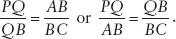
As angles PQB and ABC are right angles, triangles PQB and ABC are similar, so
The height PQ of the pyramid is independent of the length of the stick AB. If you change the length AB of the stick, the length of its shadow will be changed in proportion. You can therefore make the following important general deduction.
For the given angle ACB, the ratio
stays constant whatever the length of AB. You can calculate this ratio beforehand for any angle ACB. If you do this, you do not need to use the stick, because if you know the angle and the value of the ratio, and you have measured the length QB, you can calculate PQ.
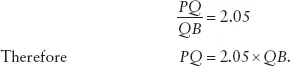
Thus if the angle of elevation is 64° and the value of the ratio for this angle had been previously found to be 2.05, then you have
1.2 The idea of the tangent ratio
The idea of a constant ratio for every angle is the key to the development of trigonometry.
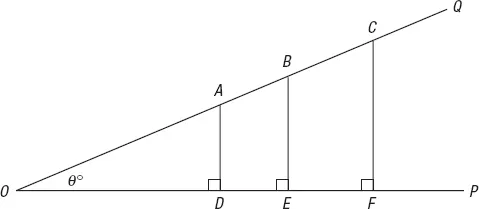
Let POQ (Figure 1.2) be any acute angle θ°. From points A, B, C on one arm, say OQ, draw perpendiculars AD, BE, CF to the other arm, OP. As these perpendiculars are parallel, the triangles AOD, BOE and COF are similar.
Figure 1.2
Spotlight
So if OE is double the length of OD then BE will be double the length of AD.
Now take any point Y, it ...
Table of contents
Cover
Title
Contents
Welcome to Trigonometry: A complete introduction
Introduction
1 The tangent
2 Sine and cosine
3 In three dimensions
4 Angles of any magnitude
5 Solving simple equations
6 The sine and cosine formulae
7 Radians
8 Relations between the ratios
9 Ratios and compound angles
10 The forms a sin x and b cos x
11 The factor formulae
12 Circles related to triangles
13 General solution of equations
Glossary
Summary of trigonometric formulae
Answers
Copyright
Trusted by 375,005 students
Access to over 1.5 million titles for a fair monthly price.
Study more efficiently using our study tools.
Frequently asked questions
Yes, you can cancel anytime from the Subscription tab in your account settings on the Perlego website. Your subscription will stay active until the end of your current billing period. Learn how to cancel your subscription
No, books cannot be downloaded as external files, such as PDFs, for use outside of Perlego. However, you can download books within the Perlego app for offline reading on mobile or tablet. Learn how to download books offline
Perlego offers two plans: Essential and Complete
Essential is ideal for learners and professionals who enjoy exploring a wide range of subjects. Access the Essential Library with 800,000+ trusted titles and best-sellers across business, personal growth, and the humanities. Includes unlimited reading time and Standard Read Aloud voice.
Complete: Perfect for advanced learners and researchers needing full, unrestricted access. Unlock 1.5M+ books across hundreds of subjects, including academic and specialized titles. The Complete Plan also includes advanced features like Premium Read Aloud and Research Assistant.
Both plans are available with monthly, semester, or annual billing cycles.
We are an online textbook subscription service, where you can get access to an entire online library for less than the price of a single book per month. With over 1.5 million books across 990+ topics, we’ve got you covered! Learn about our mission
Look out for the read-aloud symbol on your next book to see if you can listen to it. The read-aloud tool reads text aloud for you, highlighting the text as it is being read. You can pause it, speed it up and slow it down. Learn more about Read Aloud
Yes! You can use the Perlego app on both iOS and Android devices to read anytime, anywhere — even offline. Perfect for commutes or when you’re on the go. Please note we cannot support devices running on iOS 13 and Android 7 or earlier. Learn more about using the app
Yes, you can access Trigonometry: A Complete Introduction by Hugh Neill in PDF and/or ePUB format, as well as other popular books in Mathematics & Teaching Mathematics. We have over 1.5 million books available in our catalogue for you to explore.