How would you like to succeed in business and master investment by profiting in untapped areas that the masses know nothing about? Uncommon Sense guides you to unique, little-known and commonly misunderstood strategies that generate lasting revenue and sustained results by going against the tide.In this book you'll discover:
- How to asses real value, understand the hidden motives of the media and see through hype.
- Real business investing models such as hybriding and super-specialisation which will enable you to invest securely and profitably.
- Understand the popular misonceptions, schemes, traps and truths which part you from your money - and learn how to defend yourself against them and secure lasting wealth.Essential reading for investors, innovators and entrepreneurs, Uncommon Sense provides a balanced, insightful and inspiring toolkit for making smart decisions in investing and business.
eBook - ePub
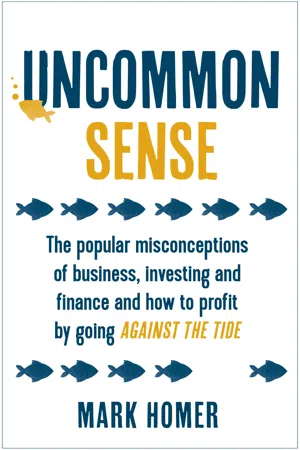
Uncommon Sense
The popular misconceptions of business, investing and finance and how to profit by going against the tide
- 192 pages
- English
- ePUB (mobile friendly)
- Available on iOS & Android
eBook - ePub
Uncommon Sense
The popular misconceptions of business, investing and finance and how to profit by going against the tide
About this book
Trusted by 375,005 students
Access to over 1.5 million titles for a fair monthly price.
Study more efficiently using our study tools.
Information
Topic
Personal DevelopmentSubtopic
EntrepreneurshipPart 1: The concept
In this part of the book, I will discuss overriding and enduring philosophies, misconceptions and realities in business, finance and investing. My aim is to present concepts that will stand the test of time and be as relevant 20 years from now as they are today. I will dig into schemes and scams to protect your capital, and detail mistakes, lessons and successes in business, finance and investing, citing precedents, competitors and personal experiences to give you a balanced view.
1
The uncommon sense philosophy
If I were to create a philosophy for uncommon sense business, finance and investing, and how to profit by going against the tide, it would be to be sceptical of mass media information and the weight of common opinion and action. While you should have half an eye on mainstream views and news, you must investigate and research for yourself by looking for information and strategies that are different, unexploited and unhyped and offer value that others haven’t yet discovered. Not contrarian for the sake of it, and not innovative too early, you will make most of your profit from hidden-from-the-masses value. Using this philosophy, you will also gain from increases in the value of the asset once it enters the consciousness of the masses – often once the value of it has risen significantly and been hyped up by the media.
There are essentially five parts to the uncommon sense philosophy:
1 Have one-half of one eye on mainstream views and news.
2 Investigate and research for yourself by looking for information and strategies that are different, unexploited and unhyped and offer value that others haven’t yet discovered.
3 Don’t be contrarian for the sake of it.
4 Don’t innovate too early.
5 Look for hidden-from-the-masses value.
1 Have half an eye on mainstream views and news
Some successful people have a ‘no mass media’ diet. While I understand why they want to stay positive and be unaffected by hypothesis and hyperbole, I feel it is important to stay in touch with current affairs. General news and politics affect stock and asset prices and also custom to your business. Therefore, they are an important part of business and investing. You just have to manage the correct dosage of each outlet, taking the credible ones seriously and taking the sensationalist ones with a pinch of salt. Later in this book, I’ll share the publications I find most credible and useful and those that I tend to pass by. I have been asked many times to share this information.
2 Investigate and research for yourself
Look for information and strategies that are different, unexploited and unhyped and offer value that others haven’t yet discovered.
Many successful businesspeople – like Walt Disney, Warren Buffett and James Caan – have followed the mantra of ‘observe the masses, do the opposite’. This has now become more mainstream than it used to be because it has been popularized by people whose success has been vast enough to reach the mainstream, and also because of the current popularization of business and entrepreneurship with shows like Dragons’ Den and The Apprentice. This will lead to point 3 below, but, for now, ensure that you take all mainstream media, commentary and advice with a pinch of salt. Do your own diligence and research, and educate yourself in niches that seem to be untapped and have inherent value.
3 Don’t be contrarian for the sake of it
In order to not be contrarian for the sake of being contrarian, we need to define contrarianism. A contrarian is someone who rejects popular opinion or current practice, regardless of how popular it might be. I believe this to be a useful mindset and strategy for investing, business and finance, because the asset value is likely to be overpriced if everyone thinks it is good. Often when something is popular, many have already bought into the asset and there is a premium attached to the price. The greater the excitement in an asset class, the more ‘froth’ it has (airy matter with no substance). There is an excited expectation of the forward price, but without there being any real substance or value. When the market turns, the froth evaporates fast and you find that the coffee you bought fills only half the cup, the froth taking with it a chunk of the value of your asset.
Because ‘contrarianism’ has become a concept in its own right, popularized by successful investors like Warren Buffett, or the perception of him, it has started to take on mainstream appeal. As soon as something can be ‘defined’, it can be copied and the masses inevitably flock in. The more exposure contrarianism gets, the less contrarian it becomes. This is a paradox and a reason why I am avoiding giving you a one-line quote or one-word name for my investment strategies. They are not holistic and cannot be simplified. Once labelled, they may be blindly followed and thus become less effective. By virtue of the fact that most business owners and investors are not successful for a sustained period of time, you will be doing the opposite of the masses, and that is as far as we should define it. So be contrarian because others don’t and can’t do what you can do – not just for the sake of it.
4 Don’t innovate too early
It is true to say that you can be ‘too early’ in a business model or investment. If you had the idea for the Internet in 1695, you may have been burned at the stake. If your model or investment theory is too complicated, relies heavily on very advanced technology, or has great resistance from competitors, it may be best to put it on ice and wait.
There are some famous-but-didn’t-become-famous examples of those who were too early. Remember ‘Ask Jeeves’, the search engine? The Go Corporation created the early palm pilots and tablets that Apple have leveraged so well. LetsBuyIt.com was Groupon before Groupon. LoudCloud was cloud computing before cloud computing.
Being the first, one of the first, or very early, of course, has the upside of there being less competition, more value and more room for growth, but it has the big risk downside of not being tested, proven, understood or scalable. You often hear only the wild success stories of the innovations that changed the world, and not the hundreds or thousands of failed cases. And, in fact, if you look at those wild successes, Facebook was not the first social media platform, Apple didn’t produce the first phone, computer or music-sharing site, and eBay and Amazon were not the first online auction or retail sites. You are often best observing the ‘version 2.0s’. Watch, sit on your hands for a while, learn and see how they develop and whether they can get through those hard early stages. Let them test and burn cash for you. Learn vicariously through their mistakes, and then get in once the concept has been proven and when the major risks and errors have mostly been removed.
5 Look for hidden-from-the-masses value
Value is latent profit, and so has not been fully extracted. By definition, it is hidden from the masses. How can you find those hidden gems? Can you look at a class in a different way? Can you look at a new class completely? Can you iterate a strategy that was nearly there but missed an essential ingredient or improvement? Can you look at a different field and bring existing models into your new field as a way of innovating without the risk?
I like to go running as it clears my mind and sets me up for a day of productive business and investing. When I run, and often while I am driving, I will take strategic detours in search of hidden properties. Maybe they are properties that have just come on the market and didn’t have a ‘for sale’ board up yesterday. Maybe they are properties hidden behind trees that I didn’t notice before. Maybe they are properties that have been defaced, that are in disrepair, have multiple ‘for sale’ boards outside, or are for lease. If I can spot these first, or more specifically, if I can spot the change of circumstances first, I may have found a hidden-from-the-masses asset, with value to be extracted and cashed in on.
Follow these five guidelines that form the ‘uncommon sense’ philosophy and you will beat the popular misconceptions of business, investing and finance, and you will profit handsomely by going against the tide.
2
Business, investing and finance: how to profit by going against the tide
Writing isn’t my natural flow. I often only end up writing articles and books when I’m asked so much that I know there is demand and I know I can add enough value to enough people. If I could summarize what I think about business, finance and investing that could be taught to others, it is that many people do not know what they are doing. So if I could add the most value to you, it would be in pointing out the plethora of these fallacies one by one, especially the popular, ‘conventional wisdom’ ones. I would bust those myths using my experience and then give you ideas and strategies to profit by going against them – things that make ‘uncommon sense’.
Please note that I will be giving you my opinion formed from my experience in business and investing since my early teens. I am someone with a real passion and who has turned that passion into a profession. I do not profess to have all the answers. I have made mistakes (which I will openly share) and do not like to be labelled an expert, a guru, or any such term to make out that I know it all. This is not so much a disclaimer, though of course you should seek professional advice when investing, but more a statement that we are all learning all the time and should remain hungry students. A big part of the philosophy of uncommon sense is to enjoy discovering new opportunities that others can’t find, and that is a never-ending (and exciting) pursuit.
Most of your latent profit exists in classes, niches and business models that others haven’t discovered or fully leveraged. I will endeavour to help you unearth these. You will be tempted, lured and persuasively sold into classes and models aimed towards the masses, and this book is about how to spot and avoid these and profit by going against them.
This is not a book of specific investment advice. This is not a rehash of a Buffett, Munger, or Soros strategy. I hope that this book is one you can’t define and fills a gap that stands the test of time rather than jumping on a fad, and it applies to all areas of business, finance and investing. There are fundamental but little-known concepts that occur in all cycles, markets and models. Whether they are presented in the same way or repackaged, these fundamental concepts are based on inherent human behaviour. This will be the focus of this book, because I believe in long-term, sustained wealth building and investing. Yes, you may make some flash-in-the pan, short-term arbitrage by going with the masses. If this is what you are looking for, this book may not be for you. Business, finance and investing are my highest passions and to that end I am very fortunate to have created a full-time career from monetizing my hobbies. And, because of that, short-term risks don’t interest me.
My hope is that you grow year on year and leverage your previous investments in time, cash and knowledge, harnessing the benefits of momentum and compounding to build a fortress that no one can infiltrate. There will be constant and consistent attacks on your wealth in the form of taxes, critics, trolls, ex-partners, competitors and regulations. You will need this momentum to carry you through for the long term. Do not take instant-fix shortcuts that jeopardize long-term sustainability. Realize that, no matter what your age, you have much longer ahead and can be much more patient than you often realize. There is a saying that I like: ‘Most people overestimate what they can achieve in a short time but underestimate what they can achieve in a lifetime.’ When asked about his secrets to success, Buffett cited compounding and great genes as his two main success factors. So leverage consistent compounding for the long term, do not chop and change, and live a long and profitable life.
The uncommon sense mentality
I have a Polish contractor who has an ‘enterprising’ way of cementing and generating new business relationships. He has created a way to form connections with his customers and gain access to their networks to get more work. When a friend of mine (for whom this contractor was also doing some work) was about to get married, he offered to ‘do the fireworks’. Little did we know what this meant!
He turned up to the event with a lorry and two men. They approached the next-door neighbour’s house to ask if they could set the fireworks off from her garden. As the wedding was being held on the peninsula of the biggest artificial lake in Europe, there was plenty of room for these fireworks to go off. The homeowner naturally hesitated at the idea of ash and flames potentially going over her manicured lawn, so he used some uncommon sense. Pushing his hand in his pocket, he pulled out £50 and offered it as a fee to use the lawn. Since the property must have been worth around £3 million, she looked a little embarrassed and said, ‘Oh no, we couldn’t possibly take that,’ and promptly agreed to let him use the garden. It seemed that the mere offer of the fee had pushed her into agreeing. Within minutes, three Polish men were in her garden setting up what can only be described as imported Polish munitions.
As the night drew in the fireworks started. The wedding guests were amazed at the display, which was probably as big as that in London during the millennium celebrations. Many of them ask to meet the builder and he made numerous connections that resulted in several million pounds’ worth of building projects for him. He had done what others wouldn’t or didn’t know how to: he pushed the boundaries, knocked on doors, and didn’t take no for an answer to create an extravaganza. This is very much the uncommon sense mentality – though in this case perhaps a little rough around the edges.
3
The signs that the lemmings are about to walk off the cliff
There are consistent telltale signs that the masses are moving blindly in droves. When you begin to recognize and understand these behaviour patterns, take it as a sign that you should sit on your hands or go against the tide. It is important to set these out early: while the loudest voices often have the biggest impact on the movement of the masses, they are also most often the most wrong.
Tighten your belt and guard your capital against the following:
1 Your friend or the shoeshine giving you advice on stocks
This is a sure sign there...
Table of contents
- Cover
- Title
- Dedication
- Contents
- Introduction
- About Mark Homer
- Abbreviations used in this book
- Part 1: The concept
- Part 2: Popular misconceptions
- Part 3: Strategies and tactics
- Part 4: Additional resources
- Afterword
- Copyright
Frequently asked questions
Yes, you can cancel anytime from the Subscription tab in your account settings on the Perlego website. Your subscription will stay active until the end of your current billing period. Learn how to cancel your subscription
No, books cannot be downloaded as external files, such as PDFs, for use outside of Perlego. However, you can download books within the Perlego app for offline reading on mobile or tablet. Learn how to download books offline
Perlego offers two plans: Essential and Complete
- Essential is ideal for learners and professionals who enjoy exploring a wide range of subjects. Access the Essential Library with 800,000+ trusted titles and best-sellers across business, personal growth, and the humanities. Includes unlimited reading time and Standard Read Aloud voice.
- Complete: Perfect for advanced learners and researchers needing full, unrestricted access. Unlock 1.5M+ books across hundreds of subjects, including academic and specialized titles. The Complete Plan also includes advanced features like Premium Read Aloud and Research Assistant.
We are an online textbook subscription service, where you can get access to an entire online library for less than the price of a single book per month. With over 1.5 million books across 990+ topics, we’ve got you covered! Learn about our mission
Look out for the read-aloud symbol on your next book to see if you can listen to it. The read-aloud tool reads text aloud for you, highlighting the text as it is being read. You can pause it, speed it up and slow it down. Learn more about Read Aloud
Yes! You can use the Perlego app on both iOS and Android devices to read anytime, anywhere — even offline. Perfect for commutes or when you’re on the go.
Please note we cannot support devices running on iOS 13 and Android 7 or earlier. Learn more about using the app
Please note we cannot support devices running on iOS 13 and Android 7 or earlier. Learn more about using the app
Yes, you can access Uncommon Sense by Mark Homer in PDF and/or ePUB format, as well as other popular books in Personal Development & Entrepreneurship. We have over 1.5 million books available in our catalogue for you to explore.