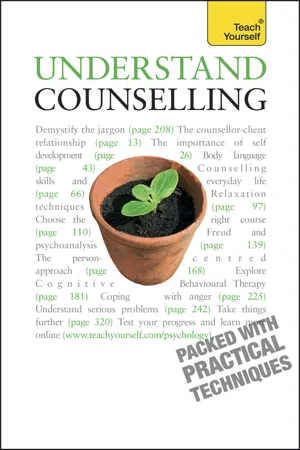
Understand Counselling will give you a clear understanding of the main counselling theories and help you develop vital counselling skills. It will introduce you to the three main branches of counselling - psychodynamic therapy, person-centred therapy and cognitive behavioural therapy - and familiarize you with the key features of each one. Whether you are interested in training as a counsellor, are considering counselling yourself or simply want to become a better communicator, this book will give you confidence and understanding.
NOT GOT MUCH TIME?One, five and ten-minute introductions to key principles to get you started.
AUTHOR INSIGHTSLots of instant help with common problems and quick tips for success, based on the author's many years of experience.
TEST YOURSELFTests in the book and online to keep track of your progress.
EXTEND YOUR KNOWLEDGEExtra online articles at www.teachyourself.com to give you a richer understanding of counselling.
FIVE THINGS TO REMEMBERQuick refreshers to help you remember the key facts.
TRY THISInnovative exercises illustrate what you've learnt and how to use it.
- 304 pages
- English
- ePUB (mobile friendly)
- Available on iOS & Android
eBook - ePub
About this book
Information
The fundamentals
1
The counselling role
In this chapter you will learn:
- the differences and similarities between counselling and psychotherapy
- what counselling involves
- about the counsellor–client relationship
- the importance of confidentiality in the counselling setting.
Counselling can take many forms: people receive counselling individually, or have couple counselling or family counselling – when the dynamics between family members will be the focus of the work. The capacity and setting in which counsellors work also varies, ranging from a few hours a week doing voluntary work with an agency or organization to working privately in a professional practice. Some counselling involves working with particular client groups – examples are student counselling and marriage counselling; and some focus on particular problems – for example, medical conditions such as cancer or AIDS, or social problems such as alcohol or drug abuse. To add to the complexity, there are many ‘schools’ of counselling which are informed by their own particular theoretical frameworks. These can, however, be identified and understood by the three core approaches of analytical, humanistic and behavioural perspectives and these will be explored in later chapters.
Given that there has been a proliferation of counselling activity in the past 20 years or so in Western societies, it seems likely that counselling is fulfilling a need that was in the past met by other means. People in the community – family members, neighbours, friends, local doctors and clergy – formed emotional and social support systems for individuals.
Many of us no longer live in supportive communities bound together by religious faith and beliefs. Our world horizons have expanded; the cities where many of us live can feel large and impersonal. Perhaps in seeking counselling we attempt to repersonalize our lives. We take our problems to a place where we feel we will be listened to and where our thoughts and feelings are regarded as important. The role of counselling is ever evolving to meet the challenges of modern social pressures and demands which we often attempt to deal with at cost to our inner world. The role of counselling has been defined by its aims and values. Aims include providing an environment that enables the client to work towards living in a more resourceful and personally fulfilling way. Integrity, respect and impartiality are basic values that are demonstrated throughout the counselling process.
We enter into a counselling relationship when we engage the help of a counsellor in mutual agreement. No one can be forced into a counselling–client relationship; a person chooses to have counselling, otherwise it isn’t counselling at all. The activity of counselling has been defined in many ways. The following are some of the ways that counselling can help people resolve problems or help people live their lives in a more insightful, fulfilling way. Counselling can help people:
- to clarify what’s important in their lives
- to get in touch with their inner resources
- in the exploration of feelings, thoughts and meanings particular to them
- by offering support at times of crisis
- by offering support during developmental and transitional periods
- to work through ‘stuck’ issues – this might involve integrating childhood experiences
- to reach a resolution of problems.
Insight
People are a lot more resourceful and resilient than they think and counselling can help them reconnect with their coping side.
Psychotherapy and counselling: where they converge and where they differ
The terms counselling, psychotherapy and therapy often seem to be used in an interchangeable way, their differences unclear to the uninitiated. In particular, the use of the term ‘therapy’ is widespread. A dictionary of psychology would define therapy using the words: ‘treatment of disease or disorder’ and ‘to make better’. If we look at the word ‘disease’ in two parts, dis and ease, we see that it refers to the state of a person who is no longer at ease with themselves in their physical and/or psychological state. Therapy, or counselling, is a process that helps the client make their life better by focusing on the areas of their lives that cause them problems or distress.
The word ‘therapy’ has come to be a generic term used to describe something that is helpful or nurturing in some way or that gives relief from the strains of everyday life, hence such terms as ‘retail therapy’. It’s also used as an abbreviated form of ‘psychotherapy’. The word ‘therapist’ is used likewise as an abbreviated form of ‘psychotherapist’, but many counsellors also refer to themselves as therapists.
SIMILARITIES BETWEEN PSYCHOTHERAPY AND COUNSELLING
Psychotherapy and counselling are regarded as separate professions. They sometimes have their own, and sometimes share, professional associations that safeguard the interests of both clients and practitioners. Among the functions that these professional associations serve is the accreditation of training courses and the accreditation of individual practitioners.
Although they have separate identities in the field of therapy, it’s a widely held view that there’s a lot of overlap between the two. Both use a similar theoretical framework of reference; the same training materials, books and resources are used on courses. This is particularly true when courses are based around the same theoretical ‘school’ or approach; for example, person-centred or psychodynamic. A person may reach professional status as either a person-centred counsellor or psychotherapist, yet their fundamental differences are unclear. The humanistic psychologist Carl Rogers made no clear distinction between the two titles, sometimes referring to himself as a counsellor and at other times as a psychotherapist. Members of both professions work in similar settings, in medical and health centres, doctors’ surgeries and clinics, and this can add to the confusion. The therapist and writer Windy Dryden, discussing the difference between the two titles in Self and Society, a humanistic psychology journal, jokes that the main difference is ‘about £8,000 a year’. He states that he finds difficulty in making clear distinctions between the two activities.
In his book Ordinary Ecstasy, John Rowan, a humanistic therapist, states, ‘Every technique which is used in personal growth and in counselling is also used in psychotherapy and vice versa,’ and in 2001 he wrote an article again discussing the subject of difference. He draws attention to the paradox when he writes:
On the one hand psychotherapy and counselling are different – they have different histories and associations, for example; while on the other hand they are the same – for example; they have many identical interventions and involvements. This contradiction – they are the same and they are different – has to be held and maintained.
(CPJ: Counselling and Psychotherapy Journal, August 2001)
DIFFERENCES BETWEEN PSYCHOTHERAPY AND COUNSELLING
Length and depth of training
There are a few differences that can be identified at training level. Psychotherapy usually involves longer training. It’s possible to obtain a certificate in counselling within a few months and a diploma in a year. There’s a lack of regularity in awarding such titles; many courses demand two or three years’ part-time study to reach diploma level. The varied length, and presumably depth, of training to reach the same status of qualification brings up ethical issues of standards. It’s obviously important for the consumer – the client – to check out what the counsellor’s qualifications and experience are when embarking on therapy.
Whereas to reach a professional level a counsellor would most likely be expected to train for a period of two to three years part-time, a psychotherapist would have spent a minimum of three years and often longer in training. Psychotherapy training often incorporates a year of working in a health care setting or private practice towards the end of the course, providing case study material for assessment.
Origins
Psychotherapy has been a branch of medicine from the late nineteenth century and psychoanalysis was a major development in psychotherapy in the twentieth century. In the early 1900s another type of psychotherapy called behaviourism associated therapy with psychology and science, mainly because its theories were developed from behavioural experiments. In contrast, counselling is a comparatively new discipline which was developed by psychotherapists such as Carl Rogers in America in the late 1950s. Counselling began in educational settings and was widely applied in marriage guidance, pastoral care and voluntary organizations. It subsequently developed into private practice.
Length of treatment
It’s generally thought that psychotherapists work long term with clients while counsellors work short term, or in crisis situations. There are no hard and fast rules. Counselling can incorporate both short-term and long-term ways of working; it sometimes begins with a short-term focus and for various reasons results in long-term therapy. Long-term counselling is common and, conversely, it’s not uncommon for psychotherapists to offer brief psychotherapy. Often the two activities are indistinguishable from each other, especially when the practitioners are very experienced. In some situations practitioners are restricted by the limited resources of their workplace; it might be deemed more satisfactory to offer six to eight weeks’ therapy to a greater number of people rather than long-term therapy to only a few.
Depth of work
The extended training of the psychotherapist is designed to equip them to work in more depth with clients. However, although this is used as a focus of training, it’s not always the case that psychotherapists exclusively cater for the client with more difficulties. It does seem true to say, as a general rule, that while the counsellor sees a client once a week for a single session, the psychotherapist might see a client two or more times in a week.
Personal therapy for trainees
Both professions require trainees to have personal therapy for the duration of the course. A psychotherapist in training, who is expecting to see individual clients two or more times a week, is usually required by the conditions of their course to have the corresponding amount of personal therapy throughout the training. The same applies to the counsellor who’s training with a view to seeing individuals once a week; they too will require personal therapy once a week for the duration of the course, although this requirement doesn’t necessarily apply to shorter courses.
The counselling role
Counselling can take many forms:
- doctors refer patients to counsellors who practise alongside them in their surgeries
- teachers and youth workers will often direct young people to counselling agencies for help
- counsellors are called to accidents and disaster areas to counsel the victims and their families
- individuals seek counselling for themselves for all kinds of reasons
- counselling is used in a variety of settings: in education, in pastoral care and increasingly in industry.
The role counselling plays in society is increasingly multifaceted and always supportive. Counselling now seems to be very much a part of our lives, no longer regarded as a luxury or indulgence. Therapy is seen for the mo...
Table of contents
- Cover
- Title
- Copyright
- Acknowledgements
- Contents
- Meet the author
- Only got a minute?
- Only got five minutes?
- Introduction
- Part one – The fundamentals
- Part two – A deeper understanding – training to a professional level
- Glossary
- Taking it further
- Index
Trusted by 375,005 students
Access to over 1.5 million titles for a fair monthly price.
Study more efficiently using our study tools.
Frequently asked questions
Yes, you can cancel anytime from the Subscription tab in your account settings on the Perlego website. Your subscription will stay active until the end of your current billing period. Learn how to cancel your subscription
No, books cannot be downloaded as external files, such as PDFs, for use outside of Perlego. However, you can download books within the Perlego app for offline reading on mobile or tablet. Learn how to download books offline
We are an online textbook subscription service, where you can get access to an entire online library for less than the price of a single book per month. With over 1.5 million books across 990+ topics, we’ve got you covered! Learn about our mission
Look out for the read-aloud symbol on your next book to see if you can listen to it. The read-aloud tool reads text aloud for you, highlighting the text as it is being read. You can pause it, speed it up and slow it down. Learn more about Read Aloud
Yes! You can use the Perlego app on both iOS and Android devices to read anytime, anywhere — even offline. Perfect for commutes or when you’re on the go.
Please note we cannot support devices running on iOS 13 and Android 7 or earlier. Learn more about using the app
Please note we cannot support devices running on iOS 13 and Android 7 or earlier. Learn more about using the app
Yes, you can access Understand Counselling by Aileen Milne in PDF and/or ePUB format, as well as other popular books in Psychology & History & Theory in Psychology. We have over 1.5 million books available in our catalogue for you to explore.