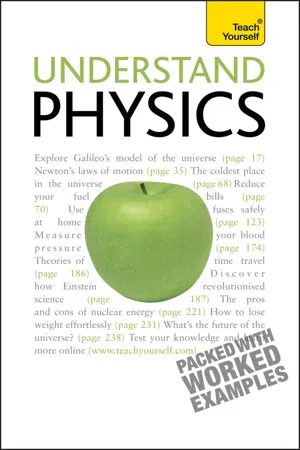
Understand Physics gives you a solid understanding of the key skills and ideas that run through the subject. You will explore the important concepts of force and motion, electricity, light, molecules, matter and space and discover the frontiers of physics. With numerous questions, answers and worked examples throughout, you will feel confident in approaching the science and applying your knowledge.
NOT GOT MUCH TIME?One, five and ten-minute introductions to key principles to get you started.
AUTHOR INSIGHTSLots of instant help with common problems and quick tips for success, based on the author's many years of experience.
TEST YOURSELFTests in the book and online to keep track of your progress.
EXTEND YOUR KNOWLEDGEExtra online articles at www.teachyourself.com to give you a richer understanding of physics.
FIVE THINGS TO REMEMBERQuick refreshers to help you remember the key facts.
TRY THISInnovative exercises illustrate what you've learnt and how to use it.
- 288 pages
- English
- ePUB (mobile friendly)
- Available on iOS & Android
eBook - ePub
Understand Physics: Teach Yourself
About this book
Information
1
Starting physics
In this chapter you will learn:
- why physics has always been a very important subject, from thousands of years ago right to the present time
- why Archimedes became a legend when he carried out the first recorded example of non-destructive testing
- how to measure the density of an object.
Physics has always been at the leading edge of human thought, not just in recent times but also before the Scientific Age, which began about four centuries ago. The theories of science that were held to be true long ago might seem very odd when we compare them with our present knowledge. We must not forget though that the scientists of ancient times, or natural philosophers as they were then called, came up with ideas and theories that were astonishingly sophisticated in comparison with other aspects of life in those times. In this chapter we will look at some of the physics ideas from long ago to see just how these ideas were developed and used. Then we will look at some important skills needed in physics, before moving on to use these skills to carry out density tests.
Physics in practice
BEFORE THE SCIENTIFIC AGE
Many theories of science before the Scientific Age were based on the assumptions that the Earth was at the centre of the Universe and that living beings were created by one or more superior beings who designated a special role for humans. The idea that humans evolved from apes over thousands of centuries found little favour, as it omitted the role of a creator. Theories about the natural world were usually chosen on grounds we would consider unscientific, and selected facts were used to support the theories. Other facts that did not match the theories were discarded as unreliable or imperfect. Not surprisingly, alchemy and astrology were two major strands of scientific endeavour before the Scientific Age. For example, attempts to turn lead into gold or to predict events occupied the working lives of many individuals, undoubtedly financed by rich and powerful patrons who imagined that they would amass further wealth as a result of such activities.
Science as a recorded activity flourished in the culture of Ancient Greece and the Mediterranean civilizations which developed from Greece. The idea that matter is composed of ‘atoms’ too small to be seen individually was a theory put forward by Democritus (470–400 BCE). Two centuries later, Aristarchus put forward the theory that the Sun was at the centre of the Universe. In the next century, Archimedes (287–212 BCE) made important discoveries in mechanics and mathematics. The importance of the scientific heritage bequeathed by these and other natural philosophers of the ancient Mediterranean civilizations is undisputed. Indeed the impact of one particular natural philosopher, Aristotle (382–322 BCE), was to influence the conduct of science for many centuries, right through to the beginning of the Scientific Age.
Aristotle was trained by the philosopher Plato, who founded the Academy in Athens. Aristotle accepted Plato’s theory of ideas as ‘eternal patterns’ that lie beyond the natural world. However, he recognized the importance of observations in formulating ideas about nature. Where observations could not be used to decide between competing theories, Aristotle rejected any theory that did not support the accepted ideals and overall philosophy developed by Plato. For example, Aristotle rejected Aristarchus’ theory that the Sun, not the Earth, was at the centre of the Universe. There was no observational evidence that the Earth was rushing through space round the Sun and no evidence either to support the associated idea that the Earth is spinning. Nor would Aristotle accept the idea that matter is composed of atoms. He rejected the idea of atoms in favour of the theory that all matter is made of the four elements: earth, water, air and fire. This older theory fitted the idea that the Earth is at the centre of the Universe, water in the seas lies above the Earth, air lies above the seas and fire is in the heavens.
Insight
Aristotle recognized the importance of observations in support of his ideas about nature and his overall philosophy.
Aristotle shaped science into a coherent set of ideas that were consistent with the prevailing world-view, namely that the Earth is the centre of the Universe and therefore a special place has been accorded to the human race by the creator of the Universe. However, Aristotle’s rejection of theories that did not fit in meant that interesting ideas were not followed up and investigated further. Aristotle stamped his method on science so firmly that it lasted for over 15 centuries. His approach of picking facts to support accepted theories dominated the way science was conducted long after his death, from Ancient Greece, through the Roman Empire, the Dark Ages and into the Middle Ages. Perhaps Aristotle’s authority enabled science to survive over this long period, especially through the Dark Ages. The Church promoted Aristotle’s scientific method, in particular the model of the Universe developed by Ptolemy a century after Aristotle. Ptolemy held that the Earth was at the centre of the Universe, with the Sun and Moon moving round it in different circular orbits. Each planet moved round in a circle whose centre moved round on its own circular orbit. This model explained the movement of the Sun, Moon and planets and fitted in with the concept of the ‘geocentric’ universe. We will look later in this chapter at the bitter struggle between Galileo and the Church which eventually led to the overthrow of Ptolemy’s model.

Figure 1.1 Ptolemy’s model of the Solar System.
ARCHIMEDES, THE FIRST GREAT SCIENTIST
Archimedes was born in Sicily, where he worked under the patronage of King Hiero, the island’s ruler. Archimedes kept in touch with the scholars of Alexandria in Egypt, where one of his inventions, the water screw, was put to practical use to raise water from the river Nile. This device consists of a tight-fitting screw in a cylinder. With the cylinder in water at its lower end, turning the screw raises water up the cylinder from the lower end. Archimedes’ screw allowed farmers to irrigate the land bordering the river Nile.
Archimedes also discovered the principle of the lever and worked out how a force could be increased using a lever. No doubt you have used the lever principle to move an obje...
Table of contents
- Cover
- Title
- Copyright
- Acknowledgements
- Contents
- Meet the author
- Only got a minute?
- Only got five minutes?
- Only got ten minutes?
- 1 Starting physics
- 2 Science in motion
- 3 Forces in action
- 4 Machines at work
- 5 Thermal physics
- 6 Engines and thermodynamics
- 7 Electricity
- 8 The nature of light
- 9 Materials and molecules
- 10 The age of new physics
- 11 The structure of matter
- 12 Energy from the nucleus
- 13 Journey into space
- 14 A challenging future
- Glossary
- Taking it further
- Answers to chapter questions
- Index
Trusted by 375,005 students
Access to over 1.5 million titles for a fair monthly price.
Study more efficiently using our study tools.
Frequently asked questions
Yes, you can cancel anytime from the Subscription tab in your account settings on the Perlego website. Your subscription will stay active until the end of your current billing period. Learn how to cancel your subscription
No, books cannot be downloaded as external files, such as PDFs, for use outside of Perlego. However, you can download books within the Perlego app for offline reading on mobile or tablet. Learn how to download books offline
Perlego offers two plans: Essential and Complete
- Essential is ideal for learners and professionals who enjoy exploring a wide range of subjects. Access the Essential Library with 800,000+ trusted titles and best-sellers across business, personal growth, and the humanities. Includes unlimited reading time and Standard Read Aloud voice.
- Complete: Perfect for advanced learners and researchers needing full, unrestricted access. Unlock 1.5M+ books across hundreds of subjects, including academic and specialized titles. The Complete Plan also includes advanced features like Premium Read Aloud and Research Assistant.
We are an online textbook subscription service, where you can get access to an entire online library for less than the price of a single book per month. With over 1.5 million books across 990+ topics, we’ve got you covered! Learn about our mission
Look out for the read-aloud symbol on your next book to see if you can listen to it. The read-aloud tool reads text aloud for you, highlighting the text as it is being read. You can pause it, speed it up and slow it down. Learn more about Read Aloud
Yes! You can use the Perlego app on both iOS and Android devices to read anytime, anywhere — even offline. Perfect for commutes or when you’re on the go.
Please note we cannot support devices running on iOS 13 and Android 7 or earlier. Learn more about using the app
Please note we cannot support devices running on iOS 13 and Android 7 or earlier. Learn more about using the app
Yes, you can access Understand Physics: Teach Yourself by Jim Breithaupt in PDF and/or ePUB format, as well as other popular books in Physical Sciences & Physics. We have over 1.5 million books available in our catalogue for you to explore.