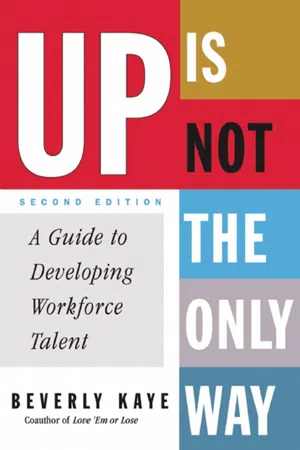
This classic shows how to forge the link between organizational strategic planning and individual career planning and development. Along with practical tips, action items, cases, and exercises, Beverly Kaye provides detailed guidelines and techniques for helping employees target suitable career goals, devise action plans, acquire appropriate skills, and develop evaluation procedures that will satisfy organizational needs. New features in this edition include communication strategies, techniques for recognizing talent in diversity, and a new approach to mentoring. Beverly Kaye is president of Career Systems International in Scranton, Pennsylvania. Her cutting-edge management and career development programs are used by Fortune 500 companies globally. A prolific writer and popular lecturer, Kaye is coauthor of Love 'Em or Lose 'Em, a Wall Street Journal best-seller that provides strategies for retaining knowledge workers, and of the classic Designing Career Development Systems. Kaye has received numerous honors and awards, including the National Best Practice Award from the American Society for Training and Development for her work with Chevron, Bechtel, Dow Corning, and First USA. Find out more about Beverly Kay's management and career development programs at www.careersystemsintl.com.
- 320 pages
- English
- ePUB (mobile friendly)
- Available on iOS & Android
eBook - ePub
About this book
Information
1
The Process and the Payoff
“The significant problems we face today
cannot be solved at the same level of thinking
we were at when we created them.”
–ALBERT EINSTEIN
cannot be solved at the same level of thinking
we were at when we created them.”
–ALBERT EINSTEIN
It all used to be so simple. American workers selected a career area, educated themselves to pursue it, settled into an organization that could use their talents, worked to achieve higher rungs on the corporate ladder, and collected a gold watch at the mandatory sixty-five-year retirement age.
Myriad social, economic, and legal changes of the past decades have radically disrupted this long-standing pattern. Individuals and organizations seem at a loss for means to anticipate and cope with the turbulence and rapid evolution of their environments. Rather than direct their own progress, individuals and organizations are instead controlled by their environments, with a subsequent loss of power and productivity. It is important that both the organization and the individual develop the ability to manage and direct such change to their own benefit.
Organizations are forced to deal with a rapidly changing environment, increased competitive pressure, pressures of globalization, swift and drastic economic shifts, as well as an exponential growth in the area of technology. How do organizations come to terms with these environmental conditions? The literature abounds with different strategies. Some advise being proactive, taking action before the environment forces the organization to react. Others tout reengineering, overhauling the structures and processes for quality and flexibility. Still others advocate self-design, building in the mechanisms for the organization to strategically and continually change itself. And there are also those who think the solution lies in the learning organization, a dynamic organization that constantly seeks and responds to feedback.
The individual operates in this same turbulent environment. To remain relevant and competitive, the individual must take action. Just as businesses face fiercer competition, employees must also compete. Career planning and development activities are to the individual what reengineering is to the firm. The individuals in today’s business environment must be dynamic and ready to take charge; they must take a business approach to planning their careers.
Career development is ideally a joint effort between the individual, the manager or leader, and the organization. While the individual has the primary responsibility for his or her own career, the leader is a supportive coach, and the organization provides the necessary systems and information. Career development involves looking realistically at the present conditions and at the career environments of today and tomorrow in order to regain the control necessary to ensure future productivity and job satisfaction.
And career development is more than this. Not only does it aid the individual in confronting and coping with a rapidly evolving working world, but it can also be a vital link between individual and organizational goals and objectives. It can become the vehicle for implementing the human resource aspects of a company’s strategic plan (for such a plan must also look closely at this resource and formulate a framework for its development and use). Career development in this sense, therefore, is not simply another human resource activity; instead it is an integrating concept that systematically ties together and builds upon human resource programs that already exist, so that they simultaneously support individual and organizational growth.
This book addresses the rationale and design of such career development efforts and is directed to those individuals who are charged with initiating and implementing those efforts within the organization.
The Employee Stimulus
The rising interest in career development has been stimulated by heightened (or at least more vociferously articulated) employee desires, such as:

Employees who are dissatisfied with any of the above areas or with the “old” motivators of money, status, or other tangible rewards are not hesitating to leave the firm at the first sign of a better offer. And they will leave the second job if conditions are not much better. Job changing, especially among the younger workers who are needed to prime the future management pump, is becoming a common phenomenon. And it is costing management a bundle, especially when it is unintended or occurs just at the point where the employee is beginning to return some of the initial investment made in training and development. Besides moving from firm to firm, employees of all ages and persuasions are beginning to see “dropping out” as a viable alternative to job stress and dissatisfaction. Men and women, young and old alike, are dropping out, returning to school, touring the country, or changing careers in midstream with increasing frequency.
In addition, employees are prepared to back up their demands for a new lease on working life. The spectacular sales records of self-insight, self-help books, such as What Color Is Your Parachute?, point to a population that is ready to assume responsibility for its own career decisions. Today’s workers do not show the blind faith or undying loyalty to their employers that those of the last generation demonstrated. Their first loyalty seems to be to themselves.
But what was it that changed the mind-set of employees in such a major way? Obviously loyalty is a two-way street. After more than a decade of massive layoffs, downsizings, streamlinings, and rightsizings, organizations face a workforce that no longer can rely on a lifelong commitment from the organization. Sharon Jordan-Evans, leadership consultant, related to me one of countless examples of this new reality of vanishing loyalty: “The CEO of an aerospace subcontracting firm pointed me to his firm’s empty parking lot. ‘This parking lot used to be full at 6 P.M. Now, as you can see, it’s empty at 5 P.M. And many of those people used to log a very productive hour between 5 and 6 P.M. We’re losing about 200 hours of productivity per day.’ This is a very telling indicator of the diminishing loyalty and commitment.”
Employers and employees thus must forge a new relationship, based not so much on mutual loyalty as on mutual benefits. As Waterman and Associates (1994) put it, in return for their employees’ productivity and commitment to the work at hand, employers offer an opportunity for individuals to develop their abilities and enhance their employability.
Changes in the workforce also affect how organizations manage their human resources. The baby boomers are middle-aged, causing a congestion at the middle- and upper-management level. There is also evidence that the younger generation has not received the quality education needed to shoulder increased responsibilities. And most important, the workforce is becoming increasingly diverse. Women have entered the business world in full force, minorities have more open access to opportunities, and the globalization of business means more organizations are managing a multicultural workforce. While difficult to manage effectively, a diverse workforce offers an opportunity for quality and flexibility.
To further confuse current corporation-employee relations, there are the increasing pressures and expense of keeping up with technological change. Our knowledge base is growing so quickly that individuals will no longer be able to think in terms of career education, but rather of a lifetime of multiple careers. It is the job of the organization to assist its employees in coping with this rapid change. The firm must be prepared to help its employees avoid the erosion of their skills and the onset of individual obsolescence.
Rapid changes in business technology require flexible employees and employers who are receptive to change. Those who cannot meet this demand become difficult to utilize. Management is then faced with a difficult decision: how to maintain productivity levels without having to terminate employees who contributed years of effective performance before reaching obsolescence. Complicating this issue, of course, is the implication of possible age discrimination. It is not an easy decision to make.
The Organizational Response
During the day...
Table of contents
- Cover Page
- Title Page
- Copyright Page
- Dedication
- Contents
- Exercises
- Case
- Foreword
- Preface
- Acknowledgments
- 1 The Process and the Payoff
- 2 Readying Resources The Preparing Stage
- 3 Tapping Talent The Profiling Stage
- 4 Optimizing Options The Targeting Stage
- 5 Making Maps The Strategizing Stage
- 6 Pursuing Plans The Implementing Stage
- 7 Remaining Relevant The Sustaining Stage
- 8 Participating Practitioners
- 9 Postscript
- References
- Resources
- About the Author
- Index
Trusted by 375,005 students
Access to over 1.5 million titles for a fair monthly price.
Study more efficiently using our study tools.
Frequently asked questions
Yes, you can cancel anytime from the Subscription tab in your account settings on the Perlego website. Your subscription will stay active until the end of your current billing period. Learn how to cancel your subscription
No, books cannot be downloaded as external files, such as PDFs, for use outside of Perlego. However, you can download books within the Perlego app for offline reading on mobile or tablet. Learn how to download books offline
Perlego offers two plans: Essential and Complete
- Essential is ideal for learners and professionals who enjoy exploring a wide range of subjects. Access the Essential Library with 800,000+ trusted titles and best-sellers across business, personal growth, and the humanities. Includes unlimited reading time and Standard Read Aloud voice.
- Complete: Perfect for advanced learners and researchers needing full, unrestricted access. Unlock 1.5M+ books across hundreds of subjects, including academic and specialized titles. The Complete Plan also includes advanced features like Premium Read Aloud and Research Assistant.
We are an online textbook subscription service, where you can get access to an entire online library for less than the price of a single book per month. With over 1.5 million books across 990+ topics, we’ve got you covered! Learn about our mission
Look out for the read-aloud symbol on your next book to see if you can listen to it. The read-aloud tool reads text aloud for you, highlighting the text as it is being read. You can pause it, speed it up and slow it down. Learn more about Read Aloud
Yes! You can use the Perlego app on both iOS and Android devices to read anytime, anywhere — even offline. Perfect for commutes or when you’re on the go.
Please note we cannot support devices running on iOS 13 and Android 7 or earlier. Learn more about using the app
Please note we cannot support devices running on iOS 13 and Android 7 or earlier. Learn more about using the app
Yes, you can access Up Is Not the Only Way by Beverly Kaye in PDF and/or ePUB format, as well as other popular books in Business & Management. We have over 1.5 million books available in our catalogue for you to explore.