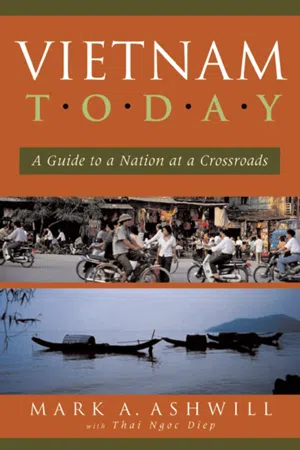
Vietnam stands at a crossroads. Located in the geographical center of Southeast Asia, Vietnam is a complex mixture of the ancient and the modern. A Soviet-style legacy contrasts with an emerging Western-style market economy. Vietnam is faced with pressing political, social and economic challenges, and yet it is full of hope and potential. Here is a first look at Vietnam in the twenty-first century, a nation undergoing rapid change and opening up to the world. Dr. Mark Ashwill paints a broad picture of Vietnam, past and present, and explores today's defining issues. Readers come to understand how a two-thousand-year history of foreign invasion, occupation and war has deeply influenced the Vietnamese character. The Chinese, French and U.S. Americans have all left their imprint. Yet the struggle against oppression has infused the Vietnamese with a fierce spirit of nationalism and caution in their dealings with foreigners. Building relationships and trust as a prelude to doing business are critical to the Vietnamese, whether at home or abroad. Vietnam Today reveals the most prominent characteristics of the Vietnamese: their energy and drive, the dominance of group over individual and the paramount importance of maintaining harmony. In doing so, Ashwill and his Vietnamese contributor shed light on many sources of misunderstanding between Vietnamese and Western professionals. But for those who are prepared to take the time to get to know the people, to move at their pace, and to learn about their culture and history, Vietnam can be a land of promise and opportunity.
- 222 pages
- English
- ePUB (mobile friendly)
- Available on iOS & Android
eBook - ePub
About this book
Information
Topic
Negocios y empresaSubtopic
Negocios internacionalesCHAPTER ONE
Nation at a Crossroads
Viet Nam is now at a crossroads and must decide whether short-term economic growth should take precedence over the long-term struggle to broaden the horizons of human freedom.
—WILLIAM DUIKER
The Vietnam of today is full of promise and potential, pulsating with energy and steeped in dreams. At the same time, Vietnam has entered the twenty-first century faced with a range of pressing political, social, and economic problems—some the result of bad policies, mismanagement, and ideological rigidity, others the legacy of colonialism, war, and subsequent attempts to punish the country for political reasons. At the same time, those who come with a knowledge of Vietnamese culture and the ability to connect and adapt—along with an abundance of energy, patience, perseverance, flexibility, humor, and commitment—will be well positioned to bridge the cultural chasm that separates Vietnamese culture from that of the West.
If you arrive in Hanoi in the summer, or in Ho Chi Minh (HCM) City (formerly Saigon) at any time of year, expect to be enveloped by a thick blanket of heat and humidity the second you step out of the air-conditioned airport. Also expect to have your senses assaulted by the kaleidoscopic smells, both tantalizing and nauseating, and sounds, both wondrous and earsplitting, of a developing tropical country. Your first walk across a street in either city will be a test of your ability to keep your wits about you, to be aware of everyone and everything around you, and to reach the other side safely by walking in measured steps and at a steady pace, allowing—trusting—drivers to glide around you, in effect putting your health, and possibly your life, in their hands. As one first-time visitor put it, “to cross the street requires nerves of steel, a Buddha’s inner calm, or, failing that, a stiff drink” (McLane 2004). Welcome to Vietnam!
Walking around, you soon discover that very few aspects of the physical environment are uniform and predictable, as in most Western countries. Beware of holes, wires not adjusted to the height of the average Westerner, unexpected steps, and other idiosyncrasies that reflect uneven development and progress on both literal and figurative levels. For example, though Hanoi now has stoplights, human beings still lower the gate before an approaching train rumbles by.
Foreigners who visit Vietnam for the first time often succumb to a myopic view of the country, making snap judgments based on limited experience. Resist the temptation to jump to conclusions based on minimal information or to attempt to make Vietnam conform to your preconceived, culturally shaped perceptions of what is real, what is normal. Consider traffic, for example. Traffic in Vietnam’s cities may appear at a glance to be chaotic and disorganized, but it can also be seen as an organic whole in which every participant is in fact working in tandem with everyone else—seemingly competitive, but cooperative as well. As if following some societal law of physics, spaces are filled almost as quickly as they open up. As you cross a street, you need to remain alert, sensitive to everything going on around you. And this applies also to your interactions with Vietnamese: you must learn to read between the lines, to become able to hear the true meaning behind their words, their silence, and their body language.
There are many more examples of how Westerners in Vietnam may leap too quickly to conclusions. Here are just a few:
• You may conclude that Vietnam’s cities are filthy because you see so many bags of trash lying in the gutters. In fact, they are waiting to be picked up by the legion of efficient, blue-shirted sanitation workers, wearing conical hats, who load them onto waiting garbage trucks.
• You may be surprised to see men holding hands in a country in which homosexuality is taboo. In fact, holding hands or walking arm in arm is acceptable among friends of the same sex, while generally frowned upon for members of the opposite sex. (Like so many other things in Vietnamese culture, this, too, is changing.)
• You may notice that some men have abnormally long fingernails by Western standards. No, they are not being effeminate; they are just making it clear that they are not manual laborers.
• Young women driving motorbikes may appear to be making a fashion statement by wearing gloves and covering their arms. In fact, they are trying to avoid getting a suntan in a society that values light over dark skin, because the latter is equated with working in the fields from dawn to dusk.
We fall into the trap of using our own culture as a frame of reference, and lack an appreciation for and understanding of the radical transformation that Vietnam has undergone since the early 1990s. Developments that many visitors take for granted—the telecommunications system, the availability and quality of consumer goods, and the depth and breadth of the hospitality industry, including Vietnamese and foreign restaurants, cafés, nightclubs, and karaoke—were unimaginable just a few years ago. Restaurants featuring foreign cuisine, which used to cater to a largely foreign clientele, are now frequented by young urban Vietnamese who can easily afford the comparatively higher prices.
Twenty years ago, making telephone calls across town could be problematic; now Vietnamese with Internet access are chatting with people around the world, and motorbike drivers can be seen talking on cell phones or sending text messages while cruising along at thirty-five miles an hour. Even the ways young people express affection toward one another have changed in the past ten years: whereas traditionally it was acceptable to hold hands only with a friend of the same sex, today it is common to see young men and women walking down the street hand in hand. And marriages between Vietnamese and foreigners, though still rare, are increasing in number and in degree of social acceptance.
The Hanoi and HCM City of 2004 bear little resemblance to their former selves in the immediate postwar period. As recently as the early 1990s, both cities were described as sleepy towns. Those were the days when Vietnam was just beginning to reform its economy and open up to the rest of world. It was before the presence of disposable income that enables people to purchase motorbikes, cars, cell phones, and fashionable clothes, or to go out for a night on the town; before the appearance of foreigners from anywhere other than the Soviet Union and the countries of Eastern Europe; before the advent of information technology that would link Vietnam with the global community.
Hoan Kiem Lake, one of the jewels of Hanoi and its main tourist area, is now brimming with activity—foreigners and Vietnamese making their rounds, young people whispering sweet nothings into each other’s ears after sunset, the steady drone of traffic, restaurants and shops in every direction, people sitting in a café overlooking the city sipping lime juice and eating coconut ice cream. In the mid-1980s, it was a quieter, darker, almost serene place, with only the whir of bicycle tires, the muffled sounds of voices, and the occasional Russian. The gardens were not as well maintained in those days, and few shops beckoned customers.
An expat who spent many years in Vietnam remembers the Hanoi of 1992—daily blackouts, very few paved roads, dirty streets. She recalls how she was unable to ask many questions outside of family or general cultural information, and also how she was asked in shops and on the street if she was Russian (at a time when most of the foreigners in Vietnam were in fact Russian).
Another Westerner, who arrived in 1994 to begin establishing his company’s presence in Vietnam, trained everyone on his fledging staff except the driver (“the only one who knew his job”). His most important decision at the time? Hiring his first local employee, who is still with the firm—a decision he says he made on the basis of “gut instinct.”Nowadays, according to this employer, hiring is much easier in terms of both job seekers’ qualifications and the ability to talk to other people about job applicants.
Just ten years ago, shortly after the trade embargo was lifted, Coca-Cola—much to the dismay and anger of the Vietnamese—was erecting giant billboards across the street from the historic opera house in Hanoi in a race to capture the nascent cola market. Today, sophisticated Western-style advertising in Vietnamese and English graces the city’s skyline in the form of billboards and signs, and TV commercials cater to a rapidly growing urban middle class. The effect of seeing this sort of advertising side by side with hand-painted posters and billboards exhorting people to have only two children, to beware of the dangers of HIV/AIDS, and to vote in an upcoming election can be a bit surreal.
Although Vietnam is still a poor country plagued by many of the problems that characterize the developing world, including corruption, child malnutrition, environmental degradation, unemployment, and underemployment—and, unlike many other developing countries, has had to cope with the additional legacy of being at war for two generations—it has made stunning progress on the home front and in the steps it has taken to become a full-fledged member of the international community. And—also unlike many other developing countries—Vietnam is stable and safe, with a government that is generally committed to improving the lives of its citizens.
Although the market reforms of the late 1980s have contributed to Vietnam’s recovery and to a stratospheric economic growth rate, they have also led to a widening gap between rich and poor and to a rural–urban migration, as in China, that the nation’s cities simply cannot absorb. In the prologue to Hanoi: City of the Rising Dragon, the authors have this to say about the “renovation” and its prospects for success:
. . . this renovation, if it is genuine and characterized by openness to a market economy, still has a long way to go. The ideologues have not had their last word yet, and the countless survivors of Vietnam’s many battles may well question the ambiguity of liberation, of national unification, of a socialist system that offers no prospects for the popular majority, and of economic development that only aggravates inequality. But it could not be otherwise in a system that encourages opportunity businesspeople and foreign investment but does not resolve problems like over-population, dilapidated housing, poor sanitation, or schools that are deserted because of high tuition and low teacher salaries. (Boudarel and Nguyen 2002, 6)
There are other, less tangible changes that may reflect a shift in values, especially among the younger generation, from a collectivist to a more individualist orientation, the result of a market economy that emphasizes competition, image, and consumerism. Nevertheless, although money has increased in figurative value, a sense of community and the family remain important to Vietnamese of all ages and backgrounds.
Gone are the old days when people pretended to be poor so that it would not appear that they were becoming capitalistic, a fear that resulted from years of centralized economic planning in the North. That was a time when a family would sell its food vouchers on the free (read “black”) market in order to buy good meat, say, or fish, and prepare a feast for the entire family. Then, so as not to draw attention to themselves in the neighborhood, they would stagger the visits of aunts, uncles, and grandparents throughout the day. Similarly, in another example of savoring a rare treat in secrecy, one family adopted the practice of cutting a chicken with scissors rather than a knife to ensure that the process was a quiet and inconspicuous one. Only during Tet (the Lunar New Year) and for meals honoring ancestors would they use a knife to cut up the chicken.
Poverty is the great equalizer, and there was a time when the Vietnamese were unified and in solidarity in terms of what they had—and, during wartime, in relation to the common enemy against which they fought. Personal initiative and risk taking in pursuit of material gain were not valued commodities under the old system. The emphasis, for both historical and political reasons, was on “safety in numbers” and working together for the common good, which frequently involved prolonged resistance against a foreign invader and physical survival.
It was a view that prevailed until quite recently. I remember cruising around Hanoi in the mid-1990s with an acquaintance in his shiny new Mercedes while he spoke of the government’s ambivalent view of the private sector and of the gnawing feeling that he could become a victim of his own success. Aside from his luxury German car, one of the few in Hanoi at that time and his only ostentatious display of wealth, his lifestyle did not reflect his status as a multimillionaire. Now, less than ten years later, the official view of the private sector is supportive, and the number of luxury cars driven by Vietnamese has skyrocketed, a barometer of increasing urban wealth.
For better and for worse, the consumer economy has arrived with a vengeance in Vietnam, particularly in the cities. In the Vietnam of 2004, especially among the members of the urban elite, the trend is to show off one’s financial well-being, whether by wearing name-brand clothes (even if they are domestically produced rip-offs) and expensive jewelry, or by driving a high-end motorbike or car. Competition is making inroads in a collectivist society, and inequality of income and wealth is on the rise. To use the traffic analogy again, one’s mode of transportation is a probable indicator of social class—from car to motorbike to bicycle to that behemoth of the road, the humble bus.
Of course, these changes range from the superficial to the substantive, encompassing the physical, economic, and legal infrastructure of the country. They are also fundamental and irreversible. There are few places in the world where so much has changed in so short a time. The atmosphere in Vietnam, especially in the cities, is electric, the energy of the people palpable. The country continues to forge ahead and may well achieve its goal of institutionalizing a “market economy with socialist orientation,” or “red capitalism,” guided by an authoritarian, centralized government with a ruling elite.
CHAPTER TWO
Country Overview
Vietnam could become the Taiwan of Southeast Asia in the next twenty years.
—EUROPEAN EXPATRIATE
This chapter presents a general overview of Vietnam, including geography, demographics, the economic and political systems, the business environment, and foreign investment. The intent here is to provide some basic background information before going on to a more detailed discussion of other aspects of Vietnamese culture and society.
Geography
Vietnam, which has been described as a shoulder pole with a rice basket at each end, stretches in an S-shape from China in the north to the Gulf of Thailand in the south. In the center, near Hue, only 50 kilometers (about 30 miles) separate the South China Sea (known as the East Sea in Vietnam) from Laos. Situated in the center of Southeast Asia, closer to the Tropic of Cancer than to the Equator, Vietnam offers everything from tropical coastal lowlands to temperate zones above 2,000 meters (about 6,500 feet) in elevation. To put these facts and figures in perspective, consider that most of this geographic diversity is condensed into an area than can be covered in a two-hour flight from Hanoi in the North to HCM City in the South.
Vietnam is a lush, verdant country defined by the color green and by the element of water. Rice paddies in low-lying areas stretch as far as the eye can see; cash crops such as coffee and rubber thrive in the Central Highlands, rice, bananas, sugarcane, and coconuts in the Mekong Delta region. There are also rolling hills covered with thick jungle and jagged mountains rising more than 3,000 meters (nearly 10,000 feet) into the sky, the jutting limestone rock formations in the aqua blue waters of the East Sea and over 3,200 kilometers (about 2,000 miles) of coastline with pristine white sand beaches. Seventy-five percent of the country consists of mountains and hills, including spectacular mountain ranges in the northern and central regions, running along the border with Laos and Cambodia.
Vietnam has an amazingly varied climate, ranging from very hot in the South to bitterly cold and (on rare occasions) even snowy in the mountains near the Chinese border. Visitors to the North are often surprised by the region’s distinct seasons: an oppressively hot, humid summer followed by a pleasant and, as the locals say, “romantic” autumn with the scent of seasonal flowers in the air, then a cool to cold winter punctuated by damp, penetrating drizzles, and finally a spring that begins warming up shortly after Tet, the Vietnamese Lunar New Year. During a May trip to Hanoi, there were days when it was actually cooler than in my home state of New York, an example of how temperatures can fluctuate before summer arrives. In July, the average temperature in Hanoi is a steamy 28.6°C (83.5°F), in Hue 28.9°C (84°F), and in HCM City 27.6°C (82°F). Humidity can reach 90 percent in the rainy season, from May to October. In the South, the year-round midday heat is mitigated by sudden showers, which have a welcome moderating effect, and by an occasional cool tropical breeze.
Most of the population is found in the two main cultivated areas, the Red River Delta in the North and the Mekong Delta in the South. Central and northern Vietnam are at greatest risk for seasonal flooding precipitated by the heavy rains and typhoons that develop between July and November. Flooding of the Mekong River is less severe than along the Red River, where, when flood control measures (a system of dikes and levees) fail, the results can be catastrophic. The change in seasons and its impact on the environment and the people is obvious when seen from the air—villages like islands, with rivers and their tributaries spreading out over the countryside in all directions. It is one of the forces of nature that the Vietnamese have lived with and attempted to control for millennia.
People
The first and lasting impressions of the Vietnamese people are of their wa...
Table of contents
- Cover Page
- Title Page
- Copyright Page
- Contents
- Acknowledgments
- To the Reader
- Introduction
- CHAPTER 1 Nation at a Crossroads
- CHAPTER 2 Country Overview
- CHAPTER 3 A Brief History
- CHAPTER 4 Vietnam at Peace
- CHAPTER 5 Core Cultural Dimensions
- CHAPTER 6 Working with the Vietnamese
- CHAPTER 7 How the Vietnamese See Westerners
- CHAPTER 8 Epilogue
- Appendixes A. Vietnam: A Statistical Profile
- B. Historical Highlights
- C. Recommended Websites
- References and Recommended Readings
- Index
Trusted by 375,005 students
Access to over 1.5 million titles for a fair monthly price.
Study more efficiently using our study tools.
Frequently asked questions
Yes, you can cancel anytime from the Subscription tab in your account settings on the Perlego website. Your subscription will stay active until the end of your current billing period. Learn how to cancel your subscription
No, books cannot be downloaded as external files, such as PDFs, for use outside of Perlego. However, you can download books within the Perlego app for offline reading on mobile or tablet. Learn how to download books offline
Perlego offers two plans: Essential and Complete
- Essential is ideal for learners and professionals who enjoy exploring a wide range of subjects. Access the Essential Library with 800,000+ trusted titles and best-sellers across business, personal growth, and the humanities. Includes unlimited reading time and Standard Read Aloud voice.
- Complete: Perfect for advanced learners and researchers needing full, unrestricted access. Unlock 1.5M+ books across hundreds of subjects, including academic and specialized titles. The Complete Plan also includes advanced features like Premium Read Aloud and Research Assistant.
We are an online textbook subscription service, where you can get access to an entire online library for less than the price of a single book per month. With over 1.5 million books across 990+ topics, we’ve got you covered! Learn about our mission
Look out for the read-aloud symbol on your next book to see if you can listen to it. The read-aloud tool reads text aloud for you, highlighting the text as it is being read. You can pause it, speed it up and slow it down. Learn more about Read Aloud
Yes! You can use the Perlego app on both iOS and Android devices to read anytime, anywhere — even offline. Perfect for commutes or when you’re on the go.
Please note we cannot support devices running on iOS 13 and Android 7 or earlier. Learn more about using the app
Please note we cannot support devices running on iOS 13 and Android 7 or earlier. Learn more about using the app
Yes, you can access Vietnam Today by Mark A. Ashwill in PDF and/or ePUB format, as well as other popular books in Negocios y empresa & Negocios internacionales. We have over 1.5 million books available in our catalogue for you to explore.