What is global leadership? It turns out that many companies around the world are missing a key point: that global leadership is distinctly different from the leadership skills needed in a domestic operation. The global economy requires a new set of leadership skills-imbued with a global mindset, multi-functional and effective across cultures and nationalities-that were not as critical even a decade ago. In What Is Global Leadership?, the authors draw on cutting-edge research conducted by Aperian Global, including first-hand interviews with successful global leaders, which highlights ten key behaviors critical to international settings, such as cultural self-awareness, frame-shifting, and developing "third-way solutions." In addition to providing a detailed description of each behavior, the authors demonstrate how these can be applied in the context of leadership development programs, executive coaching, global teams, and leader-led action learning. Whether one is leading an entire organization, a business unit, or a geographically dispersed team, this essential guide provides an important resource for developing global leadership talent.
eBook - ePub
What Is Global Leadership?
10 Key Behaviors That Define Great Global Leaders
- 256 pages
- English
- ePUB (mobile friendly)
- Available on iOS & Android
eBook - ePub
About this book
Information
CHAPTER ONE
Why Global Leadership?
Acompelling set of underlying trends drives the current focus on global leadership. Many companies have gone through enormous changes in recent times in response to dynamic—bordering on cataclysmic—economic events. They have shaken up their operations and increased, reallocated, or curtailed investments to cope with unprecedented market fluctuation. These megatrends have created a new landscape for the world at large and have made a significant impact on the ways companies conduct their daily business.
As strategic plans are shaped for the coming years, the task of determining global strategic priorities and deploying limited resources has never been more crucial. The challenge for most companies, which tend to react relatively quickly to the changing global landscape, is in getting their employees to change as rapidly. Stale mental models dictate outmoded leadership behaviors. The ability to deal with “multiplexity”—complexity in multiple forms—requires frequent retooling of previous skill sets and a new or expanded repertoire of leadership behaviors. There is an intense need for leaders who have both the vision and the skills to function effectively in a world that is simultaneously boundaryless and replete with boundaries that mark significant differences across a broad spectrum of business and culture: customer needs, supply chain issues, employee motivation, competition, ethical standards, legal frameworks, standard business practices, religious and political influences, educational systems, and so on.
Three Megatrends
Amidst the dynamic global landscape, full of uncertainty as well as clearer trend lines, what are the key underlying currents that we need to track, and what are their practical implications for global leadership strategy? Futurists have their own predilections and temperaments, and they paint different scenarios as well as more general pictures of where our planet is headed, both gloomy and optimistic.1 Some focus on technological developments and their implications, others look at social trends, and still others analyze geopolitical forces. Futurism provides a unique license to speculate without immediate feedback on one’s predictions, which can only be assessed years down the road (in contrast to investment advisors who must compete each year with monkeys throwing darts).
An important piece of futurist advice is that the years ahead will most probably bring discontinuous events that cannot be accurately predicted based strictly upon extrapolations from the present, as with unanticipated and transformative events of recent years such as armed conflicts, terrorism, financial crises, piracy, epidemics, and environmental disasters precipitated by either natural or human causes. Mixed in with these discontinuous events, the crystal ball of futurist projections also holds more easily predictable trends that are either already well-established or which are readily visible and can be expected to spread. Another piece of futurist wisdom maintains that the future is already present at certain locations in our midst (imagine those first clumsy prototype automobiles trundling down dirt roads in the early 1900s) if we have the eyes to perceive it and the imagination to anticipate where it could take us.
Three highly predictable megatrends have been steadily impacting the global business environment for decades; such trends are likely to continue to exert an increasing influence over the future and are shaping an arena in which global leadership skills will be a prerequisite for organizational survival and growth. These three trends are (1) population growth in the developing world, (2) changes in the balance of the gross domestic product (GDP) between developed and emerging markets, and (3) rapid urbanization in Asia and Africa. While they may sound familiar, each trend holds implications with which few, if any, corporations have fully come to terms.2
MEGATREND #1: POPULATION GROWTH IN THE DEVELOPING WORLD
Our planet is currently in the midst of the greatest boom in human population it has ever seen. Demographers project that in the short span of one hundred years, from 1950 to 2050, the world’s population will have more than tripled from approximately 2.5 billion to over 9 billion. Such trend lines are slow to change, and even though population growth has moderated in some locations over the last decades, it is still probable that we will hit or exceed the 9 billion mark within our own lifetimes or those of our children.
What is less commonly recognized about this trend is that virtually one hundred percent of this population growth is occurring in the developing world. The number of people in the developed world was slightly under a billion in 1950, and the population of those same countries in 2050 will probably be little more than a billion. So almost the entire increase of six and a half billion people over this hundred-year span will be in countries that represented only one and a half billion people in 1950—a fourfold increase in the developing countries vis-à-vis the stagnant population size of the developed world (see Figure 1-1).3 This trend has tremendous implications for future markets, consumer demand, workforce demographics, talent availability and readiness, and much more. Consider for a moment the implications of the related fact that nine out of ten of the world’s children under the age of fifteen currently live in developing countries.4
As their markets and the people they lead continue to diverge from the demographic features that dominated the economy in the recent past, present and future leaders will be increasingly unable to cope using only the popular, culturally embedded ideals of leadership often seen on the domestic best-seller lists.
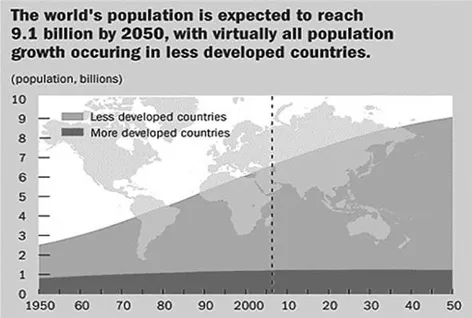
FIGURE 1-1 Projected Global Population Growth
MEGATREND #2: CHANGES IN THE BALANCE OF GDP
Companies accustomed to earning the bulk of their revenues in North America and Europe might argue that their biggest customers and business opportunities are still where they have always been in recent memory and therefore downplay the significance of developing countries’ population growth. However, along with the shifting locus of the world’s population has come a watershed change in the balance of global GDP. Estimates suggest that the combined GDP of the emerging economies has begun to exceed that of the developed world within the last few years, and that this trend will accelerate to the point where the size of the emerging economies will soon be as much as double that of developed economies (see Figure 1-2).5
These emerging economies are still in the process of adding another group of middle-class consumers, estimated variously at more than half a billion people, that will exceed the population of all of Europe. What makes this trend particularly hazardous to ignore is that patterns of both production and consumption in the emerging markets are no longer focused on basic commodities, but now include products and services usually regarded as “high tech.” Here are some examples:
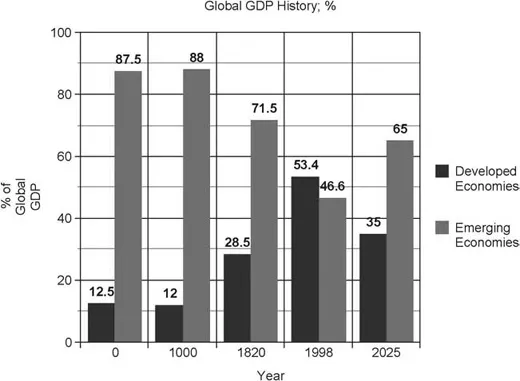
FIGURE 1-2 Global GDP of Developed and Emerging Economies

In a sense, this shift represents a return to the old normal. Looking back, China was the world’s largest economy for most of the last 2,000 years up until the last few centuries, and the Indian subcontinent had the world’s second-largest economy for at least several hundred years—hence, the relatively greater size of the emerging economies prior to the mid-1800s(see Figure 1-2).9
These developing economies don’t always want to act according to Western beliefs and values. Increasingly, they are asserting their own ideas of how the game should be played, notably at the inflection points between business, government, environmental resources, and social causes.
MEGATREND #3: RAPID URBANIZATION IN ASIA AND AFRICA
For the global economy, it makes a big difference where people live and what their occupations are. Rural populations that are engaged primarily in subsistence agriculture are less likely to purchase or provide goods and services delivered across geographic boundaries. When such people move to an urban center, however, their lifestyles tend to become far more enmeshed in the network of global commerce. For instance, they may go to work in factories that produce goods for customers on the other side of the world, and they gradually gain the purchasing power to buy clothes, foods, and consumer items produced elsewhere, while the natural resources of a local farming community are no longer immediately available to them.
North America and Europe already had a majority of their populations living in cities in 1950, and they have become progressively more urban since then, with well over seventy percent of their inhabitants now living in urban centers. In contrast, Asia and Africa were predominantly rural throughout the twentieth century, and are just now undergoing the transformation to a predominantly urban society that other parts of the world experienced many decades ago (see Figure 1-3 below).10 Given the accompanying rapid population increase, we are witnessing the burgeoning growth of cities in the world’s emerging markets of a size and scale never before seen on earth. Consumers in these new markets are already demanding different products and services, developed specifically for their needs and applications, and at price points unheard of in the past and recently regarded as unfeasible by most major corporations.
Implications for Strategy: The Need for a Global Mindset
Population growth, GDP shifts, and urbanization are driving an inexorable transformation in the blend of risks and opportunities faced by commercial enterprises worldwide. Global leadership is becoming an absolutely essential capability because such change can only be grasped and successfully met with a strategic global mindset. Companies will sooner or later need to respond to these trends through their impact on particular industries, and will eventually be rendered obsolete by them if their response is ineffective.
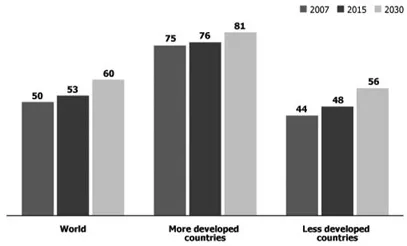
FIGURE 1-3 Percent of the World’s Urban Population
Indeed, the three megatrends outlined previously have a pervasive combined impact that is affecting almost every aspect of life on earth. Climate change, energy supply issues, deforestation, water shortages, species extinction, fisheries depletion, and migration pressures can all be linked to changes in population, GDP,...
Table of contents
- Cover Page
- Title Page
- Copyright Page
- Dedication
- Acknowledgments
- Contents
- Chapter One: Why Global Leadership?
- Chapter Two: What’s Different About Global Leadership?
- Chapter Three: Seeing Differences
- Chapter Four: Closing the Gap
- Chapter Five: Opening the System
- Chapter Six: Preserving Balance
- Chapter Seven: Establishing Solutions
- Chapter Eight: Training the Ten Behaviors
- Chapter Nine: Coaching the Ten Behaviors
- Chapter Ten: Teaming the Ten Behaviors
- Chapter Eleven: The Future of Global Leadership
- Bibliography
- Endnotes
- About the Authors
- Index
Trusted by 375,005 students
Access to over 1.5 million titles for a fair monthly price.
Study more efficiently using our study tools.
Frequently asked questions
Yes, you can cancel anytime from the Subscription tab in your account settings on the Perlego website. Your subscription will stay active until the end of your current billing period. Learn how to cancel your subscription
No, books cannot be downloaded as external files, such as PDFs, for use outside of Perlego. However, you can download books within the Perlego app for offline reading on mobile or tablet. Learn how to download books offline
Perlego offers two plans: Essential and Complete
- Essential is ideal for learners and professionals who enjoy exploring a wide range of subjects. Access the Essential Library with 800,000+ trusted titles and best-sellers across business, personal growth, and the humanities. Includes unlimited reading time and Standard Read Aloud voice.
- Complete: Perfect for advanced learners and researchers needing full, unrestricted access. Unlock 1.5M+ books across hundreds of subjects, including academic and specialized titles. The Complete Plan also includes advanced features like Premium Read Aloud and Research Assistant.
We are an online textbook subscription service, where you can get access to an entire online library for less than the price of a single book per month. With over 1.5 million books across 990+ topics, we’ve got you covered! Learn about our mission
Look out for the read-aloud symbol on your next book to see if you can listen to it. The read-aloud tool reads text aloud for you, highlighting the text as it is being read. You can pause it, speed it up and slow it down. Learn more about Read Aloud
Yes! You can use the Perlego app on both iOS and Android devices to read anytime, anywhere — even offline. Perfect for commutes or when you’re on the go.
Please note we cannot support devices running on iOS 13 and Android 7 or earlier. Learn more about using the app
Please note we cannot support devices running on iOS 13 and Android 7 or earlier. Learn more about using the app
Yes, you can access What Is Global Leadership? by Ernest Gundling in PDF and/or ePUB format, as well as other popular books in Business & International Business. We have over 1.5 million books available in our catalogue for you to explore.