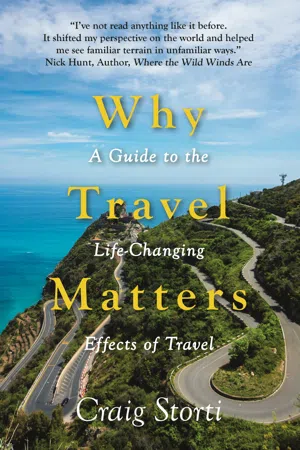
When you travel, you have a choice: You can be a tourist and have a nice time, or you can be a traveller - and change your life. Most people who travel want to get something out of the experience. They want to grow and be changed. Whether travelling for pleasure or work, on a trip of a lifetime, gap year or a short break away, Why Travel Matters will help you broaden your mind and bring back a different self from the one who set out.Using the wisdom of great travellers such as Paul Theroux, Freya Stark, George Orwell, Alexander Pope and Paul Bowles, plus the knowledge won during his years as an intercultural educator, Craig Storti lays out the ways we can approach travel for it to make a true impact. Covering the lessons we can learn from new approaches to daily life, the impact of environment and the ways we relate to ourselves, Why Travel Matters is a deeply practical guide to the transformational power of travel.
- 202 pages
- English
- ePUB (mobile friendly)
- Available on iOS & Android
eBook - ePub
About this book
Information
Topic
Crescita personaleSubtopic
EtnopsicologiaCHAPTER 1
Why Travel Matters
The goal in these pages is twofold: to describe the life-altering effects of travel (chapters 1–4) and to explain how to have the kind of journey that will indeed change your life (chapter 5). We will take up those topics presently but we should first define what we mean by travel, both in the modern era generally and in these pages in particular.
Our subject here is travel to a foreign country and a different culture, not travel inside our own country. Most contemporary observers and scholars of travel agree on the ingredients that define “true” or “serious” travel (so-called because there is also recreational or leisure travel, otherwise known as tourism), and they likewise agree that it’s important to distinguish between travel and tourism. Not so much because one is superior to the other but because they are different kinds of experience with very different results, and people should choose the experience that will give them the results they’re looking for.
Tourism is largely escape from whereas true travel is arriving at; tourism is mainly recreational whereas travel is primarily educational; tourists are driven around and served by the locals whereas travelers want to meet them; tourists want to relax whereas travelers want to be stimulated; the goal of tourism is to see the sights, while the goal of travel is to add to understanding. Paul Theroux, in his trademark curmudgeon mode, observed that “travelers don’t know where they’re going [because that’s not the point] and tourists don’t know where they’ve been” (Swick, 7). In The Oxford Book of Exploration Robin Hanbury-Tenison makes his own sharp distinctions: “There are tourists and there are travellers. The former go abroad to rest their bodies and their minds, no more. The latter go to see and understand” (xiv).
We define travel herein as journeying to a foreign country and encountering a different culture for the purpose of personal growth and self-improvement. Or, as W. Somerset Maugham would have it: adding to one’s personality and bringing back a different self.
But travel in this sense and to these ends has not existed for most of human history, not until the last 300 years or so. Understanding how travel has evolved through the ages will put in perspective the unique opportunities travel offers in the present era. And that perspective, in turn, may inspire today’s voyagers to seize these rare opportunities and make the most of their journeys—inspire them, in short, to be travelers rather than tourists. To that end we take a few pages to offer a short biography of travel.
A Brief History of Travel
Ever since humans graced the earth, more than two million years ago, we have been nomadic wanderers. . . . Sedentary lifestyles in which people sat around log fires until the cows came home are as fictional as they are absurd. Humans don’t do it. They have to travel.
Christopher Lloyd
At the dawn of history the human condition was nothing but travel, in the sense of moving about or nomadism. The life of the hunter-gatherer, the lot of humanity for close to two million years, was ceaseless movement, following the herds and the seasons. If there had been a word for travel back at the dawn of human history, it would have been the equivalent of the word for “life,” or “existence,” or “the way things are,” or simply “what we do.”
“Survival depended on mobility and opportunism,” Brian Fagan has written of the Late Ice Age (16,000 to 13,000 BC). “It was a world of small-scale living, of widely cast social networks, of occasional gatherings where several bands came together, but, above all, of mobility, where small groups survived by ranging over enormous territories . . .” (29). This was movement, to be sure, but personal growth was certainly not the object.
Many observers cite the primordial preeminence of nomadism to explain our puzzling 21st-century wanderlust, to account, that is, for the call of the road enduring into the modern era, long past the time when travel was necessary. If we consider how long mankind spent as wanderers, close to two million years, compared to how long we have lived in towns and villages, less than 20,000 years, it’s no wonder we feel like taking a trip every so often just for the fun of it. Wandering is in our DNA, much like the human fascination with fire. A French writer, Gontran de Poncins, once asked an Eskimo why his people were always on the move. “What can we do?” the man replied. “We are born with the great unrest” (Washington Post Book World, 14).
Then somewhere between 8,000 and 15,000 years ago, mankind learned how to domesticate and breed certain animals and how to grow certain crops, and human history changed forever. Along with the dawn of agriculture came the birth of sedentism, the habit of staying in place, and the beginning of semi- and ultimately permanent settlements. It became normal not to move about or regularly change one’s location, and as sedentism and staying put became the norm, nomadism and travel became the exception.
And not merely the exception: travel quickly became decidedly dangerous and hence demonstrably unwise. To be on the road (although there were almost no roads as such at this time) inevitably meant that you were separated from a settlement and no longer belonged to or could count on the protection and goodwill of a permanent kinship group. You were an exile, a stranger, and there was no one to protect the stranger, no one whose interests were allied with those of the stranger, no one who would benefit in any way from extending courtesy or goodwill to the stranger. If you were on the road in the Stone Age or the Bronze Age, it was because others had ordained it, and they would only ordain such a thing if your presence among them was undesirable. You were on the road, in short, because you had been deemed unfit to inhabit home.
One of Christianity’s great foundation stories, the tale of Adam and Eve, is an allegory of this momentous shift in the human condition from nomadism to sedentism. The story of Adam and Eve is first and foremost a cautionary tale, extolling the virtues of being settled and, largely by implication, the dangers of wandering. The Garden of Eden, after all, is the epitome of sedentism, with its self-reproducing abundance of foodstuffs and its tame and obedient animals. For their sins, Adam and Eve are banished from this idyllic world and condemned to wander. The moral of the tale is clear: only the foolish would risk the refuge and protection offered by the settled life. And the punishment for such foolishness—in Biblical parlance, Adam and Eve’s “penance”—is travel. Thus did travel or nomadism morph from being the human condition to being anathema.
In his book The Mind of the Traveler, Eric Leed observes that the oldest source of our word travel is probably the Indo-European root per, “many of the secondary meanings of which refer explicitly to motion: ‘to cross space,’ ‘to reach a goal,’ ‘to go out’” (5). And the primary meanings of per—to try, to test, to risk—are where we get our words experiment and peril. Paul Fussell finds another and more recent ancestor in the word travail. “A traveler is one who suffers travail,” he writes, “a word deriving in its turn from Latin tripalium, a torture instrument consisting of three stakes designed to rack the body” (1980, 39).
Homer’s Odyssey is probably the most famous example of the Bronze Age view of travel as deeply undesirable, an ordeal, a series of trials that the hero must somehow survive. Odysseus neither chooses to be a traveler nor actively seeks adventure; he is shipwrecked on his return from the Trojan wars and is simply trying to get back to his homeland, Ithaca, and to his beloved wife, Penelope, as soon as possible. Fortunately for western literature, it takes him ten years. From Odysseus’ perspective, his epic adventures are only so many unwanted obstacles to overcome, so many tests set by the gods to keep him from the bosom of home. “There is nothing worse for mortals,” Homer writes, “than a wandering life” (Lapham, 52).
Notice, also, how that other great traveler of the Bronze Age, Gilgamesh, likewise finds his path strewn with obstacles he must surmount before he can return home to his capital, Uruk. “He had journeyed to the edge of the world,” his epic story begins, “and made his way back, exhausted but whole. He had carved his trials on stone tablets” (Mitchell, 69). “Trials,” they are called, not adventures. “When we think of travel in the remote past,” Peter Whitfield has observed,
a number of powerful and resonant words come into our minds: Exodus and Odyssey, Epic and Saga, Quest and Pilgrimage. Each of these words has its own distinct meaning, but all convey one of the primal senses of travel—that it was an ordeal, a challenge, an experience to be endured. Travel was associated with suffering. (2)
Travel in the Stone, Bronze, and Iron Ages, then, is mostly trials, obstacles, and perils. The traveler is not so much a hero as someone to be pitied, and accordingly the arc of the travel narrative is always homeward. Travel is not a journey outward, from home, but the return voyage to home.
One way or another this state of affairs continued through ancient times, up through the Dark Ages and to the beginning of the Middle Ages. By this time strangers no longer had the roads to themselves, of course, but the three most common types of travelers during these epochs—soldiers (including sailors), merchants or traders, and pilgrims—were certainly not in search of self-improvement. Pilgrims probably came the closest, but even pilgrims did not travel for personal growth but to save their immortal souls. “There is plenty of movement from place to place,” Paul Fussell has written of travel in the ancient world and the Dark Ages, but for there to be “real travel, movement from one place to another should manifest some impulse of non-utilitarian pleasure. . . . Until then, it is perhaps best to speak not of travel but of pre-travel” (1987, 21).
By the early Middle Ages there were many more roads and many more people on them. “On the main highways,” medieval historian Morris Bishop has observed, “the traffic was very heavy.” But there was still no one we would call a traveler.
Everyone was on the roads: monks and nuns on errands for their community; bishops bound for Rome or making a parochial visitation; wandering students; singing pilgrims following their priests and their banners; papal postmen; minstrels, quacks, and drug sellers; chapmen and tinkers; seasonal workmen and serfs out of bond; discharged soldiers, beggars, and highwaymen. . . . (185, 186)
In his book Touring in 1600, E. S. Bates summarizes the reasons the wise stayed close to home during the 16th and 17th centuries.
The roads were dangerous, the inns wretched, the ships unseaworthy, the maps so bad as to be seen as gifts to an enemy rather than to a friend. . . . Never journey without something to eat in your pocket, if only to throw to dogs when attacked by them, and if bringing a watch, make sure it was not a striker, for that warns the wicked you have cash (Lapham, 15).
Waiting for the Self
[C]onventions of self-consciousness and inward scrutinizing [were] not common much before the Renaissance and not highly developed until people in the later eighteenth century became obsessed with “personality.”
Paul Fussell
The Norton Book of Travel
The Norton Book of Travel
Travel for the sake of self-improvement requires a self, and most observers agree that the self did not make its appearance in the world until the late Middle Ages. There were individuals long before the Renaissance, of course, but there was not individualism as we know it today. This is difficult for modern man to grasp since individualism is such a fundamental part of the contemporary notion of identity. Indeed, the very phrase we use to describe identity—self-concept—is not even imaginable absent the notion of individualism. The idea that there could have been something before the self, a way of being that did not somehow encompass the notion of personal identity, is almost impossible to get our modern minds around.
So if these pre-moderns didn’t look upon themselves as individuals, just who did they think they were? They were the children of God, to begin with, created in His image and put on earth to serve, worship, and obey Him. The core of their being was their connection to the divine. The human condition was widely regarded as “nasty, brutish, and short,” as Thomas Hobbes reminded us—very short in the Middle Ages—and anyway, life wasn’t the main event. What really mattered was the afterlife. “To true Christians,” William Manchester observes, “life on Earth was almost irrelevant. During it they obeyed the precepts of Catholicism to safeguard their future in paradise. The thought of living for the sheer sake of living, celebrating mortal existence before God took them unto his own, was subversive of the entire [religious] structure” (113).
Nor was individualism encouraged by the harsh circumstances of daily life before the late Middle Ages. Subsistence living was the norm, and for most people it was only possible via communal arrangements. Kin and clan were everything, and the group was the only viable unit of survival. The well-being of the group always came first, thereby offering a modicum of safety and security to its individual members.
In A World Lit Only by Fire, William Manchester observes that most people in the Middle Ages did not even have names, the ultimate signifier of self, since there was no need. “Noblemen had surnames,” he writes, “but fewer than one percent of the souls in Christendom were wellborn. [For] the rest . . . a nickname would do. Because most peasants lived and died without ever leaving their birthplace, there was seldom need for any tag beyond One-Eye, or Roussie (Redhead), or Biona (Blondie), or the like” (21; italics added).
The secular world, then, much like the spiritual one, offered precious little scope for the emergence of the individual and the possibility of self-expression. “The most baffling, elusive, yet in many ways most significant dimension of the medieval mind,” Manchester continues, “was the medieval man’s total lack of ego. Even those with creative powers had no sense of self. . . . Their anonymity approached the absolute. So did their mute acceptance of it” (21, 22).
The Birth of Individualism
A basic psychological change, a certain form of individuality, was born in Europe some time between 1000 and 1200, and [this] accounts most of all for the Western mentality.
Peter Watson
Ideas: A History of Thought and Invention
Ideas: A History of Thought and Invention
And then, sometime in the late Middle Ages, all this began to change: A fundamental realignment of human aspiration and interest took place, away from a preoccupation with God and the next life to a focus on man and the present life. Such a momentous shift had a number of causes, but one of the most significant was the rediscovery of the classic Greek thinkers and philosophers, especially Aristotle, and with it the restoration of logic and reason to compete with revelation and faith. “A secular way of thinking was introduced into the world,” Peter Watson writes, “which would eventually change man’s understanding for all time” (331).
Martin Luther greatly abetted the cause of individualism at this crucial juncture by challenging the infallibility of the Catholic church and church teaching. If Rome was not all-knowing, then man would have to decide for himself what to believe and what not to believe (guided, of course, by the Bible). Still, the idea w...
Table of contents
- Cover
- Title Page
- Copyright Page
- Contents
- Praise for Why Travel Matters
- Acknowledgments
- Prologue: A Murder in Loughborough
- Chapter 1: Why Travel Matters
- Chapter 2: A New Place
- Chapter 3: New People
- Chapter 4: A New World
- Chapter 5: How to Travel
- Epilogue: Our Insane Restlessness
- Appendix A: Rules for Travel
- Appendix B: Not So Fast: The Travel Cranks
- Appendix C: Recommended Reading
- Bibliography
- Permissions
- Author Biography
Trusted by 375,005 students
Access to over 1.5 million titles for a fair monthly price.
Study more efficiently using our study tools.
Frequently asked questions
Yes, you can cancel anytime from the Subscription tab in your account settings on the Perlego website. Your subscription will stay active until the end of your current billing period. Learn how to cancel your subscription
No, books cannot be downloaded as external files, such as PDFs, for use outside of Perlego. However, you can download books within the Perlego app for offline reading on mobile or tablet. Learn how to download books offline
Perlego offers two plans: Essential and Complete
- Essential is ideal for learners and professionals who enjoy exploring a wide range of subjects. Access the Essential Library with 800,000+ trusted titles and best-sellers across business, personal growth, and the humanities. Includes unlimited reading time and Standard Read Aloud voice.
- Complete: Perfect for advanced learners and researchers needing full, unrestricted access. Unlock 1.5M+ books across hundreds of subjects, including academic and specialized titles. The Complete Plan also includes advanced features like Premium Read Aloud and Research Assistant.
We are an online textbook subscription service, where you can get access to an entire online library for less than the price of a single book per month. With over 1.5 million books across 990+ topics, we’ve got you covered! Learn about our mission
Look out for the read-aloud symbol on your next book to see if you can listen to it. The read-aloud tool reads text aloud for you, highlighting the text as it is being read. You can pause it, speed it up and slow it down. Learn more about Read Aloud
Yes! You can use the Perlego app on both iOS and Android devices to read anytime, anywhere — even offline. Perfect for commutes or when you’re on the go.
Please note we cannot support devices running on iOS 13 and Android 7 or earlier. Learn more about using the app
Please note we cannot support devices running on iOS 13 and Android 7 or earlier. Learn more about using the app
Yes, you can access Why Travel Matters by Craig Storti in PDF and/or ePUB format, as well as other popular books in Crescita personale & Etnopsicologia. We have over 1.5 million books available in our catalogue for you to explore.