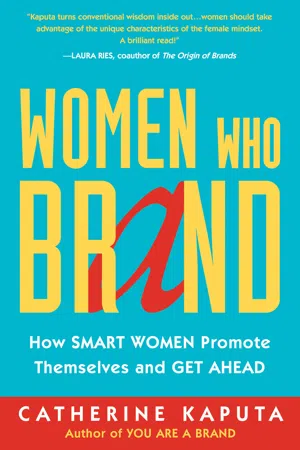
Today self-branding is not an option-it's something women need to master. Ofter what's holding women back from career success is that we don't brand ourselves as well as men do. Women Who Brand is about what happens when women take charge of their personal brands and performance success. It's about what happens when women start thinking and acting more confidently, more creatively and more strategically about themselves and their abilities.
- 216 pages
- English
- ePUB (mobile friendly)
- Available on iOS & Android
eBook - ePub
About this book
Information
1
THE ART OF AUTHENTIC PERSONAL BRANDING
Do you know this woman? She could be working in your office. She could be your college roommate. Or she could be living in your body. She’s someone who feels she needs to make a change. She doesn’t lack talent or a work ethic, but her life and career don’t seem to be on the right track. And she’s afraid the train might derail completely. Or maybe she’ll just get off the train and walk home.
She knows her workplace has modern attitudes. But something is still wrong. She’s unsure of herself. She’s not living up to her potential. She’s trying to “lean in” and advocate for herself but she’s not sure how to do it without being too aggressive.
She’s suffering from a problem that affects only women: Female Behavior Confusion Disorder (FBCD).
Too Hot? Too Cold?
What’s a woman to do? How do you get it right in the workplace?
Your instincts tell you to “be nice,” but if you’re too nice you are viewed as weak and not taken seriously. If you are too assertive and exhibit the same leadership qualities that are praised in a man, you risk being called that familiar epithet referring to a female dog that, curiously, has no male equivalent.
It’s the Goldilocks dilemma. If you’re too hot, you’re branded as aggressive or even out of control. If you’re too cold, you’re labeled an ice queen. The same behavior that’s acceptable or admired in a man is often criticized in a woman. It’s hard to get it just right.
Even Catalyst, the research organization that’s been studying women’s leadership and the workplace for more than fifty years isn’t sure. But it is sure that a key reason we don’t see more women at the higher levels in business is not because of a talent gap but because a self-promotion gap.
The Male Hubris Effect versus the Female Humility Effect
We women have some catching up to do. We’re not as good at personal branding as men are. Why is that?
One example of this disparity can be found in the personal columns. The men all sound like Brad Pitt, except even better looking and more accomplished. And what about the women? Well, the women like long walks in the country. (Not exactly the hard sell.) Ladies, that’s branding for staying single. If you ask those Brad Pitts what they are looking for in a woman, this long walk thing is not very high on the list. In fact, it’s not even on the list.
One male social scientist who did a major global study of male and female business leadership found men are so good at promoting their abilities, they often—believe it or not—exaggerate their abilities and their I.Q., what he branded “The Male Hubris Effect.”
Women, on the other hand, tend to lowball their abilities and I.Q., what he dubbed “The Female Humility Effect.” The Hubris/Humility Effect shows up in different industries and in different countries. Women judge their abilities worse than they actually are and men judge their abilities as better than they are.
Humility’s a Virtue, but Self-Promotion Pays
“Gena” is an ambitious, hardworking executive. In the morning she would often go into work very early and sometimes the CEO would pop in the elevator with her.
Gena was scared to talk. But she was also scared not to talk. So she would talk about the weather.
As she was introduced to the concept of personal branding, Gena started paying more attention to business dynamics and her performance. Then, lo and behold, she found herself in the dreaded elevator with the CEO again. This time a male colleague, Bob, walked in, turned to the CEO, and jauntily said, “John, great to run into you. I’m Bob Smith from sales on the ABC product team. You’ll be glad to know that we had a great meeting with a new client this week and we just sealed the deal.”
The beaming CEO said, “Bob, you just made my day.” And the CEO didn’t stop with the proverbial pat on the back, he actually patted Bob on the back as he was getting out of the elevator.
Now, Gena was already learning about personal branding strategies, but there’s nothing like a little reality show to convince people to take action. Gena felt like she had been slapped in the face with a fish. Later, in my office, she became reflective.
“Catherine, I saw firsthand what you’re talking about. Bob is branding himself as the next VP, and what am I doing? I’m branding myself as the weather girl.”
Bingo. Not knowing how to brand ourselves—it’s a woman’s dilemma. Business has its unspoken rules and procedures that men seem to know well. Winning is the objective, and to win men leverage typically male aptitudes like assertiveness, personal promotion, and confidence. Indeed, these are the signs of leadership.
As Gena told me, her messages growing up were to get along rather than compete, work hard and your work will be rewarded, and don’t try to get noticed. Gena got on the personal branding bandwagon and eventually she was recommended by the CEO as a high-potential employee and put on the fast track.
Later, Gena was chosen to run a large division in the Midwest. She told me that becoming a woman who brands was the single most important reason for her success. She overcame her fear of talking to the CEO and other key executives and learned how to authentically promote herself. As she got to know John, the CEO, she discovered that he hated getting into the elevator with employees, because almost everyone froze the minute he stepped in!
Judge a Book by Its Cover
As it did with Gena, branding can make the difference between success and mediocrity. If you don’t think branding is important, look at this example from the commercial world: a diet book first published more than fifteen years ago was called The Modified Carbohydrate Diet.
Did you ever hear of this diet? Probably not. That sizzling title was created by a Miami doctor. Of course, we’re always told, “Don’t judge a book by its cover,” but we do it every day. Unbranded, the Miami doctor’s book didn’t do well, selling only a few thousand copies. But so many clients loved the diet that it was passed along through word of mouth.
Then it was branded.
Enter The South Beach Diet.
Now the diet had a brand identity that had sizzle. The new name conjured up an image of beautiful people, exciting lifestyles, and the newest happening place. Here was something we like and something we’d like to be part of. The book’s cover featured palm trees and Art Deco colors like those found in South Beach. It had a different look—other diet books at the time looked like textbooks. The new brand appealed to people’s perceptions. If you like South Beach, you might like the South Beach diet. Nobody really likes modified carbohydrates.
The book got a free celebrity endorsement when a reporter asked then-President Bill Clinton how he lost weight, and he said he went on the South Beach Diet. (Isn’t that just like him?) The South Beach Diet was one of the first books to capitalize on Internet forums to create an online community of dieters who could further promote the book. So here it is. Smart branding and marketing made this modified carbohydrate diet book a colossal success. These same principles can be key in accomplishing your personal branding.
Hard Power versus Soft Power
Today, for companies and for people, what matters is not “hard power” but “soft power,” or branding power, the intangible assets that means so much. It’s the soft things that attract people to your brand.
For people, “hard power” is the tangible things you can put on your résumé like years of experience, job history, skills, education, and the like. Hard assets are important but are not enough to compete successfully in today’s ultracompetitive environment. We all know lots of people with hard power assets who are underemployed or even unemployed.
For people, soft power, or branding power, is your image and reputation, your network and alliances, your visibility, your communications ability, and the ideas and intellectual property associated with you. Soft power is your emotional connection with your “customers,” and we’ve all got customers. (Your “customers” may be your boss, other executives, and colleagues—a customer is anyone who can affect your brand.)
Soft power is the belief system people have about you. It’s standing for something that is valuable in the marketplace. It’s having a game plan for success. The fact is, like it or not, branding rules!
So, what is branding, really?
Attach an Idea to Yourself
At its core, branding is about attaching an idea to a product, or an idea to yourself.
You need to attach an idea that’s authentic, that’s based on who you are and your unique strengths and preferences. When you copy, you’ll always be second rate.
You also want to find a different idea for your brand. Brand managers spend a lot of time delineating differences: a different benefit, different look, different target audience, different process or materials, a different something. In a school of gold fish, you want to be a silver fish.
Your personal brand idea also has to be relevant. It has to be something that people value in the arena where you work. For example, my brand idea is that I am a personal brand strategist, not a career or business coach, as many others position themselves. A brand strategist is someone who applies the principles and strategies from the commercial world of brands to your most important product—Brand You.
Becoming a Woman Who Brands
Let’s look at personal branding in action. “Liz” had worked at a global company for ten years. She had a large staff but had not been promoted like some other colleagues. Liz had the staff and responsibilities but not the title and compensation. She felt stuck, a common situation for women. Her goal was to have a leadership role and be an officer of the company.
So what was Liz’s game plan to achieve her goal?
When I met with Liz, she was upset with her boss, understandably, since she had just been passed over for a promotion yet again. She was so frustrated that she communicated mainly by memo and e-mail. In staff meetings, she sat far from her boss. She let emotion...
Table of contents
- Cover
- Title Page
- Copyright
- Dedication
- Contents
- Introduction: It’s Time for Women to Brand
- 1. The Art of Authentic Personal Branding
- 2. Brand Yourself for Success
- 3. Emotional Intelligence Gives Women an Edge
- 4. Female Verbal Agility Can Give You a Communication Head Start
- 5. Use the Power of Story In Person and Online
- 6. Visual Aspects of Appearance and Power
- 7. The Female Style of Leadership
- 8. Born to Network
- 9. A Brand for All Seasons
- 10. It’s Up to You
- Acknowledgments
- About the Author
- Notes
- Index
Trusted by 375,005 students
Access to over 1.5 million titles for a fair monthly price.
Study more efficiently using our study tools.
Frequently asked questions
Yes, you can cancel anytime from the Subscription tab in your account settings on the Perlego website. Your subscription will stay active until the end of your current billing period. Learn how to cancel your subscription
No, books cannot be downloaded as external files, such as PDFs, for use outside of Perlego. However, you can download books within the Perlego app for offline reading on mobile or tablet. Learn how to download books offline
Perlego offers two plans: Essential and Complete
- Essential is ideal for learners and professionals who enjoy exploring a wide range of subjects. Access the Essential Library with 800,000+ trusted titles and best-sellers across business, personal growth, and the humanities. Includes unlimited reading time and Standard Read Aloud voice.
- Complete: Perfect for advanced learners and researchers needing full, unrestricted access. Unlock 1.5M+ books across hundreds of subjects, including academic and specialized titles. The Complete Plan also includes advanced features like Premium Read Aloud and Research Assistant.
We are an online textbook subscription service, where you can get access to an entire online library for less than the price of a single book per month. With over 1.5 million books across 990+ topics, we’ve got you covered! Learn about our mission
Look out for the read-aloud symbol on your next book to see if you can listen to it. The read-aloud tool reads text aloud for you, highlighting the text as it is being read. You can pause it, speed it up and slow it down. Learn more about Read Aloud
Yes! You can use the Perlego app on both iOS and Android devices to read anytime, anywhere — even offline. Perfect for commutes or when you’re on the go.
Please note we cannot support devices running on iOS 13 and Android 7 or earlier. Learn more about using the app
Please note we cannot support devices running on iOS 13 and Android 7 or earlier. Learn more about using the app
Yes, you can access Women Who Brand by Catherine Kaputa in PDF and/or ePUB format, as well as other popular books in Business & Management. We have over 1.5 million books available in our catalogue for you to explore.