LEARN HOW TO WRITE FICTION BY WRITING EVERY DAYWould you like to write but have no spare time?Do you not know where to begin? Write A Novel In 10 Minutes A Day will help you sculpt a full-length piece of creative writing in just ten minutes a day. Starting with a daily practical exercise, it will help you manage your writing schedule within this time frame and help you bring your novel to life. You will be able to clarify your vision and review your time commitments, as well as understand your own abilities. Learning to observe the world around you, write quickly and tap into your unique voice will help you to create all the elements of your story and, by the time you've finished all the exercises, you'll have created something beautiful. ABOUT THE SERIES
The Teach Yourself Creative Writing series helps aspiring authors tell their story. Covering a range of genres from science fiction and romantic novels, to illustrated children's books and comedy, this series is packed with advice, exercises and tips for unlocking creativity and improving your writing. And because we know how daunting the blank page can be, we set up the Just Write online community at tyjustwrite, for budding authors and successful writers to connect and share.
eBook - ePub
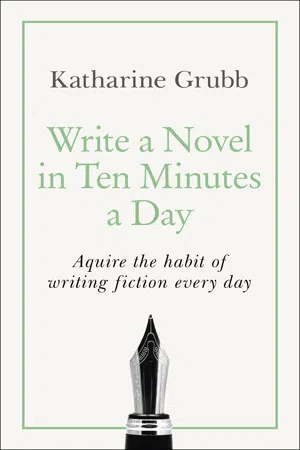
Write a Novel in 10 Minutes a Day
Acquire the habit of writing fiction every day
- 256 pages
- English
- ePUB (mobile friendly)
- Available on iOS & Android
eBook - ePub
About this book
Information
PART ONE
Arranging your writing around your life
1
Envisioning and planning
Before a sculptor applies that first cut, hack or wallop to an expensive piece of marble, he’s envisioned what he’s doing. He has sketched. He has studied other artists. He has looked for inspiration everywhere. Unless he’s a fool, he’s not going to start hacking away and hope, somehow, that David pops out of it. So his first move has to be right.
Novelists have it much easier. We sculpt together words bit by bit to create our art. Words are far cheaper than marble, but just because they’re cheap doesn’t mean we shouldn’t put thought and care into our choices. Like a sculptor, we should study, practise, look to other writers and create a vision before we attempt the final product.
In this chapter, you will be comparing your desire to write to a sculptor’s desire to create a masterpiece.

‘If there's a book that you want to read, but it hasn't been written yet, then you must write it.’

Each of the exercises in this book should take you at least ten minutes. Self-editing or critical thoughts are not allowed. Do each exercise and answer each question as freely as possible for at least ten minutes. If you want to write for a longer time than ten minutes, then go for it!

Picture yourself at a bookstore signing. Hundreds of people are there to meet you, buy your book and get a signed copy. You’re being photographed. You’re getting handshakes. Some readers are potentially star-struck. What is this book about? Is it a romance? A thriller? A mystery? Is it a story that asks big questions in life? Is it a fantasy? Is it for Young Adults? Don’t worry about the title, but instead take ten minutes and envision this book. What would you like the blurbs on the back to say? ‘Romantic?’ ‘Gripping?’ If you need help, start your answer like this:
At my book signing, my book will be a _______________. On the back, critics will say that it is _______________. I want to be known as that writer who _______________.

List your favourite authors, the ones to whom you’d like to be favourably compared. Why do you like them so much? Why would this comparison be important to you?
List your favourite books. Which genres are the most represented? Would you like to write in this genre? Why or why not?
Embracing low expectations
You may imagine that most writers must have a smoke-filled office in which they spend their days perfecting their prose in solitude, their only interruption the clink of the bottle on their glass as they pour another shot of whisky, or when the cat climbs up on their computer to walk across the keyboard, or when the post arrives with their fan mail. This isn’t the reality for most writers: many have day jobs, families and outside obligations that drain their energy and brainpower. Little time or energy is left for pursuing their goals. Their interruptions are more numerous than the unmatched socks in the endless piles of laundry.
Despite this, these writers do manage to sculpt a novel in ten-minute increments. It might take them months or years, but they still succeed in the end. My first novel took five years to sculpt. I wasn’t trying to get the job done quickly; I was just learning how to do it. I was committed to giving my passion every small chunk of time I had, so that at least I could write something. I was often discouraged and I was often interrupted, and I probably discarded half a million words before the finished 95,000-word book was done, but I did it. I succeeded around homeschooling five children, baking bread and doing laundry.
It looked like this: I set the timer on my microwave for ten minutes and then wrote. Once the timer went off, I reset it and emptied the dishwasher or folded a load of washing or started a meal. I also checked on the children and made sure no one was bleeding. Once that timer went off, I went back to the computer and got a few sentences out. (Woe to the child who interrupted me while I wrote!) I did this all afternoon and somehow, everything got done.
I developed this system because I wanted to do it all. I wanted to give all to my family and pursue my writing dreams. I knew that if I looked for big chunks of time or perfect conditions, they would never come. My theory was that ten minutes were better than none at all. And if I did this six times in one day, I would have written for an hour. An hour devoted to writing seemed like a luxury.
‘If we let ourselves, we shall always be waiting for some distraction or other to end before we can really get down to our work. The only people who achieve much are those who want knowledge so badly that they seek it while the conditions are still unfavourable. Favourable conditions never come.’
I don’t believe that any writer should wait for the perfect moment, or for when the kids are older, or for huge chunks of time, or even when our offices and pets and drinking habits resemble those of famous writers. I think, instead, that setting a timer and typing like mad until it goes off is a better strategy. Doing something is better than doing nothing.
Do you have a set time daily to put in at least ten minutes? Can you have more than one ten-minute session a day?
Facing the darkness
‘If you find yourself asking yourself (and your friends), “Am I really a writer? Am I really an artist?” chances are you are. The counterfeit innovator is wildly self-confident. The real one is scared to death.’
In his book Do the Work (2011), author Steven Pressfield explains that there is inside each budding author a drive to write, to create, to sculpt stories and to change the world through words. Yet, just as powerful as that drive is, there is an equally powerful drive to resist. This opposing drive can demean and diminish a writer’s dream by shaking their confidence. This opposition whispers in their ear that they don’t deserve this passion, they will never succeed, they shouldn’t attempt writing, or that failure is their only destiny. Pressfield calls this the resistance.
In her book The Artist’s Way (1992), Julia Cameron coaches budding artists to identify the source of their resistance, to substitute positive self-talk, to encourage a budding artist (or writer) to pursue their dreams without fear of judgement, condemnation, ridicule or uncertainty. She says, ‘Creativity flourishes when we have a sense of safety and self-acceptance.’ She describes the practical steps that artists can take to protect themselves against negativity.
Darkness and negativity are arguably the biggest blockers of success for many writers. I would like to suggest that an honest assessment of this darkness in our lives is critical to our future success.
We deserve to pursue our dreams. The desires that we have are there for a reason. Anything that opposes them may have been put there by others, perhaps those who are abusive, jealous, powerful, controlling or manipulative. This fear is a lie. If we believe it, and allow it to stifle our art, then we will be miserable. Our spirits, our souls, our destinies and certainly our future books are at stake if we do not overcome this darkness and continue to fight against it as we write.
Successful writers are overcomers. Not only have they wielded their stories, wrestled with characters, sculpted, chiselled and hammered away at their stories for months or even years, but they have also fought fears, doubts, discouragement and possible mental instability. Any published work is far more than the sum of its parts: it is also a mark of courage, of tenacity and – possibly literally – blood, sweat and tears. Each published novel could be called the trophy of a victorious battle, won despite much turmoil from within the author or from his environment.
I, too, have struggled with this. I decided, at age 38, that I would not live one more day not pursuing my dreams. I would not allow the negative forces behind the lies to steal one more day of victory from me. I’d rather fail miserably at writing than let my children see me not try out of fear. In my case, I needed to seek the advice of a therapist, read books like The Artist’s Way, pray a lot, and disassociate myself from people around me who, as my therapist puts it, ‘won’t let me walk in the fullness of my awesome’. Every artist who has a shadow of negativity in their lives has to find their own way to overcome this darkness.
The following is potentially the most intimate and difficult exercise in the book, but also the most important. You may find it helpful to weaken the power of the darkness in you by explaining it to another writer, a trusted friend or a counsellor.
This exercise, this facing the darkness, is possibly one of the most challenging in the book. When you think of the darkness, that powerful resistance that is holding you back from pursuing your writing dreams, who or what is the source of it? What specific things does this darkness say to you?
For every lie others have told you, write two truths. For example, if one of the lies told to you was ‘Taking time to write every day is selfish and childish’, your response should be: ‘It’s never selfish to nurture my soul. Childish? I’m doing this so that I can return to the child-like joy I once had for my passions.’
Your strengths and supports
This workshop will help you identify the things that will help you when you are feeling discouraged. Refer to them regularly to lift your morale.
• What are your streng...
Table of contents
- Cover
- Title
- Dedication
- Acknowledgements
- Contents
- Introduction
- Part One: Arranging your writing around your life
- Part Two: Thinking like a writer
- Part Three: Sculpting the elements of story
- Part Four: Putting it all together
- References
- Novelists’ associations, guilds and organizations
- Copyright
Trusted by 375,005 students
Access to over 1.5 million titles for a fair monthly price.
Study more efficiently using our study tools.
Frequently asked questions
Yes, you can cancel anytime from the Subscription tab in your account settings on the Perlego website. Your subscription will stay active until the end of your current billing period. Learn how to cancel your subscription
No, books cannot be downloaded as external files, such as PDFs, for use outside of Perlego. However, you can download books within the Perlego app for offline reading on mobile or tablet. Learn how to download books offline
Perlego offers two plans: Essential and Complete
- Essential is ideal for learners and professionals who enjoy exploring a wide range of subjects. Access the Essential Library with 800,000+ trusted titles and best-sellers across business, personal growth, and the humanities. Includes unlimited reading time and Standard Read Aloud voice.
- Complete: Perfect for advanced learners and researchers needing full, unrestricted access. Unlock 1.5M+ books across hundreds of subjects, including academic and specialized titles. The Complete Plan also includes advanced features like Premium Read Aloud and Research Assistant.
We are an online textbook subscription service, where you can get access to an entire online library for less than the price of a single book per month. With over 1.5 million books across 990+ topics, we’ve got you covered! Learn about our mission
Look out for the read-aloud symbol on your next book to see if you can listen to it. The read-aloud tool reads text aloud for you, highlighting the text as it is being read. You can pause it, speed it up and slow it down. Learn more about Read Aloud
Yes! You can use the Perlego app on both iOS and Android devices to read anytime, anywhere — even offline. Perfect for commutes or when you’re on the go.
Please note we cannot support devices running on iOS 13 and Android 7 or earlier. Learn more about using the app
Please note we cannot support devices running on iOS 13 and Android 7 or earlier. Learn more about using the app
Yes, you can access Write a Novel in 10 Minutes a Day by Katharine Grubb in PDF and/or ePUB format, as well as other popular books in Languages & Linguistics & Creative Writing. We have over 1.5 million books available in our catalogue for you to explore.