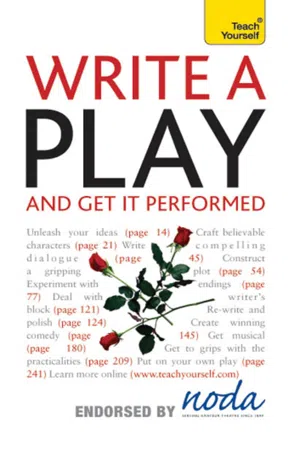
Write a Play - and Get It Performed is designed for would-be writers of every level and for all types of motivation by two prize-winning professionals. Whether writing for the specific needs of an amateur drama group, community event, political campaign or simply for personal or professional development, this is a guide to the craft of playwriting. It offers guidance on the creative principles of scripts, characters, plot, structure and dialogue and explains the principles of staging and stage directions as well as gives tips on how to write for a variety of different situations, for every age and ability and according to specific genres - particularly those often preferred by amateur groups, such as pantomime and musical theatre.
NOT GOT MUCH TIME?One, five and ten-minute introductions to key principles to get you started.
AUTHOR INSIGHTSLots of instant help with common problems and quick tips for success, based on the author's many years of experience.
TEST YOURSELFTests in the book and online to keep track of your progress.
EXTEND YOUR KNOWLEDGEExtra online articles at www.teachyourself.com to give you a richer understanding of writing a play.
FIVE THINGS TO REMEMBERQuick refreshers to help you remember the key facts.
TRY THISInnovative exercises illustrate what you've learnt and how to use it.
eBook - ePub
Write A Play And Get It Performed: Teach Yourself
- 192 pages
- English
- ePUB (mobile friendly)
- Available on iOS & Android
eBook - ePub
Write A Play And Get It Performed: Teach Yourself
About this book
Information
Subtopic
Performing Artsone
1
A writing mindset
In this chapter you will learn:
- about audiences
- what equipment you will need to write
- how to think like a writer.
The most common mistake that new playwrights make is that new writers try to replicate something they’ve enjoyed and end up writing in a voice that is not their own, but a poor imitation of someone else.
Michael Jenner, writer for EastEnders, Holby, Taggart
Maybe you already have an idea for a play, and want to plunge straight into it. Fine. Get a piece of paper or open a computer file and write the idea down – that way you won’t lose it and you can come back to it later, after you have done the right preparation.
On the other hand, perhaps you feel you haven’t got enough imagination to be a writer. This simply isn’t true. Everybody can learn to use their imagination. Think of your brain as a series of muscles – the more you use them, the stronger they get. Imagination, logic, emotional intelligence can all be improved and developed through use. Techniques such as free-thinking will help you build up your mental muscles.
The audience
A writer needs to be aware of the probable audience for the play without allowing that awareness to dictate every aspect of the play. A play that is written with the sole purpose of pleasing an audience will never be more than a trivial piece of work with no heart. A play that is written without any consideration for the audience will probably never be performed.
If you know exactly where your play is going to be performed – the school nativity for instance – then it is sensible to consider the audience quite early in the writing process. However, in most cases the best thing is to write the play that you want to write, and then decide what its audience is and how it can best reach that audience. A play can’t reach its audience until a theatre company has been persuaded that it is suitable for them, so in most cases the first hurdle is to write a play that theatre people are interested in.
Practical basics
Should you use a computer, word processor, typewriter or pen and paper? Many writers are still more comfortable with a pen and paper for early drafts and there is nothing wrong with this. It’s best to create a system for organizing your work – don’t let yourself be overwhelmed by scribbled piles of paper. Whether you use a loose leaf folder or an exercise book you need to keep the script under control.
Remember your script will have to be typed or printed out before you can send it off. Whether typed or computer printed, a manuscript must be immaculately presented. There is further information on script layout and presentation in Chapter 19.
There is no doubt that once you have mastered a computer or word processor many aspects of writing become much quicker and easier. You can re-write or re-organize a script, or try things out just to see how they look. Changing a character’s name takes a moment, and if you don’t like it you can change it back again just as easily.
Good software will help you with the layout and it is much easier to do re-writes on a computer. However, you still need to be organized. If you want to be able to refer back to earlier drafts, then you need to save each one under a different name. Remember to make backups, on floppy disc or CD, at regular intervals, and keep the backup somewhere safe away from the computer.
Insight
One essential item is a small notebook in which you can write down thoughts, ideas, snatches of dialogue, anything which could be used to good effect in your play. Keep it to hand and if you do make notes on anything else keep them safe and transfer them to the notebook ASAP.
TIME AVAILABLE
You may have ambitions to become a full-time writer, but initially you will have to fit writing in with your other commitments. However you choose to do this, the main thing is to write regularly. Writing is a form of mental exercise, and the more you do it, the stronger you will become. Leaving long gaps between your writing sessions will mean that you never establish a rhythm, and each time you go back to it you will spend part of the session re-familiarizing yourself with what you wrote last time. So try to set some time aside for writing on a regular basis, even if it is only a few hours a week. For most of us it is better to write for a short time every day than for several hours once a month. If you feel you can only write at weekends, try to add one weekday evening so that you maintain the flow.
If you can’t write regularly like this then don’t despair, but do accept that your play will progress slowly. The danger with slow progress of course is that you may lose motivation and give up altogether without finishing the piece. You can avoid this by putting extra effort into the planning stage, so that each time you sit down to write, you only have to look at your meticulously outlined plot and detailed character studies, to know exactly what you need to do next.
Insight
Time to write can be snatched from even the busiest day. Try getting up half an hour earlier or going to bed a bit later. If you decide to write for an hour a day, remember that hour can be broken down into three 20-minute periods.
REFERENCE MATERIAL
While it is not essential to have any reference books, a dictionary and a thesaurus are extremely useful. Those using a computer will already have these, but remember to set the spell checker to UK or US English, depending on where you are sending the play. Other reference books can be acquired as needed, and writers with Internet access can use the vast online resources for research. It is always worth checking your facts, since you can be sure that there will be at least one person in an audience who will notice if you get something wrong – however obscure.
Mental basics
PEOPLE-WATCHING
Drama is all about people. Even if you want to write about robots, or animals, you will find it only works if you give them human personalities. Fortunately your raw material is all around you. All the characters you will probably ever need can be found in the average high street.
Shakespeare said ‘all the world’s a stage’ – and it is. So why not pretend that everyone around you is acting out a little play for your delight. Imagine what their lives are like. Where do they work? What relationships do they have? Spend some time alone in a crowded public place where you can watch people – a café, a railway station, or even in your car in a busy car park.
LISTENING
Assuming that your play is not going to be performed entirely in mime, your characters will need to communicate verbally with each other. A large part of the information given to the audience will come from speeches. So now is the time to start taking an interest in speech patterns, as well as dialects, accents, hesitation, deviation and repetition. The best way of learning about speech patterns is to listen to other people. Pay attention to how people speak and react to each other. Try to analyse why person A sounds different from person B. How do they construct their sentences? Do long words roll off their tongue in a sonorous procession, or do they use the local patois? Does the way they speak indicate their social standing and educational achievements?
It doesn’t stop there though. In a play, speeches need to appear to be natural even though we all know they have been cleverly constructed, and so it is not enough to simply repeat natural speech, you will have to learn how to capture its essence.
Conversations
Pay attention to how conversations work. Without realizing it, we are all obeying the unwritten rules of conversation most of the time. Each person gets their turn to talk, and most of us understand that we have to wait our turn, and we mustn’t go on for too long when we get our turn. A person who fails to observe the rules makes everyone else feel uncomfortable, and a person in crisis will probably forget the rules...
Table of contents
- Cover
- Title
- Copyright
- Contents
- Meet the authors
- Only got a minute?
- Only got five minutes?
- Only got ten minutes?
- Introduction
- Section one
- Section two
- Section three
- Taking it further
- Appendix A: Plays mentioned
- Appendix B: Final version of work in progress
- Index
Trusted by 375,005 students
Access to over 1.5 million titles for a fair monthly price.
Study more efficiently using our study tools.
Frequently asked questions
Yes, you can cancel anytime from the Subscription tab in your account settings on the Perlego website. Your subscription will stay active until the end of your current billing period. Learn how to cancel your subscription
No, books cannot be downloaded as external files, such as PDFs, for use outside of Perlego. However, you can download books within the Perlego app for offline reading on mobile or tablet. Learn how to download books offline
Perlego offers two plans: Essential and Complete
- Essential is ideal for learners and professionals who enjoy exploring a wide range of subjects. Access the Essential Library with 800,000+ trusted titles and best-sellers across business, personal growth, and the humanities. Includes unlimited reading time and Standard Read Aloud voice.
- Complete: Perfect for advanced learners and researchers needing full, unrestricted access. Unlock 1.5M+ books across hundreds of subjects, including academic and specialized titles. The Complete Plan also includes advanced features like Premium Read Aloud and Research Assistant.
We are an online textbook subscription service, where you can get access to an entire online library for less than the price of a single book per month. With over 1.5 million books across 990+ topics, we’ve got you covered! Learn about our mission
Look out for the read-aloud symbol on your next book to see if you can listen to it. The read-aloud tool reads text aloud for you, highlighting the text as it is being read. You can pause it, speed it up and slow it down. Learn more about Read Aloud
Yes! You can use the Perlego app on both iOS and Android devices to read anytime, anywhere — even offline. Perfect for commutes or when you’re on the go.
Please note we cannot support devices running on iOS 13 and Android 7 or earlier. Learn more about using the app
Please note we cannot support devices running on iOS 13 and Android 7 or earlier. Learn more about using the app
Yes, you can access Write A Play And Get It Performed: Teach Yourself by Lesley Bown,Lesley Hudswell,Ann Gawthorpe in PDF and/or ePUB format, as well as other popular books in Media & Performing Arts & Performing Arts. We have over 1.5 million books available in our catalogue for you to explore.