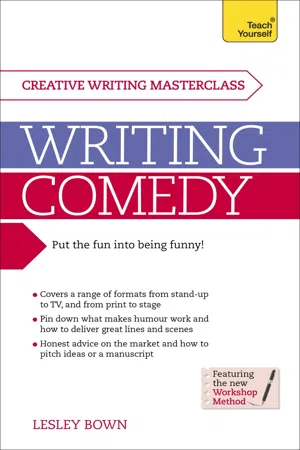
Learn how to write comedy that makes people laugh. Masterclass: Writing Comedy will reveal to both beginners and experienced writers the distinctive features that mark out comedy from other forms of creative writing. Having identified these, it will help you then to unlock your inner anarchist, and explore the different elements of comedy, using a combination of practical exercises, insight and creative inspiration. Whatever your preferred comic genre, you will find guidance on everything from wordplay and visual humour to plots, comedy characters and different styles.A section on performance will help you to hone stand-up skills, while chapters on stage and screen will give techniques and tips on how to craft a sitcom or create a sketch show. Finally, there is a uniquely frank but useful section on the realities of the markets, and the actualities of going it alone with self-publishing and self-promotion - or the tools you need to successfully pitch an idea or comic manuscript.ABOUT THE SERIES
The Teach Yourself Creative Writing series helps aspiring authors tell their stories. Covering a range of genres from science fiction and romantic novels to illustrated children's books and comedy, this series is packed with advice, exercises, and tips for unlocking creativity and improving your writing. And because we know how daunting the blank page can be, we set up the Just Write online community, at tyjustwrite.com, for budding authors and successful writers to connect and share.
eBook - ePub
Writing Comedy
How to use funny plots and characters, wordplay and humour in your creative writing
- 256 pages
- English
- ePUB (mobile friendly)
- Available on iOS & Android
eBook - ePub
Writing Comedy
How to use funny plots and characters, wordplay and humour in your creative writing
About this book
Information
Subtopic
Creative Writing1

Comedy basics
It’s pretty difficult to fake laughter: ask any actor. It’s also hard to stop laughing once you’ve started: again, actors will tell you about the nightmare of ‘corpsing’ – when they break character by getting the giggles on stage and being unable to stop. It can also be just as hard to start laughing if you’re not in the mood. We really don’t have much control over laughing and perhaps that’s why we value it so much.
So what makes us laugh? Or rather, what is there in common between the various things that make us laugh? In this chapter you will learn about the many ways of creating laughs, including surprise and recognition, and about visual, verbal and physical comedy.
 | Alan Ayckbourn, director and playwright |
‘If I had to give just one piece of comedy writing advice it would be: for God’s sake take it seriously.’
 | Key idea |
The two main factors in creating laughs are surprise and recognition.
Most laughs come from surprise: the sudden unexpected event, the twist that you didn’t see coming, the moment when the penny drops. A lot of surprise laughs are created when an audience thinks they recognize what’s about to happen, and are taken by surprise with what actually does happen.
We usually laugh at moments of recognition in a less explosive, more thoughtful way. It’s a rueful, ‘Yes, I do that too’ sort of laugh. Observational comedy makes great use of recognition precisely because it is based on everyday life, but to be successful it has to include some surprises too. Recognition laughs are very useful as laughs along the way, as you build up to the big surprise punchline.
 | Create surprise |
To practise creating surprise, have a go at this job applications exercise.
Who would be the worst possible applicants for these jobs: heart transplant surgeon, TV weather forecaster, massage therapist? There are no correct answers, but whatever you choose will only be funny if it’s surprising.
 | Focus point |
The key concept in creating both surprise and recognition laughs is incongruity, because the incongruous is also the unexpected. This works at every level of comedy, from the simplest joke to the most complex plot.
| | Create incongruity |
To practise creating incongruity, try this simple exercise. First choose a character from list A and another from list B.
• List A: doctor, maths teacher, High Court judge, politician
• List B: used car salesman, streetwise teenager, hairdresser, plumber
Now write a short speech for one of the characters using the type of language you’d expect from the other character. For instance, the doctor could be looking at a patient’s operation scar and saying ‘What cowboy did this, then? I could sort it out but it won’t be easy, can’t get the parts you see, could fit you in Tuesday week, cash in hand all right with you, Squire?’ and so on. Choose your own incongruous characters and try the exercise again. You can use specific people (such as the Prime Minister) or fictional characters (such as Robin Hood).
Creating laughs
Let’s look at ways of creating incongruity, surprise and recognition in more detail, but first a couple of exercises.
| | What do you find funny? |
Make a list of the words and objects that you personally find funny.
 | The more boring the better… |
Write about something boringly ordinary and humdrum that you did yesterday. It could be something like travelling to work, watching TV or buying carrots – as long as nothing interesting exciting or amusing happened. Describe what you were doing and the environment you were in. Maximum 750 words.
OPPOSITES
Opposites provide instant incongruity: big and small, happy and sad, funerals and weddings. This is why double acts often exaggerate the physical differences between them; for instance, Laurel was thin and Hardy was fat. The casting of Only Fools and Horses must have...
Table of contents
- Cover
- Title
- Dedication
- Acknowledgments
- Contents
- Meet the author
- Introduction
- 1 Comedy basics
- 2 The comedy writing mindset
- 3 Getting started
- 4 Language and style
- 5 Jokes
- 6 Stand-up
- 7 Simple characters and situations
- 8 Quickies and sketches
- 9 Creating more complex characters
- 10 More complex situations and plots
- 11 Sitcoms
- 12 Character development and deeper plotting
- 13 Editing, polishing and unblocking
- 14 Writing for different media
- 15 The practicalities of placing your work
- Appendix A: Other types of comedy writing
- Appendix B: Comedy styles and genres
- Appendix C: Doing it yourself
- Appendix D: Figures of speech
- Appendix E: Works mentioned
- Appendix F: Full texts of examples
- Appendix G: Taking it further
- Copyright
Trusted by 375,005 students
Access to over 1.5 million titles for a fair monthly price.
Study more efficiently using our study tools.
Frequently asked questions
Yes, you can cancel anytime from the Subscription tab in your account settings on the Perlego website. Your subscription will stay active until the end of your current billing period. Learn how to cancel your subscription
No, books cannot be downloaded as external files, such as PDFs, for use outside of Perlego. However, you can download books within the Perlego app for offline reading on mobile or tablet. Learn how to download books offline
We are an online textbook subscription service, where you can get access to an entire online library for less than the price of a single book per month. With over 1.5 million books across 990+ topics, we’ve got you covered! Learn about our mission
Look out for the read-aloud symbol on your next book to see if you can listen to it. The read-aloud tool reads text aloud for you, highlighting the text as it is being read. You can pause it, speed it up and slow it down. Learn more about Read Aloud
Yes! You can use the Perlego app on both iOS and Android devices to read anytime, anywhere — even offline. Perfect for commutes or when you’re on the go.
Please note we cannot support devices running on iOS 13 and Android 7 or earlier. Learn more about using the app
Please note we cannot support devices running on iOS 13 and Android 7 or earlier. Learn more about using the app
Yes, you can access Writing Comedy by Lesley Bown,Lesley Hudswell in PDF and/or ePUB format, as well as other popular books in Media & Performing Arts & Creative Writing. We have over 1.5 million books available in our catalogue for you to explore.