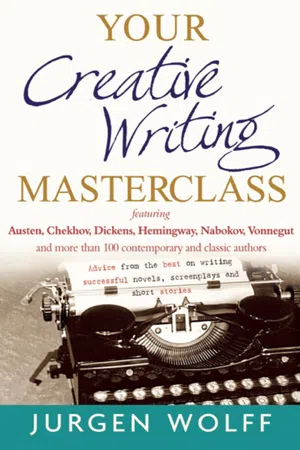
If you dream of being a writer, why not learn from the best? In Your Creative Writing Masterclass you'll find ideas, techniques and encouragement from the most admired and respected contemporary and classic authors, including Charles Dickens, Jane Austen and Anton Chekhov. Jurgen Wolff, bestselling author of Your Writing Coach, helps you translate these insights into action to master your craft and write what only you can write. From Robert Louis Stevenson to Mary Shelley, Alice Munro to Stephen King, Your Creative Writing Masterclass guide you through: finding your style, constructing powerful plots, generating story ideas, overcoming writer's block, creating vivid characters and crafting your ideal writer's life. Brimming with support and suggested activities to develop your writing skills, the book also features unique bonus advice, exercises, resources and sharing capabilities via the website www.YourCreativeWritingMasterclass.com.
eBook - ePub
Your Creative Writing Masterclass
featuring Austen, Chekhov, Dickens, Hemingway, Nabokov, Vonnegut, and more than 100 Contemporary and Classic Authors
- 320 pages
- English
- ePUB (mobile friendly)
- Available on iOS & Android
eBook - ePub
Your Creative Writing Masterclass
featuring Austen, Chekhov, Dickens, Hemingway, Nabokov, Vonnegut, and more than 100 Contemporary and Classic Authors
About this book
Information
PART I
FINDING INSPIRATION
What inspired great works that are still read decades or even centuries after they were written? What did master writers do when they were stuck for an idea? What methods gave some of them a never-ending flow of stories?
In this section you’ll discover the sometimes ordinary, sometimes strange ways in which authors such as Anton Chekhov, Robert Louis Stevenson, Mary Shelley, and Gabriel García Márquez found their inspiration and their starting points. I’ll also look at how their methods can help you to move forward with your writing.
1
It starts with (someone else’s) words
Do you remember the first book that had an impact on you? Perhaps it was one that was read to you or the first one you were able to read yourself. Or was there a book later in your childhood that had an influence you didn’t discern at the time?
Many noted authors have said they were deeply moved by what they read as youngsters. In some cases it was one particular book that made them want to be writers and to which they still return for inspiration years later.
Even once a writer is established, a classic author may serve as their mentor. Martin Amis has said:
When I am stuck with a sentence that isn’t fully born, it isn’t there yet, I sometimes think, How would Dickens go at this sentence, how would Bellow or Nabokov go at this sentence? What you hope to emerge with is how you would go at that sentence, but you get a little shove in the back by thinking about writers you admire.
If that sounds like a strategy you’d like to employ, it can be handy to have the masters nearby. Hanging near my desk is a collection of postcard portraits of nine of my writing heroes: Shakespeare, Samuel Johnson, Dickens, Stevenson, Conrad, Wilde, Bertrand Russell, Somerset Maugham, and Graham Greene. I got the postcards at the National Portrait Gallery and had them framed. Having them watch as I write makes it very easy to stay humble, but most of the time it’s more inspirational than daunting to have them looking down on me with what I interpret as benevolent gazes.
You don’t have to limit yourself to the greats. William Faulkner’s advice was:
Read, read, read. Read everything—trash, classics, good and bad, and see how they do it. Just like a carpenter who works as an apprentice and studies the master. Read! You’ll absorb it.
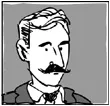
WILLIAM FAULKNER (1897–1962)
Faulkner’s most famous novels are The Sound and the Fury, As I Lay Dying, and Absalom, Absalom!. In 1949 he won the Nobel Prize for Literature, and went on to win two Pulitzer Prizes. In 1987 the US Postal Service issued a 22-cent stamp bearing his image.
Vladimir Nabokov advocates reading poetry:
You have to saturate yourself with English poetry in order to compose English prose.
For Maya Angelou, the Bible is the greatest inspiration:
The language of all the interpretations, the translations, of the Judaic Bible and the Christian Bible, is musical, just wonderful. I read the Bible to myself. I’ll take any translation, any edition, and read it aloud, just to hear the language, hear the rhythm, and remind myself how beautiful English is.
Being changed—and changing others
In a letter to Oprah Winfrey published in the magazine O, Harper Lee, author of To Kill a Mockingbird, referred to her love of books when she was young and said:
Now, 75 years later in an abundant society where people have laptops, cell phones, iPods and minds like empty rooms, I still plod along with books.
The young Lee couldn’t have imagined that some day her own book would have a profound effect.
A survey of lawyers active in the civil rights movement in the 1960s and 1970s revealed that many of them were inspired by the novel To Kill a Mockingbird (published in 1960) or its film version (made in 1962). The novel won a Pulitzer Prize for Fiction in 1962 and in 1999 it was voted Best Novel of the Century by the Library Journal. It was the reclusive author’s only published book, although it is rumored that she has continued to write, just not for publication.
Eudora Welty found that Virginia Woolf was
the one who opened the door. When I read To the Lighthouse, I felt, Heavens, what is this? I was so excited by the experience I couldn’t eat or sleep. I’ve read it many times since, though more often these days I go back to her diary. Any day you open it to will be tragic, and yet all the marvellous things she says about her work, about working, leave you filled with joy that’s stronger than your misery for her.
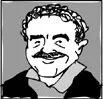
GABRIEL GARCIA MARQUEZ (b 1927)
Márquez’s works include One Hundred Years of Solitude, Love in the Time of Cholera, and Autumn of the Patriarch. Due to his political views on imperialism and his personal friendship with Fidel Castro, he was denied a US visa until Bill Clinton’s administration. Many of his works have been adapted into films, particularly in Mexico.
It was the works of Kafka that literally shocked Gabriel García Márquez into writing:
One night a friend lent me a book of short stories by Franz Kafka. I went back to the pension where I was staying and began to read The Metamorphosis. The first line almost knocked me off the bed. I was so surprised. The first line reads, “When Gregor Samsa woke up one morning from unsettling dreams, he found himself changed in his bed into a monstrous vermin…” When I read the line I thought to myself that I didn’t know anyone was allowed to write things like that. If I had known, I would have started writing a long time ago. So I immediately started writing short stories.
The influence of that tale on Márquez’s development as a leading writer of magical realism is clear. Ralph Ellison told the Paris Review:
In 1935 I discovered Eliot’s The Waste Land, which moved and intrigued me but defied my powers of analysis… At night I practiced writing and studied Joyce, Dostoyevsky, Stein, and Hemingway. Especially Hemingway; I read him to learn his sentence structure and how to organize a story.
Let the library inspire you
Ray Bradbury advises:
You must lurk in libraries and climb the stacks like ladders to sniff books like perfume and wear books like hats upon your crazy heads.
That’s harder to do now that libraries are being turned into multimedia centres in which actual books sometimes are the quaintest and most neglected element, but it’s good advice nonetheless. Until iPads and Kindles and other ereaders can give off the lovely musty smell of an old book (and probably it’s only a matter of time), at least those of us brought up on traditional books will always have a place in our hearts for them and for libraries.
It was in the Redwood City Public Library that I found my most influential childhood books: Enid Blyton’s series of Famous Five books, rather idealized stories of the sleuthing adventures of a group of four English children and their dog. That library had the whole series of 21 volumes and I whipped through them, enjoying the England of my (and Blyton’s) imagination. Surely that had some influence on my decision, many years later, first to study in the UK and eventually to move to London. Perhaps in 20 years there will be a huge wave of British immigration prompted by the Harry Potter books.
Look beyond the word
Sometimes inspiration comes from another branch of the arts. Salman Rushdie says:
Much of my thinking about writing was shaped by a youth spent watching the extraordinary outburst of world cinema in the sixties and seventies. I think I learned as much from Bunuel and Bergman and Godard and Fellini as I learned from books.
For Stephen Sondheim, seeing a rather obscure movie called Hangover Square was formative:
It was a moody, romantic, gothic thriller starring Laird Cregar, about a composer in London in 1900 who was ahead of his time. And whenever he heard a high note he went crazy and ran around murdering people. It had an absolutely brilliant score by Bernard Herrmann, centred around a one-movement piano concerto.
Sondheim said his Sweeney Todd was an homage to Herrmann.
While you can be inspired by the words and experiences of others, you’ll be drawing on your own as you write. In the next chapter I look at how to use your memories and fears as a source.
FROM ADVICE TO ACTION!
In today’s busy world it can be a challenge to find the time to read, but it’s still one of the best ways to feed your mind. How long has it been since you’ve read some of the classic authors like Joyce, Dostoyevsky, Hemingway, or Dickens?
I have a friend who plans reading sessions into a very busy schedule because it nourishes his brain and brings an hour of peace into an otherwise hectic day. If you looked at his calendar you’d find entries like “5pm–6pm: Melville” or “1pm–2pm: Joyce.”
Is there a famous work you’ve always intended to read or a classic movie you’ve meant to watch but haven’t gotten around to?
ACTION: Make an appointment with yourself to read a book or see a film that’s noted as a classic. You may also want to revisit some of your favorites. There are a few books I go back to from time to time and find new virtues each visit: The Seven Pillars of Wisdom by TE Lawrence, The Courage to Create by Rollo May, and Joseph Conrad’s Lord Jim. The equivalent films for me are Citizen Kane, Treasure of the Sierra Madre, Lawrence of Arabia, High Noon, The Godfather I and II, Day for Night (and the list goes on).
Consider the books and films you found most formative, choose one you think would warrant rereading or reviewing, and schedule the required time. This time read it not only for enjoyment but to analyze what made the book or film so powerful for you. What can you learn from that author’s methods that might help you make your own writing more vivid and influential? For starters, consider:

I invite you to share your most special books on the website www.YourCreativeWritingMasterclass.com, so that everyone can benefit from your experience.
2
Memories and fears
What were the most significant events of your childhood? Do you find yourself drawing on them, directly or indirectly, in your writing? Many writers do. Willa Cather claimed:
Most of the basic material a writer works with is acquired before the age of fifteen.
F Scott Fitzgerald gave it a bit longer:
A writer can spin on about his adventures after thirty, after forty, after fifty, but the criteria by which these adventures are weighed and valued are irrevocably settled at the age of twenty-five.
The theme of much of Fitzgerald’s work was rooted in his own youth:
That was always my experience—a poor boy in a rich town; a poor boy in a rich boy’s school; a poor boy in a rich man’s club at Princeton… However, I have never been able to forgive the rich for being rich, and it has coloured my entire life and works.
This ambivalence is reflected in how the narrator of The Great Gatsby first describes Jay Gatsby:
Gatsby, who represented everything for which I have an unaffected scorn. If personality is an unbroken series of successful gestures...
Table of contents
- Cover Page
- Title Page
- Copyright Page
- Dedication
- Contents
- Introduction
- Part I Finding Inspiration
- Part II Characters Come to Life
- Part III Shaping the Story
- Part IV Finding Your Style
- Part V The Process
- Part VI The Writing Life
- Afterword
- Your Masterclass authors
- Sources
Trusted by 375,005 students
Access to over 1.5 million titles for a fair monthly price.
Study more efficiently using our study tools.
Frequently asked questions
Yes, you can cancel anytime from the Subscription tab in your account settings on the Perlego website. Your subscription will stay active until the end of your current billing period. Learn how to cancel your subscription
No, books cannot be downloaded as external files, such as PDFs, for use outside of Perlego. However, you can download books within the Perlego app for offline reading on mobile or tablet. Learn how to download books offline
Perlego offers two plans: Essential and Complete
- Essential is ideal for learners and professionals who enjoy exploring a wide range of subjects. Access the Essential Library with 800,000+ trusted titles and best-sellers across business, personal growth, and the humanities. Includes unlimited reading time and Standard Read Aloud voice.
- Complete: Perfect for advanced learners and researchers needing full, unrestricted access. Unlock 1.5M+ books across hundreds of subjects, including academic and specialized titles. The Complete Plan also includes advanced features like Premium Read Aloud and Research Assistant.
We are an online textbook subscription service, where you can get access to an entire online library for less than the price of a single book per month. With over 1.5 million books across 990+ topics, we’ve got you covered! Learn about our mission
Look out for the read-aloud symbol on your next book to see if you can listen to it. The read-aloud tool reads text aloud for you, highlighting the text as it is being read. You can pause it, speed it up and slow it down. Learn more about Read Aloud
Yes! You can use the Perlego app on both iOS and Android devices to read anytime, anywhere — even offline. Perfect for commutes or when you’re on the go.
Please note we cannot support devices running on iOS 13 and Android 7 or earlier. Learn more about using the app
Please note we cannot support devices running on iOS 13 and Android 7 or earlier. Learn more about using the app
Yes, you can access Your Creative Writing Masterclass by Jurgen Wolff in PDF and/or ePUB format, as well as other popular books in Languages & Linguistics & Creative Writing. We have over 1.5 million books available in our catalogue for you to explore.