Do you have a working knowledge of French, but want to improve? Allow this book to come to your rescue and eliminate basic errors and slips of the pen. Each one of 50 top tips for improving your spoken and written French is presented and analysed across a whole double page, with explanations as to where and why people sometimes go wrong. The tips are grouped into grammar, spelling, false friends, pronunciation and cultural faux pas sections. There's even free downloadable audio content available to help you with your pronunciation. Polish your French with this brand new series from Teach Yourself - the No. 1 brand in language learning. 50 ways to improve your French touches all essential bases and is divided into the following easily digestible sections: Only got a minute?
A 60-second introduction to French to get you started.Only got five minutes?
Get to grips with French and its common pitfalls even if you're short of time.Only got ten minutes?
Use your free time wisely to learn something about the French language. Insights
Instant help with common problems and quick tips for success, based on Lorna Wright and Marie-Jo Morelle's many years of experience.Test yourself
Tests online to keep track of your progress. Articles
Extra information to keep you motivated.Summaries
Quick refreshers to help you remember the key facts.Grammar
Easy-to-follow building blocks to give you a clear understanding.Pronunciation
Don't sound like a tourist - polish your pronunciation before you go.Audio
Downloadable audio support online to help with key areas - iPod/MP3 compatible
For your free audio download please visit: www.hodder.co.uk/TYLfreedownloads
- 160 pages
- English
- ePUB (mobile friendly)
- Available on iOS & Android
eBook - ePub
50 Ways to Improve your French: Teach Yourself
About this book
Information
Subtopic
French LanguageGetting the structure right
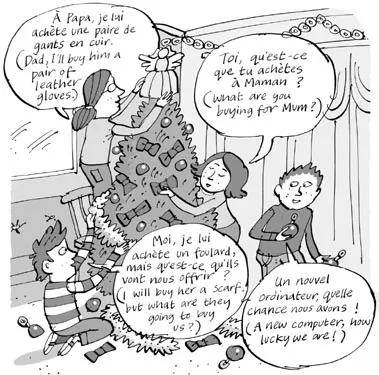
11 Adjectives – you don’t have carte blanche!
WHERE TO PUT ADJECTIVES
The usual position for an adjective is after the item it describes.
| un livre intéressant | an interesting book |
| un film ennuyeux | a boring film |
This is not always the case, however, and the exceptions include some of the most common adjectives in use.
| Tu as vu ce melon gros ? × | |
Tu as vu ce gros melon ?  | Have you seen this big melon? |
| Quelles tomates belles ! × | |
| Quelles belles tomates ! | What beautiful tomatoes! |
Watch out for the following common adjectives which are usually placed before the noun. This is then what they mean when you do:
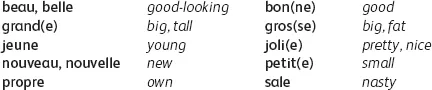
SOME ADJECTIVES CAN CHANGE THEIR MEANING: ‘GRAND’, ‘SALE’, ‘PROPRE’ AND ‘NOUVEAU’
As you know, French nouns and adjectives have to know their place and agree with each other in order to be in harmony (see Chapter 20). Some adjectives, however, are fickle and can be used before or after a noun; the meaning of the adjective may change, depending upon its position in the sentence. (Be especially careful when you use the word sale (dirty) – there is nothing wrong with some good honest dirt, but if you put its French equivalent in the wrong place in the sentence it could be very insulting to the person concerned!)
Here are some examples:
| Le marchand de fleurs est un homme grand. | The flower seller is a tall man. |
| Son père était maire de la ville; c’était un grand homme. | His father was mayor of the town; he was a great man. |
| La nouvelle vendeuse est très amusante. | The new (succeeding) stallholder is very funny. |
| Regarde ! Il y a des pommes de terre nouvelles chez le marchand de fruits et légumes. | There are new (appearing for the first time) potatoes on the fruit and vegetable stall. |
| Ses légumes viennent de son propre jardin potager. | His vegetables come from his own vegetable garden. |
| Il vend des salades propres. | He sells clean lettuces. |
| Tu as vu les mains sales qu’il a ? | Have you seen what dirty hands he’s got? |
| On dit que, malgré ses bons légumes, c’est un sale type. | People say he’s an unpleasant character. |
Insight
There is a certain logic to the normal placing of an adjective after the noun it describes since adjectives are, after all, in most cases additional extras. If the adjective is omitted, the sentence will usually still make sense, even though it may lack interesting detail; e.g. j’ai vu un chien (blanc) (I saw a (white) dog).
USING TWO ADJECTIVES
If you want to use two adjectives, both of which belong in front of the noun, you put them side by side where they belong. When you use two adjectives after a noun, as is more usual, you link them with et (and), and when using two adjectives, one of which belongs before and one after the noun, you leave them in their rightful place:
| Je vais acheter ces jolies petites fleurs. | I am going to buy these pretty little flowers. |
| Je vais prendre aussi des pêches blanches et jaunes. | I’m also going to have some white and yellow peaches. |
| Ces petites fraises mûres ont l’air dél... |
Table of contents
- Cover
- Title Page
- Dedication and acknowledgements
- Contents
- Meet the authors
- Only got a minute?
- Only got five minutes?
- Only got ten minutes?
- How to use this book
- Sounding right
- Getting the structure right
- Choosing the right words
- Glossary of grammatical terms
- Simplified sound system
- Index to grammar
- Copyright
Trusted by 375,005 students
Access to over 1.5 million titles for a fair monthly price.
Study more efficiently using our study tools.
Frequently asked questions
Yes, you can cancel anytime from the Subscription tab in your account settings on the Perlego website. Your subscription will stay active until the end of your current billing period. Learn how to cancel your subscription
No, books cannot be downloaded as external files, such as PDFs, for use outside of Perlego. However, you can download books within the Perlego app for offline reading on mobile or tablet. Learn how to download books offline
Perlego offers two plans: Essential and Complete
- Essential is ideal for learners and professionals who enjoy exploring a wide range of subjects. Access the Essential Library with 800,000+ trusted titles and best-sellers across business, personal growth, and the humanities. Includes unlimited reading time and Standard Read Aloud voice.
- Complete: Perfect for advanced learners and researchers needing full, unrestricted access. Unlock 1.5M+ books across hundreds of subjects, including academic and specialized titles. The Complete Plan also includes advanced features like Premium Read Aloud and Research Assistant.
We are an online textbook subscription service, where you can get access to an entire online library for less than the price of a single book per month. With over 1.5 million books across 990+ topics, we’ve got you covered! Learn about our mission
Look out for the read-aloud symbol on your next book to see if you can listen to it. The read-aloud tool reads text aloud for you, highlighting the text as it is being read. You can pause it, speed it up and slow it down. Learn more about Read Aloud
Yes! You can use the Perlego app on both iOS and Android devices to read anytime, anywhere — even offline. Perfect for commutes or when you’re on the go.
Please note we cannot support devices running on iOS 13 and Android 7 or earlier. Learn more about using the app
Please note we cannot support devices running on iOS 13 and Android 7 or earlier. Learn more about using the app
Yes, you can access 50 Ways to Improve your French: Teach Yourself by Lorna Wright,Marie-Jo Morelle in PDF and/or ePUB format, as well as other popular books in Languages & Linguistics & French Language. We have over 1.5 million books available in our catalogue for you to explore.