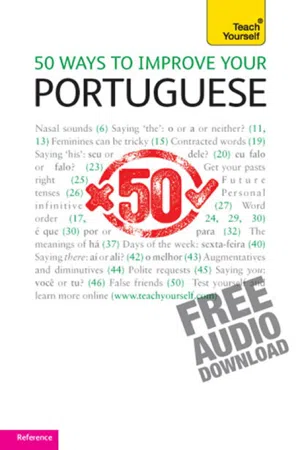
Do you have a working knowledge of Portuguese, but want to improve? Allow this book to come to your rescue and eliminate basic errors and slips of the pen. Each one of 50 top tips for improving your spoken and written Portuguese is presented and analysed across a whole double page, with explanations as to where and why people sometimes go wrong. The tips are grouped into grammar, spelling, false friends, pronunciation and cultural faux pas sections. There's even free downloadable audio content available to help you with your pronunciation. Polish your Portuguese with this brand new series from Teach Yourself - the No. 1 brand in language learning. 50 ways to improve your Portuguese touches all essential bases and is divided into the following easily digestible sections: Only got a minute?
A 60-second introduction to Portuguese to get you started. Only got five minutes?
Get to grips with Portuguese and its common pitfalls even if you're short of time. Only got ten minutes?
Use your free time wisely to learn something about the Portuguese language. Insights
Instant help with common problems and quick tips for success, based on Manuela Cook and Helena Tostevin's many years of experience. Test yourself
Tests online to keep track of your progress. Articles
Extra information to keep you motivated. Summaries
Quick refreshers to help you remember the key facts. Grammar
Easy-to-follow building blocks to give you a clear understanding. Pronunciation
Don't sound like a tourist - polish your pronunciation before you go. Audio
Downloadable audio support online to help with key areas - iPod/MP3 compatible.
For your free audio download please visit: www.hodder.co.uk/TYLfreedownloads
- 160 pages
- English
- ePUB (mobile friendly)
- Available on iOS & Android
eBook - ePub
50 Ways to Improve your Portuguese: Teach Yourself
About this book
Information

Getting the structure right
11a Eu viajo frequentemente entre o Brasil e Portugal I travel frequently between Brazil and Portugal (The definite article)
In English, the definite article is the, but in Portuguese it changes according to whether the noun it is related to is masculine or feminine, singular or plural.

For English-speaking learners pitfalls arise from the fact that the Portuguese definite article is much more widely used than its English counterpart.
Look carefully at the following examples where the article is used.
• continents:
| A África é maior que a Europa. | Africa is larger than Europe. |
| A Europa é um continente relativamente pequeno. | Europe is a relatively small continent. |
• many countries (though not Portugal and some other Portuguese-speaking countries – Angola, Cabo Verde, Moçambique, São Tomé e Príncipe, Timor – and Cuba, Israel, Marrocos and a few others):
| O Brasil é o país mais vasto da América do Sul. | Brazil is the largest country in South America. |
In some cases, however, it may or may not be used.
| A Inglaterra faz parte do Reino Unido. | England is part of the United Kingdom. |
| Ele vai para (a) Inglaterra. | He is going to England. |
• generally, with place names where the name also has a general meaning:
| O Porto fica no norte de Portugal. | Porto is in northern Portugal. |
| (porto as a common noun means port, harbour.) | |
| A Guarda é uma cidade portuguesa. | Guarda is a Portuguese town. |
| (guarda as a common name means guard.) | |
| Os Açores são ilhas do Oceano Atlântico. | The Azores are islands in the Atlantic Ocean. |
| (açor as a common name means goshawk) | |
• often with the names of languages:
| O Português é falado em várias partes do mundo. | Portuguese is spoken in several parts of the world. |
• with nouns used in a general sense:
| A água não deve ser desperdiçada. | Water should not be wasted. |
• with the names of meals:
| Por favor, fique para o jantar. | Please stay for dinner. |
• with the names of seasons:
| O verão é a minha estação favorita. | Summer is my favourite season. |
• with the names of religious and other festivals:
| Este ano a Páscoa é cedo. | This year Easter is early. |
| Vou passar o Natal em casa. | I’m going to spend Christmas at home. |
• with the days of the week:
| Para mim o domingo é o melhor dia da semana. | For me Sunday is the best day... |
Table of contents
- Cover
- Title Page
- Contents
- Meet the Authors
- Only got a minute?
- Only got five minutes?
- Only got ten minutes?
- How to use this book
- Sounding right: pronunciation and spelling
- Getting the structure right
- Choosing the right words
- Glossary of grammatical terms
- Index
- Credits
- Copyright
Trusted by 375,005 students
Access to over 1.5 million titles for a fair monthly price.
Study more efficiently using our study tools.
Frequently asked questions
Yes, you can cancel anytime from the Subscription tab in your account settings on the Perlego website. Your subscription will stay active until the end of your current billing period. Learn how to cancel your subscription
No, books cannot be downloaded as external files, such as PDFs, for use outside of Perlego. However, you can download books within the Perlego app for offline reading on mobile or tablet. Learn how to download books offline
Perlego offers two plans: Essential and Complete
- Essential is ideal for learners and professionals who enjoy exploring a wide range of subjects. Access the Essential Library with 800,000+ trusted titles and best-sellers across business, personal growth, and the humanities. Includes unlimited reading time and Standard Read Aloud voice.
- Complete: Perfect for advanced learners and researchers needing full, unrestricted access. Unlock 1.5M+ books across hundreds of subjects, including academic and specialized titles. The Complete Plan also includes advanced features like Premium Read Aloud and Research Assistant.
We are an online textbook subscription service, where you can get access to an entire online library for less than the price of a single book per month. With over 1.5 million books across 990+ topics, we’ve got you covered! Learn about our mission
Look out for the read-aloud symbol on your next book to see if you can listen to it. The read-aloud tool reads text aloud for you, highlighting the text as it is being read. You can pause it, speed it up and slow it down. Learn more about Read Aloud
Yes! You can use the Perlego app on both iOS and Android devices to read anytime, anywhere — even offline. Perfect for commutes or when you’re on the go.
Please note we cannot support devices running on iOS 13 and Android 7 or earlier. Learn more about using the app
Please note we cannot support devices running on iOS 13 and Android 7 or earlier. Learn more about using the app
Yes, you can access 50 Ways to Improve your Portuguese: Teach Yourself by Helena Tostevin,Manuela Cook in PDF and/or ePUB format, as well as other popular books in Languages & Linguistics & Languages. We have over 1.5 million books available in our catalogue for you to explore.