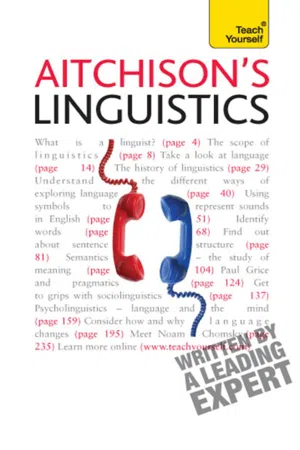
This classic book is a straightforward introduction to linguistics which attempts to answer two fundamental questions: 'What is language?' and 'How does language work?' It outlines the scope of linguistics, explaining basic concepts and essential terminology with examples drawn mainly from English. Sound patterning, syntax and meaning - the inner core of linguistics - are discussed simply and clearly, as are the rapidly growing areas of pragmatics, sociolinguistics, psycholinguistics and stylistics. You will find this contemporary, easy-to-read book essential to broadening your understanding of the subtleties and power of language.
NOT GOT MUCH TIME?One, five and ten-minute introductions to key principles to get you started.
AUTHOR INSIGHTSLots of instant help with common problems and quick tips for success, based on the author's many years of experience.
TEST YOURSELFTests in the book and online to keep track of your progress.
EXTEND YOUR KNOWLEDGEExtra online articles at www.teachyourself.com to give you a richer understanding of linguistics.
FIVE THINGS TO REMEMBERQuick refreshers to help you remember the key facts.
TRY THISInnovative exercises illustrate what you've learnt and how to use it.
eBook - ePub
Aitchison's Linguistics
A practical introduction to contemporary linguistics
- 272 pages
- English
- ePUB (mobile friendly)
- Available on iOS & Android
eBook - ePub
About this book
Information
Part one
Starting out
Worry about words, Bobby. Your grandmother is right. For, whatever else you may do, you will be using words always. All day, and every day, words matter. Though you live in a barrel and speak to nobody but yourself, words matter. For words are the tools of thought …
A.P. Herbert
1
What is linguistics?
This chapter explains how linguistics differs from traditional grammar studies, and outlines the main subdivisions of the subject.
Most people spend an immense amount of their life talking, listening and, in advanced societies, reading and writing. Normal conversation uses 4,000 or 5,000 words an hour. A radio talk, where there are fewer pauses, uses as many as 8,000 or 9,000 words per hour. A person reading at a normal speed covers 14,000 or 15,000 words per hour. So someone who chats for an hour, listens to a radio talk for an hour and reads for an hour possibly comes into contact with 25,000 words in that time. Per day, the total could be as high as 100,000.
The use of language is an integral part of being human. Children all over the world start putting words together at approximately the same age, and follow remarkably similar paths in their speech development. All languages are surprisingly similar in their basic structure, whether they are found in South America, Australia or near the North Pole. Language and abstract thought are closely connected, and many people think that these two characteristics above all distinguish human beings from animals.
Insight
Normal humans use language incessantly: speaking, hearing, reading and writing. They come into contact with tens of thousands of words each day.
An inability to use language adequately can affect someone’s status in society, and may even alter their personality. Because of its crucial importance in human life, every year an increasing number of psychologists, sociologists, anthropologists, teachers, speech therapists, computer scientists and copywriters (to name but a few professional groups) realize that they need to study language more deeply. So it is not surprising that in recent years one of the fastest-expanding branches of knowledge has been linguistics – the systematic study of language.
Linguistics tries to answer the basic questions ‘What is language?’ and ‘How does language work?’. It probes into various aspects of these problems, such as ‘What do all languages have in common?’, ‘What range of variation is found among languages?’, ‘How does human language differ from animal communication?’, ‘How does a child learn to speak?’, ‘How does one write down and analyse an unwritten language?’, ‘Why do languages change?’, ‘To what extent are social class differences reflected in language?’ and so on.
What is a linguist?
A person who studies linguistics is usually referred to as a linguist. The more accurate term ‘linguistician’ is too much of a tongue-twister to become generally accepted. The word ‘linguist’ is unsatisfactory: it causes confusion, since it also refers to someone who speaks a large number of languages. Linguists in the sense of linguistics experts need not be fluent in languages, though they must have a wide experience of different types of language. It is more important for them to analyse and explain linguistic phenomena such as the Turkish vowel system, or German verbs, than to make themselves understood in Istanbul or Berlin. They are skilled, objective observers rather than participants – consumers of languages rather than producers, as one social scientist flippantly commented.
Insight
A linguist in the sense of someone who analyses languages need not actually speak the language(s) they are studying.
Our type of linguist is perhaps best likened to a musicologist. A musicologist could analyse a piano concerto by pointing out the theme and variations, harmony and counterpoint. But such a person need not actually play the concerto, a task left to the concert pianist. Music theory bears the same relation to actual music as linguistics does to language.
How does linguistics differ from traditional grammar?
One frequently meets people who think that linguistics is old school grammar jazzed up with a few new names. But it differs in several basic ways.
First, and most important, linguistics is descriptive, not prescriptive. Linguists are interested in what is said, not what they think ought to be said. They describe language in all its aspects, but do not prescribe rules of ‘correctness’.
Insight
Those who work on linguistics describe languages; they do not dictate how to use them.
It is a common fallacy that there is some absolute standard of correctness which it is the duty of linguists, schoolteachers, grammars and dictionaries to maintain. There was an uproar in the USA when in 1961 Webster’s Third New International Dictionary of the English Language included words such as ain’t and phrases such as ants in one’s pants. The editors were deliberately corrupting the language – or else they were incompetent, argued the critics. ‘Webster III has thrust upon us a dismaying assortment of the questionable, the perverse, the unworthy and the downright outrageous,’ raged one angry reviewer. But if people say ain’t and ants in one’s pants, linguists consider it important to record the fact. They are observers and recorders, not judges.
‘I am irritated by the frequent use of the words different to on radio and other programmes’ ran a letter to a daily paper.
‘In my schooldays of fifty years ago we were taught that things were alike to and different from. Were our teachers so terribly ignorant?’ This correspondent has not realized that languages are constantly changing. And the fact that he comments on the frequent use of different to indicates that it has as much right to be classified as ‘correct’ as different from.
The notion of absolute and unchanging ‘correctness’ is quite foreign to linguists. They might recognize that one type of speech appears, through the whim of fashion, to be more socially acceptable than others. But this does not make the socially acceptable variety any more interesting for them than the other varieties, or the old words any better than new ones. To linguists the language of a pop singer is not intrinsically worse (or better) than that of a duke. They would disagree strongly with the Daily Telegraph writer who complained that ‘a disc jockey talking to the latest Neanderthal pop idol is a truly shocking experience of verbal squalor’. Nor do linguists condemn the coining of new words. This is a natural and continuous process, not a sign of decadence and decay. A linguist would note with interest, rather than horror, the fact that you can have your hair washed and set in a glamorama in North Carolina, or your car oiled at a lubritorium in Sydney, or that you can buy apples at a fruitique in a trendy suburb of London.
A second important way in which linguistics differs from traditional school grammar is that linguists regard the spoken language as primary, rather than the written. In the past, grammarians have over-stressed the importance of the written word, partly because of its permanence. It was difficult to cope with fleeting utterances before the invention of sound recording. The traditional classical education was also partly to blame. People insisted on moulding language in accordance with the usage of the ‘best authors’ of the ancient world, and these authors existed only in written form. This attitude began as far back as the second century bc, when scholars in Alexandria took the authors of fifth-century Greece as their models. This belief in the superiority of the written word has continued for over two millennia.
But linguists look first at the spoken word, which preceded the written everywhere in the world, as far as we know. Moreover, most writing systems are derived from the vocal sounds. Although spoken utterances and written sentences share many common features, they also exhibit considerable differences. Linguists therefore regard spoken and written forms as belonging to different, though overlapping systems, which must be analysed separately: the spoken first, then the written.
Insight
Spoken and written language need to be analysed separately. Both are important, and neither is better than the other.
A third way in which linguistics differs from traditional grammar studies is that it does not force languages into a Latin-based framework. In the past, many traditional textbooks have assumed unquestioningly that Latin provides a universal framework into which all languages fit, and countless schoolchildren have been confused by meaningless attempts to force English into foreign patterns. It is sometimes claimed, for example, that a phrase such as for John is in the ‘dative case’. But this is blatantly untrue, since English does not have a Latin-type case system. At other times, the influence of the Latin framework is more subtle, and so more misleading. Many people have wrongly come to regard certain Latin categories as being ‘natural’ ones. For example, it is commonly assumed that the Latin tense divisions of past, present and future are inevitable. Yet one frequently meets languages which do not make this neat threefold distinction. In some languages, it is more important to express the duration of an action – whether it is a single act or a continuing process – than to locate the action in time.
In addition, judgements on certain constructions often turn out to have a Latin origin. For example, people frequently argue that ‘good English’ avoids ‘split infinitives’ as in the phrase to humbly apologize, where the infinitive to apologize is ‘split’ by humbly. A letter to the London Evening Standard is typical of many: ‘Do split infinitives madden your readers as much as they do me?’ asks the correspondent. ‘Can I perhaps ask that, at least, judges and editors make an effort to maintain the form of our language?’ The idea that a split infinitive is wrong is based on Latin. Purists insist that, because a Latin infinitive is only one word, its English equivalent must be as near to one word as possible. To linguists, it is unthinkable to judge one language by the standards of another. Since split infinitives occur frequently in English...
Table of contents
- Cover
- Title
- Copyright
- Acknowledgements
- Contents
- Introduction
- Only got a minute?
- Only got five minutes?
- Part one: Starting out
- Part two: The inner circles
- Part three: The outer rings
- Part four: Changes and comparisons
- Part five: Towards a universal grammar
- Where now?
- Further reading
- List of symbols and abbreviations
- Phonetics: the study of speech sounds
- Index
Trusted by 375,005 students
Access to over 1.5 million titles for a fair monthly price.
Study more efficiently using our study tools.
Frequently asked questions
Yes, you can cancel anytime from the Subscription tab in your account settings on the Perlego website. Your subscription will stay active until the end of your current billing period. Learn how to cancel your subscription
No, books cannot be downloaded as external files, such as PDFs, for use outside of Perlego. However, you can download books within the Perlego app for offline reading on mobile or tablet. Learn how to download books offline
Perlego offers two plans: Essential and Complete
- Essential is ideal for learners and professionals who enjoy exploring a wide range of subjects. Access the Essential Library with 800,000+ trusted titles and best-sellers across business, personal growth, and the humanities. Includes unlimited reading time and Standard Read Aloud voice.
- Complete: Perfect for advanced learners and researchers needing full, unrestricted access. Unlock 1.5M+ books across hundreds of subjects, including academic and specialized titles. The Complete Plan also includes advanced features like Premium Read Aloud and Research Assistant.
We are an online textbook subscription service, where you can get access to an entire online library for less than the price of a single book per month. With over 1.5 million books across 990+ topics, we’ve got you covered! Learn about our mission
Look out for the read-aloud symbol on your next book to see if you can listen to it. The read-aloud tool reads text aloud for you, highlighting the text as it is being read. You can pause it, speed it up and slow it down. Learn more about Read Aloud
Yes! You can use the Perlego app on both iOS and Android devices to read anytime, anywhere — even offline. Perfect for commutes or when you’re on the go.
Please note we cannot support devices running on iOS 13 and Android 7 or earlier. Learn more about using the app
Please note we cannot support devices running on iOS 13 and Android 7 or earlier. Learn more about using the app
Yes, you can access Aitchison's Linguistics by Jean Aitchison in PDF and/or ePUB format, as well as other popular books in Languages & Linguistics & Linguistic Semantics. We have over 1.5 million books available in our catalogue for you to explore.