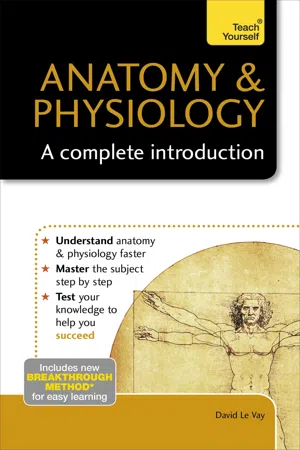
Anatomy & Physiology: A Complete Introduction is designed to give you everything you need to succeed, all in one place. It covers the key areas that students are expected to be confident in, outlining the basics in clear, jargon-free English and providing added-value features like summaries of key books and even lists of questions you might be asked in your seminar or exam.The book uses a structure that mirrors the way anatomy & physiology is taught on many university courses, providing a comprehensive introduction to the structure and function of the human body. Extensively illustrated, the book also covers modern methods of investigation, relevant aspects of modern genetics, sports injuries, environmental and evolutionary considerations, and the physiological aspects of AIDS. Topics covered include: cells and tissues; the skeleton; muscle; body coverings and body systems; the upper limb; the lower limb; the abdomen; the thorax; the head and neck; basic biophysics and chemistry; foodstuffs and vitamins; digestion; absorption, utilization and storage of digested food; blood, lymph and reticuloendothelial (immune) system; the heart and circulation; respiration; excretion; nervous system and sense organs; the endocrine system; reproduction and development; environmental considerations; evolution. Anatomy & Physiology employs the 'Breakthrough Method' to help you advance quickly at any subject, whether you're studing for an exam or just for your own interst. The Breakthrough Method is designed to overcome typical problems you'll face as learn new concepts and skills.- Problem: "I find it difficult to remember what I've read."; Solution: this book includes end-of-chapter summaries and questions to test your understanding.
- Problem: "Lots of introductory books turn out to cover totally different topics than my course."; Solution: this book is written by a university lecturer who understands what students are expected to know.
- 288 pages
- English
- ePUB (mobile friendly)
- Available on iOS & Android
eBook - ePub
Anatomy & Physiology: A Complete Introduction: Teach Yourself
About this book
Information
Part 1:
Anatomy
1
General considerations

In this chapter you will learn about:
• what anatomy means
• key terms used in anatomy
• different methods of acquiring anatomical knowledge
• the history of anatomy.
Anatomy
The word anatomy means the cutting up of the body to examine its parts. Knowledge gained in this way is essentially regional in that one gains a familiarity with each body part, such as the arm or leg. However, every part contains the same kinds of blood vessels, nerves, bones and so on – so that, as well as regional anatomy, there is also a systemic aspect in which the body is considered to be made up of several coordinated systems such as the nervous system. Body systems are known as macroscopic or gross anatomy, and contrast with microscopic anatomy or histology, which is the study of the structure of cells and tissues.
We should also consider developmental anatomy, which is known as ontogeny, and consists of embryology, which is the growth of the individual within the womb, postnatal development from infancy to maturity, and then, towards the end of life, certain changes as one grows older called senescence.
Methods of acquiring anatomical knowledge
• Dissection
The oldest method of acquiring anatomical knowledge is by dissection, which involves cutting body tissue and examining it. This can take place on both the living body and the recently dead through surgical explorations and autopsies respectively.

Nugget
In the early nineteenth century it was difficult to obtain subjects for dissection; only the bodies of hanged criminals were available – in fact, their dissection was compulsory by law. However, as this source proved inadequate, the snatching of freshly buried corpses by the ‘resurrection men’ became prevalent in London, Glasgow and Edinburgh, a lucrative occupation. Increasing public anger was aroused, especially when murders were committed to obtain bodies for sale, as in the infamous Burke and Hare episode in Edinburgh. The disclosures at their trial in 1828 were ultimately responsible for the Anatomy Act of 1831, regularizing the conduct of schools of anatomy and authorizing the use of donated bodies for dissection.
• Optical microscopy
This method uses electron microscopes to study microscopic anatomy of the cells and tissues which links up with the study of molecular biology.
• Surface anatomy inspection
These methods deal with the relation of superficial landmarks to the deeper structures in the body. Inspection reveals the bulge of muscles when they contract, the pulsation of arteries and the course of veins, and the position of bony prominences. Palpation, manipulation and percussion are methods used in surface anatomy to reveal respectively the consistence of the deep structures, the movements of joints, and the boundaries of hollow air-containing or solid organs, while listening with a stethoscope – auscultation – locates organs such as the heart, lungs and bowel.
• Endoscopy
This is the introduction of an instrument carrying an optical system, which may be connected to a videocamera, to visualize the inside of cavities such as the abdomen or hollow organs like the stomach or bladder, or the interior of joints (arthroscopy).
• Ultrasound
This method produces images of deep-lying structures without irradiation and is routinely used for studying the foetus in pregnancy; it shows up most internal organs but without much detail.
• Radiographic anatomy
X-rays show the skeletal system and also demonstrate hollow organs when these are filled with air, which is abnormally translucent, or with substances opaque to the rays.
• Computed tomography (CT)
This method uses X-rays and produces ‘slices’ at selected depths and planes of various body parts and areas.
• Magnetic resonance imaging (MRI)
MRI is a magnetic excitation of tissue hydrogen molecules without irradiation and also allows sections of any desired thickness, at any depth and in any plane of areas of the body, but remains a lengthy procedure.
Variation in human anatomy
Human beings are essentially similar, but there is a continuous variation from the standard pattern in inessential details. We vary outwardly in height and colouring, and internally there may be minor differences in the arrangement of nerves and blood vessels, bile ducts and bronchi. But just as the general catalogue – ‘item, two lips, indifferent red; item, two eyes, with lids to them; item, one neck, one chin’, and so forth – is always correct, so the femoral artery or the biceps muscle is always where we expect to find it. There are occasional grosser errors which represent a failure or misdirection of normal development, such as absence of part or whole of a limb or cleft palate.
The history of anatomy
Some prehistoric anatomical instinct is evident from the uncanny accuracy of carvings and cave drawings and indicates an acquaintance with underlying structures. The Egyptians had a body of knowledge derived from embalming, various surgical procedures and ritual divination using the entrails of animals. However, it is to the Greeks that we owe the idea of structure as a matter for deliberate investigation. The superb surface anatomy of Greek sculpture speaks for itself and various operations, such as trephining for head injuries, were common. Aristotle and Hippocrates are the great names of this period. Hippocrates worked from a practical surgical viewpoint in connection with wounds, fractures and dislocations. Aristotle, who founded comparative anatomy, did not practise human dissection but made many accurate observations of adult and embryo animals. After his death, the school at Alexandria established a discipline which included the public dissection of human bodies. There was a medical school in Rome and systematic descriptions of bones and organs began. In the second century AD, Galen was the greatest physician and anatomist of antiquity; his work was the basis of European anatomy for a thousand years, surviving the Dark Ages to reappear in translations by Arab scholars at the Renaissance.
The Middle Ages saw the rise of the great Italian universities and medical schools – Salerno, Bologna and Padua – where students were formally instructed in anatomy by professors. Leonardo da Vinci is remarkable in this period as a brilliant artist and anatomis...
Table of contents
- Cover
- Title
- Contents
- Acknowledgements
- Part 1: Anatomy
- Part 2: Physiology
- Test answers
- Copyright
Trusted by 375,005 students
Access to over 1.5 million titles for a fair monthly price.
Study more efficiently using our study tools.
Frequently asked questions
Yes, you can cancel anytime from the Subscription tab in your account settings on the Perlego website. Your subscription will stay active until the end of your current billing period. Learn how to cancel your subscription
No, books cannot be downloaded as external files, such as PDFs, for use outside of Perlego. However, you can download books within the Perlego app for offline reading on mobile or tablet. Learn how to download books offline
Perlego offers two plans: Essential and Complete
- Essential is ideal for learners and professionals who enjoy exploring a wide range of subjects. Access the Essential Library with 800,000+ trusted titles and best-sellers across business, personal growth, and the humanities. Includes unlimited reading time and Standard Read Aloud voice.
- Complete: Perfect for advanced learners and researchers needing full, unrestricted access. Unlock 1.5M+ books across hundreds of subjects, including academic and specialized titles. The Complete Plan also includes advanced features like Premium Read Aloud and Research Assistant.
We are an online textbook subscription service, where you can get access to an entire online library for less than the price of a single book per month. With over 1.5 million books across 990+ topics, we’ve got you covered! Learn about our mission
Look out for the read-aloud symbol on your next book to see if you can listen to it. The read-aloud tool reads text aloud for you, highlighting the text as it is being read. You can pause it, speed it up and slow it down. Learn more about Read Aloud
Yes! You can use the Perlego app on both iOS and Android devices to read anytime, anywhere — even offline. Perfect for commutes or when you’re on the go.
Please note we cannot support devices running on iOS 13 and Android 7 or earlier. Learn more about using the app
Please note we cannot support devices running on iOS 13 and Android 7 or earlier. Learn more about using the app
Yes, you can access Anatomy & Physiology: A Complete Introduction: Teach Yourself by David Le Vay in PDF and/or ePUB format, as well as other popular books in Biological Sciences & Human Anatomy & Physiology. We have over 1.5 million books available in our catalogue for you to explore.