Do you want to protect yourself from all the legal pitfalls in planning, setting up and running your SME? Then let one of the UK's leading law firms guide you through the minefield with this book - the best quick reference to all of those risks and how to avoid them, With a practical approach that takes you from: Pre-start up ( Operating structures; Restrictions preventing start up; Corporate finance considerations) Through start-up (Shareholder/partnership agreements and exit strategies; Property/premises issues; Employment of staff, including drafting contracts of employment; Supplier contracts; Customer/client contracts; Protecting IP rights) To practical ongoing SME pitfalls (IP rights and disputes; Owner disputes; HR/employee problems; Health and Safety problems; PI claims and HSE prosecutions; Supplier disputes; Customer disputes including debt collection; Merger & Acquisitions activity including issues related to disposing of a business)This invaluable book could save you from legal and financial disaster: a great value resource for every small to medium business.
eBook - ePub
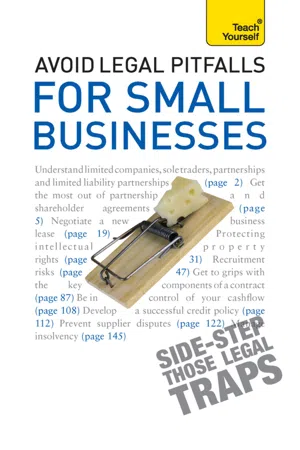
Avoid Legal Pitfalls for Small Businesses
An essential reference guide to law and litigation for SMEs
- 208 pages
- English
- ePUB (mobile friendly)
- Available on iOS & Android
eBook - ePub
Avoid Legal Pitfalls for Small Businesses
An essential reference guide to law and litigation for SMEs
About this book
Information
1

Setting up a business
In this chapter you will learn about:
- the different legal forms of business
- what steps are necessary to start up your chosen legal structure for your business
- shareholders’ and partnership agreements and how they can considerably ease the working of your company.

Initial considerations
When setting up a business, it is extremely important to take time to consider carefully which structure is best suited to the nature of the business itself and the individuals involved and how they intend to carry out that business. From a financial perspective, choosing the correct legal form for your business is key. The legal structure has an effect on:
- National Insurance and tax liabilities
- statutory requirements in respect of records/accounts to be kept and filed
- liability of the business or individuals within the business if the business were to fail
- the authorities to which the business reports and answers
…and, in more general terms, how the business is run and how decisions are made.
This chapter aims to provide a more detailed overview of the types of legal business structures that exist, their specific characteristics and differences, and their benefits and drawbacks. It is worthwhile carrying out some research online and obtaining as much information as possible from Business Link and Companies House on the types of structure. It is also worth investing in time with a solicitor or accountant to assist in the process of choosing the correct structure that best suits the particular circumstances of the business and individuals concerned. We will take these structures in order.
There are essentially five main choices. These are:
- sole trader
- private company (either a private limited or private unlimited company)
- partnership
- limited liability partnership
- public company.
There are also various other business structures that have come into being in more recent times. It should be noted that it is possible to change the legal form of the business after it has commenced trading and has been created, but to effect that change takes time, money, specialist advice (either from accountants in respect of tax implications and/or from solicitors in respect of legal implications) and requires notification to HMRC.
Sole trader
The simplest option is for you to trade on your own behalf and in your own name. Most who start up small businesses find that this is their best option. Though you might well talk about ‘your business’, as a sole trader in legal terms your business is not an entity that is distinct from you. Your customers and suppliers or anyone with whom you have entered into a contractual relationship in the course of your business will be contracting with you as an individual.
There are upsides and downsides to this structure. All the assets and profits are owned by you but so is the risk. You are personally liable for all debts and liabilities during the course of your business. Many small businesses are structured in this way since the set-up, management, accounting, tax and National Insurance positions are all relatively straightforward. To start up as a sole trader you must simply register with HMRC as being self-employed. Your statutory obligations are to keep accounting records of your business, income and expenses, and to file self-assessment tax returns. All the decisions are yours in respect of the management. You are considered self-employed. You pay fixed-rate Class 2 National Insurance contributions regardless of any profits you make. You pay Class 4 National Insurance contributions on any profit and your profits are taxed as income. You may have to register for VAT depending on the amount of sales. While you have complete control over your business, if you run up debts or if your business does not succeed, any liability lies with you. This will often mean that your home and other assets may be at risk.
POSITIVES
- You can keep simple, unaudited accounts.
- National Insurance is low.
- Unless your earnings are high, you may find that your total tax burden is lower than that of a limited company.
- Setting up is quick and easy.
- As your earnings increase, you can form a limited company, although you may have to pay stamp duty to do so.
NEGATIVES
- You have personal liability for all your business debts. This means that all of your personal assets are at risk.
- You are entitled to fewer social security benefits.
- Your options for financing your business are limited.
- It can be harder to sell your business or pass it on.
Private company
The second structure is that of a private company. There are generally two types of private companies:
- a private limited company, and
- a private unlimited company (less common).
The great advantage and crucial element of this structure is that, no matter how small or how large the company is, in legal terms it is an entity that is distinct from you. This means that the assets of the company are owned by the company and not by you. If things went wrong, other parties to contracts would sue the company and not you personally. It is the company and not you which has entered into contracts and is liable for all debts and liabilities incurred.
The company is a separate legal entity even if it is entirely and wholly owned by you. There are a number of legal consequences that flow from the separate legal personality of the company. There is a distinction between the assets of a company and your personal assets. The failure of the company, and its possible liquidation, limits the creditors’ claim to the assets of the company and not those owned by you.
Some common features of all private companies are that the company must be registered at Companies House, the company must file accounts with Companies House and these accounts should be audited unless they are exempt. A further obligation is to file an annual return with Companies House. There are specific provisions in respect of company secretaries and directors and their eligibility. If the company has any taxable income or profits, there is an obligation to notify HMRC and an obligation to file a corporation tax return. There are a further number of HMRC requirements that must be met – for example, VAT, PAYE, and so on.
A fundamental distinction between a private limited and private unlimited company is that in a limited company the finances are separate from the personal finances of their owner. A company is limited either by shares or by guarantee and, in the event of the company either being wound up or found liable, the members’ liability is limited. In reality, there are still many instances when personal liability can still arise, such as in cases of security on borrowings or personal guarantees. In a private unlimited company, there is no limit on liability of its members in the event of the company’s liquidation. Such companies are not common and, indeed, it would be unusual to find a small business being a private unlimited company. It is very important in these structures to both have a shareholders’ agreement (see box below), setting out the relationship between the shareholders and articles of association, which define the company structure. The advantages of limited companies tend to increase as the business grows.
POSITIVES
- A private limited or unlimited company is a separate entity distinct from you personally.
- A limited company carries greater credibility.
- It is easier to raise finance for the business or to sell a part of the business.
- High earners can gain tax advantages either by keeping money in the business or making dividend or pension payments.
NEGATIVES
- There is a great deal of red tape associated with registering a limited company (although your solicitor or accountant may be able to make life easier here by buying an ‘off-the-shelf’ company on your behalf, or you can use a reputable company registration agent) and appointing directors.
- Annual accounts are generally more complex.
- Companies with turnovers of greater than £6.5 million require an independent audit, with all of the associated costs and administration.
- National Insurance payments are higher, given the requirement to pay employer’s and employee’s NI contributions on all salaries, including those of the company directors.
- If you decide to cease trading, it can be more difficult and more expensive to wind up your company.
| Shareholders’ agreements |
At law a company is a separate legal entity and quite distinct from its shareholders (the owners), the directors (who run the company day to day) and the employees. It may be that an individual is a shareholder, director and employee, but one of the core strengths of the limited company vehicle is the fact that there can be a separation of ownership from management. It is therefore very important that the owners’ – the shareholders’ – rights, duties, obligations and powers are clearly set out. The articles of association of the company may provide a basic framework; however, normally the articles of association will not cover all of the important matters such as how a shareholder can transfer their shares if they leave. Moreover, the articles of association are public documents which must be filed with Companies House and so anyone can obtain a copy. Ordinarily, the shareholders will not want the details of their arrangements available publicly and so will opt for a shareholders’ agreement which will be private as between them and which will govern their relationships as shareholders.
A shareholders’ agreement must be tailored to the particular business, and you should always seek legal advice before entering into such an important document. Further, the shareholders’ agreement should be a living document in the sense that it should grow with your business. There is little point incurring the cost of having a 100-page, all singing, all dancing agreement drawn up from day one if the business is a new start-up and costs are tight. In this scenario, a basic well-drafted agreement would provide the core protections necessary, and over time, as the business grows, the agreement can be redrafted to become more sophisticated. A shareholders’ agreement is particularly important if there are minority shareholders as the agreement will be a chance for them to ensure appropriate protection of their minority interests in the company, although much will depend on their relative negotiating strength as to how much protection they can obtain.
Common things that ought to be considered and dealt with in a shareholders’ agreement include:
- Whether there are any core business decisions that require unanimity of all the shareholders. Under company law, most company decisions require a simple majority of the shareholders and so 51 per cent of the vote suffices. There are some matters which require 75 per cent of the votes but nothing requires unanimity. Therefore, a shareholders’ agreement will commonly set out certain important decisions that can only be taken with the written agreement of all shareholders. These typically include:
- the selling, transferring, leasing, assigning or otherwise disposing of a material part of, or any interest in, the undertaking, property or assets of the company or any subsidiary
- doing anything whereby the company may be wound up (whether voluntarily or compulsorily) unless the company is insolvent
- entering into any contract except in the ordinary and proper course of business
- borrowing money
- taking major decisions relating to the conduct of material legal proceedings to which the company is a party
- incurring capital expenditure above a certain limit
- holding any meeting of shareholders unless all shareholders or duly authorized representatives or proxies for each of the shareholders are present
- amending the articles of association of the company
- altering any rights or restrictions attached to any class of shares
- changing the company’s name
- passing any resolution or engaging in any other matter which represents a substantial change in the nature of the company’s business or in the manner in which that business is conducted
- removing a director
- issuing any additional shares otherwise than in accordance with the shareholders’ agreement.
- Whether a shareholder has the right to be a director (or to appoint a director to represent th...
Table of contents
- Cover
- Half Title
- Title
- Copyright
- Contents
- Preface
- In One Minute
- 1 Setting up a Business
- 2 Property
- 3 Intellectual Property
- 4 Employment
- 5 Contracts: an Overview
- 6 Standard Terms and Conditions
- 7 Cash, Funding and Debt Recovery
- 8 Dispute Resolution
- 9 Other Legal Pitfalls
- Annex 1: Sample Employment Contact
- Answers to Test Yourself Sections
Trusted by 375,005 students
Access to over 1.5 million titles for a fair monthly price.
Study more efficiently using our study tools.
Frequently asked questions
Yes, you can cancel anytime from the Subscription tab in your account settings on the Perlego website. Your subscription will stay active until the end of your current billing period. Learn how to cancel your subscription
No, books cannot be downloaded as external files, such as PDFs, for use outside of Perlego. However, you can download books within the Perlego app for offline reading on mobile or tablet. Learn how to download books offline
Perlego offers two plans: Essential and Complete
- Essential is ideal for learners and professionals who enjoy exploring a wide range of subjects. Access the Essential Library with 800,000+ trusted titles and best-sellers across business, personal growth, and the humanities. Includes unlimited reading time and Standard Read Aloud voice.
- Complete: Perfect for advanced learners and researchers needing full, unrestricted access. Unlock 1.5M+ books across hundreds of subjects, including academic and specialized titles. The Complete Plan also includes advanced features like Premium Read Aloud and Research Assistant.
We are an online textbook subscription service, where you can get access to an entire online library for less than the price of a single book per month. With over 1.5 million books across 990+ topics, we’ve got you covered! Learn about our mission
Look out for the read-aloud symbol on your next book to see if you can listen to it. The read-aloud tool reads text aloud for you, highlighting the text as it is being read. You can pause it, speed it up and slow it down. Learn more about Read Aloud
Yes! You can use the Perlego app on both iOS and Android devices to read anytime, anywhere — even offline. Perfect for commutes or when you’re on the go.
Please note we cannot support devices running on iOS 13 and Android 7 or earlier. Learn more about using the app
Please note we cannot support devices running on iOS 13 and Android 7 or earlier. Learn more about using the app
Yes, you can access Avoid Legal Pitfalls for Small Businesses by Bevans Solicitors in PDF and/or ePUB format, as well as other popular books in Business & Business Law. We have over 1.5 million books available in our catalogue for you to explore.