If you want to learn how to be an inspirational leader then this is the book for you! It is clearly written and enriched throughout with invaluable case studies, exercises and descriptions of how great leaders have made a difference. Coverage includes:
·Setting a clear vision·What makes a great leader·Different types of leader·The building blocks·Unlocking patterns of communication·Working with and relating to others·Achieving the balance between leadership and life
Containing lots of practical advice, this book helps you to change bad habits, guides you towards the sort of leadership style that's right for you and empowers you to be the best leader you can be.
NOT GOT MUCH TIME?One, five and ten-minute introductions to key principles to get you started.
AUTHOR INSIGHTSLots of instant help with common problems and quick tips for success, based on the author's many years of experience.
TEST YOURSELFTests in the book and online to keep track of your progress.
EXTEND YOUR KNOWLEDGEExtra online articles at www.teachyourself.com to give you a richer understanding of how to be a better leader.
FIVE THINGS TO REMEMBERQuick refreshers to help you remember the key facts.
TRY THISInnovative exercises illustrate what you've learnt and how to use it.
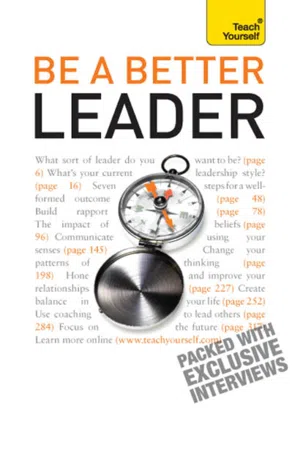
eBook - ePub
Be A Better Leader
An inspiring, practical guide to becoming a successful leader
- 256 pages
- English
- ePUB (mobile friendly)
- Available on iOS & Android
eBook - ePub
About this book
Information
Topic
Personal DevelopmentSubtopic
Self Improvement1
Everybody can be, and everybody is, a leader
In this chapter we will consider how to:
- acknowledge your potential to grow to be the leader you desire to be
- explore how you want to be viewed as a leader
- listen to what others said about a noted leader
Introduction
‘Personally, I’m always ready to learn although I do not always like being taught.’
Winston Churchill
Wouldn’t it be fantastic to be able to learn in a way that suits you and be able to apply that learning immediately, to practical benefit and to understand why what you then do enables you to lead with effectiveness and impact?
‘Leadership is something that can be learned by anyone, taught to everyone, denied to no-one.’
Bennis and Nanus from Leaders: Strategies for Taking Charge
A manager asked his mentor ‘What do I have to do to be a better leader?’ The mentor replied: ‘It is not the doing, it is the being that counts.’ So how does one be a better leader? Everyone has within them the ability to lead. This book aims to unlock some of the most successful techniques used by leaders to help you go beyond even what you dreamt you could be.
The attributes of leaders are not in a formula. We do not have a little list of things to do to be a great leader. What we do have is a series of techniques that will unlock in you the qualities that you already have to lead, and which will introduce you to the experience of other key leadership behaviours that you can develop.
Leadership is not a thing. You cannot pick it up, fill a wheelbarrow with it, or buy it.
Insight
Leadership is the ability to lead; the ability to generate ideas, communicate them and create the belief in followers that the idea or mission is worthwhile.
Leaders are all around us. Some leaders have a title – Prime Minister, President, Chief Executive, Principal, Conductor, Captain, Mother. Some demonstrate leadership over a long period of time – matriarch, founder of the family business, political idealist, general, head of nursing.
Some show leadership in the moment and we sometimes call them heroes, as they seem to take charge of impossible situations and lead people through them – the nursery teacher who led her children to safety in the face of a knife attack, or the passenger in a capsizing ferry who convinced others to join him to create a human bridge over which many could scramble to a place of rescue.
Leadership is not a function of age. There is not an age at which you become old enough to lead. Children can lead and do it with unconscious ease. They have ideas, they tell their friends about the idea and their friends want to do it, and will undertake extraordinary feats to be part of the leading child’s adventure.
Insight
The qualities that make followers want to support the leader are not the same in every circumstance. There is no secret list to be shared. The secrets to our potential are inside us.
This book will tell you how to unlock your own ability to lead.
JUST BECAUSE SOMEONE IS A LEADER IT DOESN’T MEAN THEY ARE A NICE PERSON
We can think of leaders who may have created following but we perceived their mission or outcome was flawed: Saddam Hussein, Jim Jones and his People’s Temple where he led 900 followers to commit mass suicide and President Mugabe of Zimbabwe. This book gives us ways of cross-referencing our own missions, identities, beliefs and values, which in turn influence the skills and capabilities and individual behaviour as well as the environments in which we choose to lead. Leaders need valuable ways of eliciting feedback from others to ensure they harvest the perspectives of critical friends and not just the adoration of submissive or intimidated followers. Many flawed leaders on the world stage did not have critical feedback, and were viewed by followers as demi-gods. Hitler had no one to provide feedback, whereas many who succeeded did – Shackleton had Wild, Nixon had Kissinger, and Queen Victoria had Prince Albert. Blair had Mandelson and for Obama it is perhaps his chief of staff, Rahm Emanuel.
How are you leading now?
It may be that you are not leading in the way that you want to lead. You may not be achieving the outcomes that are important to you. Then again, you may disagree and feel that your leadership meets the needs of the moment.
If you keep leading in the way that you currently do the useful patterns, and the less useful patterns, are likely to continue to occur. The outcomes you keep arriving at may or may not be where you want to be.
‘None of us knows what the next change is going to be, what unexpected opportunities are just around the corner, waiting a few months or a few years to change all the tenor of our lives.’
Kathleen Norris
In working through this book you will unlock secrets of motivation, flexibility and creating choices that make for excellence in leadership and that allow us to continue to achieve results in different circumstances. We do this by tuning the skills and awareness inside ourselves rather than practising leadership according to a set of predetermined behaviours. Leadership is about being, not about doing.
As you read on you will be helped to recognize the genius, power and magic in yourself and take yourself beyond your current expectations of what you can achieve as a leader.
Insight
Leadership requires boldness, clarity and focus. We don’t know of anyone who has been successful when they are timid, vague and all over the place – although we have heard many followers describe their so-called leaders in such terms!
The book explores leading with the help of some voices of leaders who have been remarkable and voices of people who are just like us. You will learn techniques, hear stories and recognize styles of leadership that can give insight, confidence and new skills to enable you as a leader to be your best, to lead in a way that is right for you and for those you seek to lead.
Your path to success as a leader is laid out in this book. You can be your best. Each step will enable you to:
- know what ‘the right’ leadership is like for you
- focus on what you really want to achieve
- focus on knowing yourself better than you ever have and know that you can prepare to lead in the way you want to
- influence and relate with others
- create the balance you need in your life to lead and remain the person you want to be.
Insight
‘Our deepest fear is not that we are inadequate. Our deepest fear is that we are powerful beyond measure. It is our light, not our darkness that frightens us.’
The voice of Nelson Mandela at his inauguration speech as President in 1994 gives a moment of great inspiration by quoting the words of Marianne Williamson.
‘Our deepest fear is not that we are inadequate. Our deepest fear is that we are powerful beyond measure.
It is our light, not our darkness that frightens us.
We ask ourselves, “Who am I to be brilliant, gorgeous, talented and fabulous?” Actually, who are you not to be? You are a child of God. Your playing small doesn’t serve the world.
There is nothing enlightened about shrinking so that other people won’t feel insecure around you.
We were born to make manifest the glory of God that is within us. It is not just in some of us, it is in everyone.
And as we let our own light shine, we unconsciously give other people permission to do the same.
As we are liberated from our fear, our presence automatically liberates others.’
Insight
Fear is often born out of uncertainty. How certain are you of what works and what doesn’t work in your leadership? The clearer YOU can get, the less fearful you will be and the more convinced followers are likely to be.
Let the journey begin
Your first step to be the leader you want to be, is to come on a journey into the future. When you see how much you can achieve you can begin to head for that place. If you don’t know where you are going you may end up somewhere else. In Alice in Wonderland. the Cat makes this point to Alice. Alice asks, ‘Would you tell me please, which way I am to go from here?’ ‘That depends a great deal on where you want to get to,’ said the Cat. ‘I don’t much care where …’ said Alice. ‘Then it doesn’t matter which way you go,’ said the Cat. ‘So long as I get SOMEWHERE,’ Alice added as an explanation. ‘Oh, you’re sure to do that,’ said the Cat, ‘if you only walk long enough.’
So where do you want to be as a leader? You can look into the future and make these choices. Imagine you are Ann, a leader who is saying goodbye to her team of the last ten years. You are a fly on the wall and you can hear all that people are saying about Ann. You look down and you see all the people at the event. You notice how they are interacting with each other and you hear what they are saying about the woman as a leader …
‘She was great but she never really achieved what she was capable of …’
‘She did a great job and yet there was something more that I believed she could have done …’
‘I have no idea if she believed in me and my abilities …’
‘She once talked about her dream and then she got so busy doing things that I never really found out what that dream was … Maybe she can achieve it in her next job.’
‘I liked her and yet I never felt I knew her.’
If Ann, who is at the point of completing her leadership of this task was listening it is likely that she has not heard the words from others that she would like to have heard used to describe her as a leader. Such an experience of eavesdropping would inevitably leave her (or any of us) disappointed. She would much rather have heard them saying things like:
‘She allowed me to connect with her ideas...
Table of contents
- Cover
- Title
- Copyright
- Contents
- Meet the authors
- Only got a minute?
- Only got five minutes?
- 1 Everybody can be, and everybody is, a leader
- 2 Seven styles of leading
- 3 Leadership through well-formed outcomes
- 4 The five foundations of leadership
- 5 Believe in: your cause, yourself, it being possible
- 6 Unlocking patterns of communication
- 7 Unlocking patterns of thinking
- 8 Communicating powerfully
- 9 Working with and relating to others
- 10 Balancing leadership and life
- 11 Leader as coach, and coaches for leaders
- 12 Freedom from things that stop you
- Taking it further
- Index
Trusted by 375,005 students
Access to over 1.5 million titles for a fair monthly price.
Study more efficiently using our study tools.
Frequently asked questions
Yes, you can cancel anytime from the Subscription tab in your account settings on the Perlego website. Your subscription will stay active until the end of your current billing period. Learn how to cancel your subscription
No, books cannot be downloaded as external files, such as PDFs, for use outside of Perlego. However, you can download books within the Perlego app for offline reading on mobile or tablet. Learn how to download books offline
Perlego offers two plans: Essential and Complete
- Essential is ideal for learners and professionals who enjoy exploring a wide range of subjects. Access the Essential Library with 800,000+ trusted titles and best-sellers across business, personal growth, and the humanities. Includes unlimited reading time and Standard Read Aloud voice.
- Complete: Perfect for advanced learners and researchers needing full, unrestricted access. Unlock 1.5M+ books across hundreds of subjects, including academic and specialized titles. The Complete Plan also includes advanced features like Premium Read Aloud and Research Assistant.
We are an online textbook subscription service, where you can get access to an entire online library for less than the price of a single book per month. With over 1.5 million books across 990+ topics, we’ve got you covered! Learn about our mission
Look out for the read-aloud symbol on your next book to see if you can listen to it. The read-aloud tool reads text aloud for you, highlighting the text as it is being read. You can pause it, speed it up and slow it down. Learn more about Read Aloud
Yes! You can use the Perlego app on both iOS and Android devices to read anytime, anywhere — even offline. Perfect for commutes or when you’re on the go.
Please note we cannot support devices running on iOS 13 and Android 7 or earlier. Learn more about using the app
Please note we cannot support devices running on iOS 13 and Android 7 or earlier. Learn more about using the app
Yes, you can access Be A Better Leader by Catherine Doherty in PDF and/or ePUB format, as well as other popular books in Personal Development & Self Improvement. We have over 1.5 million books available in our catalogue for you to explore.