From weighing up the pros and cons of jumping ship in the first place to establishing and maintaining a successful solo enterprise, this book is all you need to make the leap to working alone.
All aspects of setting up a new business are covered including:
- managing resources, time, clients etc.- establishing good working practices and maintaining a desirable work/life balance for those who choose to work from home.- getting the financial aspects right - one of the biggest pitfalls in going it alone.- being a 'five to niner' - building up a business in your spare time while still employed.
Practical examples of best (and worst) practices are provided, gleaned from interviews with dozens of people from across the globe who are successful solo workers. Be your own Boss contains hundreds of relevant examples and genuine, tried and tested tips and practices which really work.
NOT GOT MUCH TIME?
One and five-minute introductions to key principles to get you started.
AUTHOR INSIGHTSLots of instant help with common problems and quick tips for success, based on the author's many years of experience.
TEST YOURSELFTests in the book and online to keep track of your progress.
EXTEND YOUR KNOWLEDGEExtra online articles at www.teachyourself.com to give you a richer understanding of how to keep your small business afloat and going strong.
THINGS TO REMEMBERQuick refreshers to help you remember the key facts.
TRY THISInnovative exercises illustrate what you've learnt and how to use it.
eBook - ePub
Be Your Own Boss
How to start doing what you love: a guide to being a successful solo enterpreneur
- 208 pages
- English
- ePUB (mobile friendly)
- Available on iOS & Android
eBook - ePub
Be Your Own Boss
How to start doing what you love: a guide to being a successful solo enterpreneur
About this book
Information
1
Weighing the options
In this chapter you will learn:
- whether you should stay put or it is time to leave
- whether you can improve your situation without leaving
- the pros and cons of quitting and of becoming your own boss
Should you stay put or is it time to leave?
‘Whenever you see a successful business, someone once made a courageous decision.’
Peter Drucker
The lure of becoming your own boss can be incredibly strong, particularly if things are not that great in your current job or if you have a burning desire to take charge of your own career destiny. The opportunity to work for yourself and to be answerable to no one but yourself, whilst keeping all the rewards of your efforts, can certainly seem mightily attractive. But it is important to keep a sense of perspective and to remember that there can be significant downsides to going solo too. Before taking the leap to solo working, therefore, you will need to be very clear about your reasons for doing so. Have you reached the end of the road in your current job? Are you bored, and craving a new challenge? Have you really fully explored all the other options open to you (a sideways move within the same company, taking a similar job within a different company, changing careers altogether but remaining in salaried employment etc.) or have you been blinded by the thought of being your own boss? Have you thought through the practicalities of leaving? Have you given yourself sufficient time and space to really understand what it is you want from your new career? Have you achieved everything you wanted to achieve whilst in paid employment? Will you be missing out on valuable training and experience by leaving? It is only through a process of rigorous self-examination and soul-searching, as well as an exploration of all the options available to you, that you can reach a considered opinion as to which direction to take in the next step along your career path.
Case study
‘Having achieved the goals I had set myself in my old company (to become MD), I began looking around for the next goal. I gradually realized that I did not want any of the jobs the people “above” me had, they were all political, inward-looking roles. It also dawned on me that now that I was the boss I had no one to look up to and learn from, other than the corporate suits, and I did not want to learn about global business management, P & L reporting or sitting in endless internal meetings discussing company finances. I also looked at my remuneration package and found that despite the fact that I was solely responsible for 30 per cent of the 100-person company’s revenues, I was still paid a standard salary and that even with the best bonus the company had ever paid anyone (which they begrudgingly paid me) I was never going to make serious money – the kind of money that the firm’s founders had made when they sold the company (and my career) to a big corporation. All this led me, with much soul-searching (was I being too greedy? was I too selfish? shouldn’t I be grateful?), to hand in my resignation. I had to do it several times over six months as it was not accepted and pushed back with offers of more money, a better title (really) and “we need to think about it”, before I finally arranged to meet the top boss for breakfast out of the office with a typed signed letter in my hand. Job done.’
Not only do you need to be clear as to your reasons for leaving, but you need to be clear about what you will be taking on. It is important to fully understand the realities of becoming your own boss and to take the time to appreciate what you will be leaving behind if you do decide to go solo as well as to understand the challenges with which you will be faced. The grass, as they say, is always greener on the other side. A considered approach at this stage, weighing up your options and thinking through the consequences of your actions should you decide to take the leap to becoming your own boss can save you a lot of time, heartache and money further down the line. If becoming your own boss is not the right career move for you, or not at this time, then it is best to be honest with yourself and find out now. If it is, going into it with your eyes open and your expectations realistic will help you to derive maximum benefit from your new career right from day one.
Case study
‘I chose to leave my previous employer once I had achieved my main goals with them. I had reached the age when the pension was payable (i.e. outside of the pension trap) and I had gained training, a range of sought-after skills, qualifications and experience that made me marketable and attractive as a consultant. I was lucky because the Royal Navy have a very good and comprehensive resettlement package. This provides some general resettlement courses, but I focused some weeks of training on “Small Business” and “Managing a Successful Business” courses. These ensured I started my business correctly and eased my way into profit.’
Insight
Only five per cent of new business ventures succeed, largely because people take the leap to becoming their own boss without fully understanding what it involves. Invest the necessary time and effort now to avoid making this costly mistake.
First things first – working for other people is not a bad thing per se, nor is self-employment necessarily a good thing, and becoming your own boss is certainly not for everyone; it all depends what you are looking for. For many people, working in a normal, paid job is just fine and it does have some undeniable advantages. It is predictable (which makes it feel stable), the income is guaranteed, paid holidays are included and the work finds you, not the other way around; for many self-employed people the constant drudge of trying to find the next piece of work or the next profitable workstream is one of the biggest drawbacks to becoming their own boss – and for many employed people the safety and security afforded by having a steady job where finding the work is someone else’s responsibility outweighs not owning the company or getting to keep all the profits. Paid employment also usually involves working in a shared space, be it an office, a warehouse, a factory or wherever, which means you have company and a social element to your working life – something which is absent from the day-to-day working lives of most people who have decided to become their own boss as this usually means working on their own, at least to begin with. Being employed offers a secure and predictable structure to your working life and to your opportunities for promotion and salary advancement, as well as a ready-made support network – and so on and so on. So while there are a great many fantastic advantages to becoming your own boss there are also some significant plus points to being in someone else’s employ. It is therefore vital that you have weighed up all your options, and fully understood all the pros and cons of being in someone else’s employ versus being self-employed before you actually take the leap and begin the transition to becoming your own boss – a transition which can be long, complicated and very hard work.
Case study
Q: What were the most daunting/difficult elements of the change to becoming your own boss?
A: Having to deal with the small things … from finding the right accountant, to fixing IT issues, from buying the right PC to finding support. I was used to focusing on my work and on my clients’ needs … all of a sudden I had to deal with practical matters … I am not very good at that! The most challenging was finding the right help and support … I made a few mistakes.
Can you improve your situation without leaving?
If you are unsure as to whether or not you wish to take the leap to becoming your own boss, one of the first things you will need to do is to determine whether it is likely, or even possible, that those elements of your work life which dissatisfy you can be changed; and if they can be how long will it take to change them? Equally, you need to decide whether or not those things which you would love to see in your work life are realistic and, if so, how long they would take to implement. The following exercise will help you to draw a clear picture of your situation.
First, make a list of the major bugbears in your working life, those things you feel would need to change in order to tempt you to remain in your current employment. Try to limit your list to a maximum of about ten items (if you find that this is not nearly enough then you probably do not need the rest of the exercise to tell you that it is time to move on!). Now draw a simple two-axes graph on which to plot the points you have identified. On the X axis chart the degree of difficulty (time and/or effort required) of achieving each of your aims. On the Y axis rate the level of importance, so that something that you feel is crucial but difficult or slow to implement will be in the top right corner and something that is less important and easier/quicker to implement will be in the lower left corner.
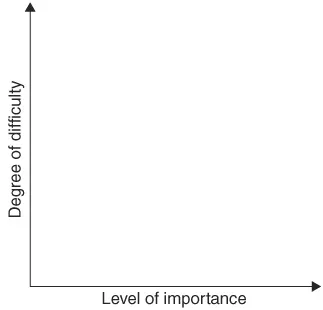
Next make a list of all those things which would be introduced into your work life, not in an ideal world, but in a better yet still realistic world. Again, try to limit your list to a maximum of about ten items. Draw another chart identical to the one you have just completed and plot the points accordingly.
Now draw a vertical line down the middle of both charts and ignore everything on the left hand side. If they are not sufficiently important to you to have made it into the right-hand side then they really should not influence your ‘Should I stay or should I go?’ decision. Of the remaining points on each chart, how many are in the top half and how many in the bottom half? What is the percentage difference between the two? If the vast majority in chart 1 are in the top right-hand corner, then most of the aspects which are really important to you and would need to be improved to make your current working life tenable are very unlikely to be achieved any time soon, if at all, and even if they are the process is likely to be drawn-out and painful. Likewise, if the majority in chart 2 are in the top right-hand corner then most of the new elements you would like to see introduced to give you the working life you desire are very unlikely to happen, at least any time soon. So if the majority of the points you have identified as needing to change, improve or be introduced are in the top right portion of your charts, it may well be time to move on.
Case study
‘You have two choices in life – to live your own life and reach your own potential or to contribute to someone else’s dreams and help realize theirs. I am not being pejorative here – for some people a life’s work is about helping someone else’s cause that they feel a connection with. So be careful to make your choice – this is the easiest time in history that anyone has been able to express themselves and realize their own dreams – so make an informed choice.’
If you feel that moving on is the best option for you then the next decision is whether you opt to move to a similar company and work in a similar field or use this useful re-evaluation of your situation as the spur to move on to something completely new. This will depend on a great many factors, but whatever you decide you will be taking positive action to rectify a poor situation and that, surely, can only be a good thing. On the other hand, if most of the points are in the bottom right-hand corner then the things that matter to you most are reasonably easy to alter, perhaps even speedily, ...
Table of contents
- Cover
- Title
- Copyright
- Dedication
- Contents
- Meet the author
- Only got a minute?
- Only got five minutes?
- Foreword
- Introduction
- Acknowledgements
- 1 Weighing the options
- 2 Are you cut out to be your own boss?
- 3 Staying put
- 4 Quitting your job
- 5 What becoming your own boss actually means – and how to do it
- 6 Setting up your solo work life
- 7 Effective home working
- 8 Accentuating the positives of being your own boss
- 9 Maximizing home–office potential
- 10 Targets and planning
- 11 Mobile working
- 12 Working 5 to 9
- 13 IT for the solo worker
- 14 Accounting for successful business
- 15 Dealing with clients
- Conclusion
- Appendices
- Index
Trusted by 375,005 students
Access to over 1.5 million titles for a fair monthly price.
Study more efficiently using our study tools.
Frequently asked questions
Yes, you can cancel anytime from the Subscription tab in your account settings on the Perlego website. Your subscription will stay active until the end of your current billing period. Learn how to cancel your subscription
No, books cannot be downloaded as external files, such as PDFs, for use outside of Perlego. However, you can download books within the Perlego app for offline reading on mobile or tablet. Learn how to download books offline
Perlego offers two plans: Essential and Complete
- Essential is ideal for learners and professionals who enjoy exploring a wide range of subjects. Access the Essential Library with 800,000+ trusted titles and best-sellers across business, personal growth, and the humanities. Includes unlimited reading time and Standard Read Aloud voice.
- Complete: Perfect for advanced learners and researchers needing full, unrestricted access. Unlock 1.5M+ books across hundreds of subjects, including academic and specialized titles. The Complete Plan also includes advanced features like Premium Read Aloud and Research Assistant.
We are an online textbook subscription service, where you can get access to an entire online library for less than the price of a single book per month. With over 1.5 million books across 990+ topics, we’ve got you covered! Learn about our mission
Look out for the read-aloud symbol on your next book to see if you can listen to it. The read-aloud tool reads text aloud for you, highlighting the text as it is being read. You can pause it, speed it up and slow it down. Learn more about Read Aloud
Yes! You can use the Perlego app on both iOS and Android devices to read anytime, anywhere — even offline. Perfect for commutes or when you’re on the go.
Please note we cannot support devices running on iOS 13 and Android 7 or earlier. Learn more about using the app
Please note we cannot support devices running on iOS 13 and Android 7 or earlier. Learn more about using the app
Yes, you can access Be Your Own Boss by Matt Avery in PDF and/or ePUB format, as well as other popular books in Business & Imprenditoria. We have over 1.5 million books available in our catalogue for you to explore.