Unlock your personality to discover your hidden strengths and reach your true potential, with this new guide to being extraordinary. Through some simple quizzes you can find out what really makes you tick, before learning how to tap into your strengths, and make the most of your natural gifts. With the author's guidance, you will use tests and exercises to unlock parts of your psyche you didn't know you had, helping you to understand what makes you truly special, to change the parts of you you don't like, and to strengthen those that you do. Whether you want to be more creative, more confident or more dynamic, you will find the ability to achieve anything or everything in this revelatory new book.
eBook - ePub
Be Your Own Personality Coach
A practical guide to discover your hidden strengths and reach your true potential
- 208 pages
- English
- ePUB (mobile friendly)
- Available on iOS & Android
eBook - ePub
Be Your Own Personality Coach
A practical guide to discover your hidden strengths and reach your true potential
About this book
Information
Topic
Personal DevelopmentSubtopic
Self Improvement1

The Big Five
In this chapter you will learn:
- how to measure personality
- the Big Five personality traits
- your own five-factor personality scores.
Most psychologists now agree that your personality, and everyone else’s, can usefully be defined in terms of just five traits. According to this five-factor model, you are the product of various amounts of:
- Openness
- Conscientiousness
- Extroversion
- Agreeableness
- Neuroticism.
I’ve stated them in that order because they can then easily be remembered using the acronym OCEAN, but there’s no particular order of importance. Of course, you may wish to argue that your personality is far too complex to be reduced to a web of five dimensions. Raymond Catell (1905–1998), one of the outstanding psychologists of his time, used a framework of 16 traits and the most recent edition of the test that he first introduced in 1949 has as many as 185 multiple-choice questions. His 16 factors are:
- warmth
- reasoning
- emotional stability
- dominance
- liveliness
- rule-consciousness
- social boldness
- sensitivity
- vigilance
- abstractedness
- privateness
- apprehension
- openness to change
- self-reliance
- perfectionism
- tension.
But, in fact, Catell, too, considered that there were five ‘global’ or ‘second-order’ factors that are more or less the Big Five.
At the opposite end of the scale, the specialist in personality theory Hans Eysenck (1916–1997) concluded that no matter how ‘deep’ you think you are, it’s possible to capture your personality with just two factors, Extroversion and Neuroticism. Variations in these two provided four basic personality types (very much as the Greek physician Hippocrates had proposed more than 2,000 years earlier). But in the 1970s Eysenck added a third factor to his model, Psychoticism, which largely corresponded with the traits of Agreeableness and Conscientiousness.
So he, too, came close to the Big Five, and that’s where the consensus is now.
Insight
In this context, a Big Five trait is a bundle of characteristics that normally come together, so that if you have one characteristic in the bundle you’ll have the others, too. Nobody can say any particular number of traits is right or wrong. There are different ways of measuring personality, just as you can measure a box in centimetres or in inches. The method doesn’t change the box. The beauty of the Big Five is simply that it’s a system on which large numbers of psychologists all over the world have agreed. It makes it easier to carry out research and to standardize therapies. It also means you can now compare yourself with people from the UK to the USA, and from Uruguay to Uzbekistan.
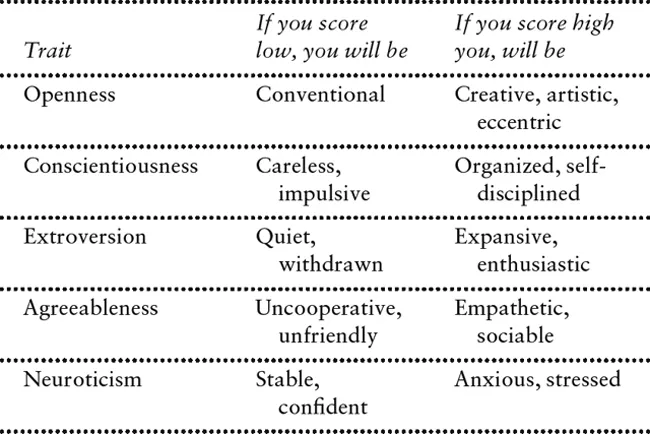
In a moment I’m going to give you the opportunity to build a comprehensive picture of your personality by answering a mere 20 questions. But first, let’s get an idea of what these Big Five traits mean. Each of them is a continuum on which you will score somewhere between low and high.
So let’s see where you lie along each of these scales and what that implies in terms of your personality.

The quick Big Five test
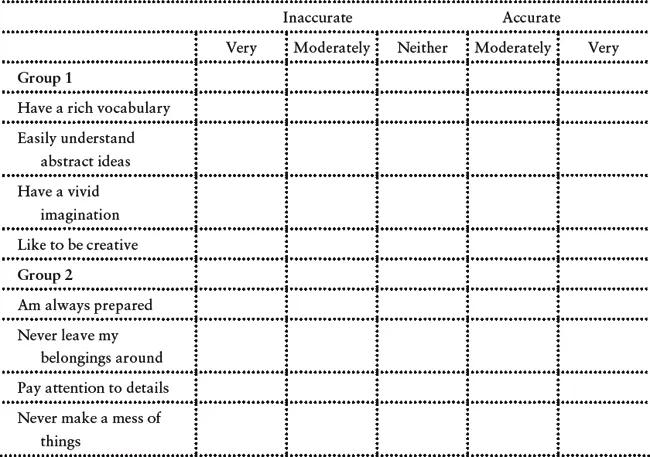
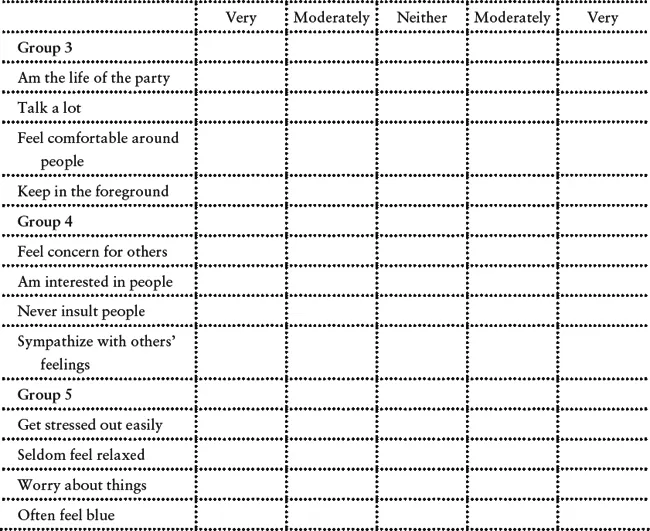
Simply rate the extent to which each of the following statements is an accurate description of you:
Scoring
For every ‘very inaccurate’ score 1.
For every ‘moderately inaccurate’ score 2.
For every ‘neither’ score 3.
For every ‘moderately accurate’ score 4.
For every ‘very accurate’ score 5.
(This is a short version of the International Personality Item Pool (IPIP), adapted by me. If you would like to take a more detailed 50 or 100 item questionnaire you will find it online at http://ipip.ori.org.)
So in any Group you could score anything from a low of 4 up to a high of 20, with a median of 12. Now let’s take a look at what your scores mean.
Group 1 – Openness
Group 1 measures the personality dimension that, at its highest, is associated with creative people such as poets, artists and composers. Some psychologists use the term ‘Intellect’ and some ‘Culture’ but the most common tag is ‘Openness to experience’ or just ‘Openness’.
If you scored high on Openness, you almost certainly enjoy not just some but more or less all cultural activities such as going to concerts, plays and art galleries, and probably are very creative yourself, either professionally or in an amateur way. You’re probably unconventional and individualistic; other people may consider you eccentric. You may ignore or oppose taboos and you’ll probably have more lifetime sexual partners than average. You probably spent longer in education than the norm and, according to some psychologists, Openness is a reflection of greater efficiency in the cognitive circuits in the frontal lobes of the brain. In other words, you should be of above average intelligence.
Your Openness also probably extends to what are known as ‘unusual experiences’, which means you’re likely to experience hallucinations or something close to them, to believe in the supernatural, to have unusual religious beliefs, to be susceptible to hypnosis, and to use language and images in unusual ways. At the most extreme all of this may add up to psychosis, that’s to say, being out of touch with reality.
Self-coaching tip
It’s important to understand that there’s no ‘right’ or ‘wrong’ amount of Openness or of any of the other Big Five traits. Each point on the continuum has its advantages and disadvantages. But if you want to change your degree of Openness, then you probably want to increase it (while falling short of psychosis) and we’ll be looking at how to do that later in the book.
Group 2 – Conscientiousness
Group 2 measures Conscientiousness which, in this context, means self-discipline and self-control. If you’re very low in Conscientiousness, you may find it hard to focus on one thing for any length of time and as a child you may have been diagnosed with attention-deficit hyperactivity disorder (ADHD). If you were, you’re probably male because the condition occurs five times more often among boys than girls. As a person low in Conscientiousness, you’ll also be highly impulsive and prone to become addicted to whatever gives you a buzz, such as adrenaline sports, gambling, alcohol, and drugs.
At the other end of the scale, if you’re high in Conscientiousness you may get the same buzz but you’ll easily be capable of controlling it. In tests of people’s ability to inhibit their responses to stimuli, those who were the most successful (the most Conscientiousness) showed considerable activity in the dorsolateral prefrontal and orbit ofrontal brain areas. Those who were the least successful (the most impulsive) had far lower activity in these areas.
As someone high in Conscientiousness, you’ll be good at making plans and sticking to them, at paying attention to details, and at dealing with repetitive tasks. At its upper extreme, Conscientiousness becomes obsessive-compulsive personality disorder. (Note that OCPD is not the same as obsessive-compulsive disorder, in which sufferers feel compelled to repeat certain thoughts and actions such as hand-washing.) In OCPD, sufferers don’t necessarily feel any need to repeat things, but are obsessed with doing things in a very precise and particular way. An OCPD sufferer might always get up at exactly the same time, eat exactly the same thing for breakfast, insist on everything being in exactly the ‘right’ place on the desk at work, apply rules to the letter, pursue perfection and become irritable and even disorientated if there’s any deviation from the routine.
Self-coaching tip
Not surprisingly, those with high Conscientiousness tend to be the most successful in more conventional careers. But, interestingly, the most Conscientious people are not necessarily the most intelligent. In fact, the cleverer anyone is, the less Conscientious they’re likely to be. That’s because they can ‘get away with’ more. Conscientiousness can be a way of making up for being less bright (which is another way of saying that genius is 90 per cent perspiration and only 10 per cent inspiration). If you’re not very high in Conscientiousness, it helps to be clever. Or you need to seek occupations that generate enough excitement to maintain your interest – but make sure someone else is paying attention to the details (especially to do with safety).
Group 3 – Extroversion
Group 3 measures the extent to which anybody prefers action to reflection, and company to solitude, that’s to say, Extroversion. It was the Swiss psychiatrist Carl Jung (1875–1961) who first developed the idea of the extroverted and introverted personalities. The Big Five trait of Extroversion with a capital E explores very much the same continuum but is not quite the same.
If you scored high in Extroversion, you’re talkative and like social occasions at which you aim to be the centre of attention. You’re open to new friendships but they don’t necessarily go well. You’re probably ambitious and crave status, so you work hard but also play hard, enjoying travel, adventurous activities and new sensations. You’re also likely to enjoy sex and romance more than average.
Given ...
Table of contents
- Cover
- Title
- Copyright
- Dedication
- Acknowledgements
- Contents
- Meet the Author
- In One Minute
- 1 The Big Five
- 2 The Big One
- 3 Success in Love
- 4 Personality Poppycock?
- 5 Financial Success
- 6 How Rational are You?
- 7 Creative Success
- 8 How Nice are You?
- 9 Successfully Happy
- 10 What made Your Personality?
- 11 The Hidden Self
- 12 Tackling High Neuroticism
- 13 Increasing Your Personality Scores
- Taking It Further
Trusted by 375,005 students
Access to over 1.5 million titles for a fair monthly price.
Study more efficiently using our study tools.
Frequently asked questions
Yes, you can cancel anytime from the Subscription tab in your account settings on the Perlego website. Your subscription will stay active until the end of your current billing period. Learn how to cancel your subscription
No, books cannot be downloaded as external files, such as PDFs, for use outside of Perlego. However, you can download books within the Perlego app for offline reading on mobile or tablet. Learn how to download books offline
Perlego offers two plans: Essential and Complete
- Essential is ideal for learners and professionals who enjoy exploring a wide range of subjects. Access the Essential Library with 800,000+ trusted titles and best-sellers across business, personal growth, and the humanities. Includes unlimited reading time and Standard Read Aloud voice.
- Complete: Perfect for advanced learners and researchers needing full, unrestricted access. Unlock 1.5M+ books across hundreds of subjects, including academic and specialized titles. The Complete Plan also includes advanced features like Premium Read Aloud and Research Assistant.
We are an online textbook subscription service, where you can get access to an entire online library for less than the price of a single book per month. With over 1.5 million books across 990+ topics, we’ve got you covered! Learn about our mission
Look out for the read-aloud symbol on your next book to see if you can listen to it. The read-aloud tool reads text aloud for you, highlighting the text as it is being read. You can pause it, speed it up and slow it down. Learn more about Read Aloud
Yes! You can use the Perlego app on both iOS and Android devices to read anytime, anywhere — even offline. Perfect for commutes or when you’re on the go.
Please note we cannot support devices running on iOS 13 and Android 7 or earlier. Learn more about using the app
Please note we cannot support devices running on iOS 13 and Android 7 or earlier. Learn more about using the app
Yes, you can access Be Your Own Personality Coach by Paul Jenner in PDF and/or ePUB format, as well as other popular books in Personal Development & Self Improvement. We have over 1.5 million books available in our catalogue for you to explore.