Insomnia is a problem that seriously affects millions of people. But Adrian Tannock has found that by using NLP techniques, people can hugely improve their sleeping experience.
This book is full of practical, NLP-based guidance, which will help everyone from serious sufferers to people who have the occasional problems. These NLP techniques, combined with the friendly and straightforward approach of Teach Yourself, could hold the answer to your sleep problems.
eBook - ePub
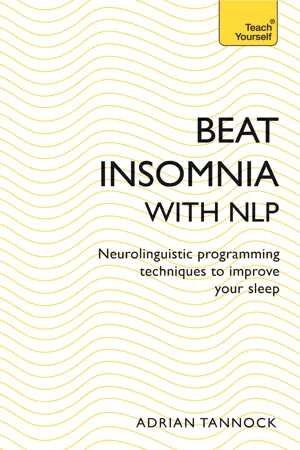
Beat Insomnia with NLP
Neurolinguistic programming techniques to improve your sleep
- 176 pages
- English
- ePUB (mobile friendly)
- Available on iOS & Android
eBook - ePub
About this book
Information
Topic
Medicine1

Understanding insomnia
In this chapter you will learn:
• about the basics of sleep
• how to tell if you have insomnia
• about the different types of insomnia
• about other sleep disorders.
O sleep! O gentle sleep!
Nature’s soft nurse, how have I frighted thee,
That thou no more wilt weigh my eyelids down
And steep my senses in forgetfulness?
William Shakespeare
In times such as these, how valuable is sleep? In our increasingly 24-hour society, it is the timekeeping of modern life that dictates how we work and rest. Our biological clocks, honed by many millions of years of evolution, are struggling to keep up. Perhaps unsurprisingly, it is estimated that around 10–15 per cent of the UK population experiences chronic insomnia. It is a major public health problem with serious consequences. Left unchecked, insomnia can be a miserable experience.
This book has been written to guide you towards better sleep. It will be a straightforward process, and a gentle one. Some of the recommendations in this book will be easy to implement. Others will be challenging at first, getting easier with practice or time. Despite the pressures of modern life, we retain a natural ability to sleep. This book will reconnect you with that ability.

What to expect
To begin, we will learn about sleep and sleeplessness, Neuro-linguistic Programming (NLP) and how it is best implemented. In Chapter 4 we will discuss your sleeping environment, and put in place changes that will make it ideal for sleep.
From there we will optimize your behaviours, your thoughts and your feelings so they are sleep-promoting. Each recommendation will be explained thoroughly. We will work out ways to help you sleep more easily. In order for you to find the change you are looking for, to enjoy a more refreshing and restorative sleep, our approach will be simple and collaborative.
Towards the end of this book we will turn our attention to any outstanding difficulties, ironing out any problems that remain. It may take four weeks or so before you fully complete the programme laid out in this book, and then a little while longer as you fine-tune it to suit your lifestyle. Within two months or so, your ability to sleep will be greatly improved. You will feel that you have turned a corner, your troubles with sleep left behind. After three months, these changes will be fixed firmly in place and you will begin to see yourself as somebody who can sleep easily and naturally.
Many people will find that simply reading this book will aid sleep. Contained within its pages are powerful suggestions designed to promote sleep. As we work through this comprehensive programme together, focus on practising the exercises repeatedly. As a result, your sleep will improve.
The basics of sleep
So, what is sleep? And why do we need it? For the most part, when we sleep, we are physically inactive. We lose awareness of ourselves and of our environment. Sleep unfolds in cycles, typically four or five cycles per night, where we alternate between periods of deep sleep, followed by shorter periods of Rapid Eye Movement (REM) sleep. During the first part of the night there tends to be more deep sleep, and during the second part of the night we experience longer periods of REM sleep.
The deep sleep period of each cycle comprises four stages. Stage 1 is in fact very light sleep, coming just after wakefulness. Stage 2 then quickly follows as our muscles relax, and our heart rate and breathing slows. From there, a person phases into much deeper sleep, Stages 3 and 4, where our breathing and heart rate slow further. It is during this deeper sleep that restorative processes in the body take place. Stages 3 and 4 are known as slow-wave sleep, because brain activity during this period is markedly different from when we are awake. One sleep cycle, from Stage 1 sleep through to slow-wave sleep and then REM sleep, can take around 90 minutes or so.
As we approach the end of each cycle, we enter REM sleep, which is characterized by the jerky rapid eye movements that give it its name. The onset of REM sleep is abrupt, and in some ways our brain activity is similar to when we are awake. REM sleep is when most of our dreaming occurs. Usually, there is a complete paralysis of our body, most likely to stop us from acting out our dreams. Periods of REM sleep become longer in duration as the night progresses. This is why people tend to remember the dreams they have in the early morning hours, rather than those dreams that happen in the dead of night.
So, there are periods of restorative slow-wave sleep, followed by short bursts of REM sleep. As the night progresses, the duration and intensity of the slow-wave sleep cycle reduces, and REM sleep becomes more prevalent. Usually a person will wake several times each night. However, these awakenings are rarely noticed or remembered, except in cases of insomnia.
Insight – the need for sleep
We spend around a third of our lives asleep. It is essential to brain function, and losing sleep can result in consequences for our mood, our cognitive ability and our body’s ability to restore itself. A loss of sleep also affects our ability to learn and remember, and can affect our immune system. Those of us who lose sleep regularly will frequently report a dissatisfaction with life.
These days, a great deal is understood about the nature of sleep. Typically, each night, we get about three to four hours of slow-wave sleep. It is estimated that around two hours of deep, slow-wave sleep is required for our body to remain healthy.
The majority of people will sleep for between seven and eight hours per night. However, there is no standard amount of sleep we, as humans, require. The amount of sleep you need is simply the length of time it takes for you to function normally on the following day. That might be six hours or it might be nine hours. There is no prescribed length of time that suits all people; our needs are unique to us.
We do tend to need less sleep as we grow older. For example, there is a strong relationship between sleep and the body’s production of growth hormone. In our adult life the production of growth hormone reduces markedly, therefore we require less sleep. As the amount of slow-wave sleep we get decreases, our sleep becomes increasingly fragmented. The relationship between sleep and our body is complex. It is driven by two independent processes: the circadian process and the homeostatic process.
THE CIRCADIAN PROCESS
Circadian (from Latin, meaning ‘around a day’) rhythms are bodily cycles that repeat once per day, and which regulate the daily function of our body and brain. Most circadian rhythms are driven by our master body clock, and are responsible for processes such as liver function, body temperature, hormone release and our sleep–wake cycle. Each night the circadian process sends signals to the body that induce sleep. By 4 a.m. this circadian-based drive to sleep is at its strongest. By mid-morning the next day, the circadian process will have replaced sleep-promoting signals with wakefulness-promoting signals, keeping us alert during the day. This cycle of sleep-promotion and wakefulness-promotion continues day after day, and is independent of tiredness or the amount of sleep we get.
The circadian process is dependent on our internal body clock. This clock is in fact a pair of pinhead-sized structures found in the hypothalamus region of the brain. This part of the brain is connected to our eyes, and is sensitive to light. Generally, exposing yourself to daylight during the early hours of the day helps to set your body clock for an earlier rise time. Other external cues, such as keeping to a regular time for eating, working, exercising and socializing, also regulate our body’s internal clock. It is telling that people with insomnia often struggle to keep to a regular schedule, frequently skipping breakfast or rising at differ...
Table of contents
- Cover
- Title
- Dedication
- Contents
- Meet the author
- In one minute
- 1 Understanding insomnia
- 2 Exploring NLP
- 3 Making NLP work for you
- 4 Improving your sleeping environment
- 5 Increasing your drive to sleep
- 6 Overcoming worry and anxiety
- 7 Learning how to relax
- 8 Transforming negative beliefs
- 9 Troubleshooting problems with your sleep
- 10 Choosing freedom
- Copyright
Trusted by 375,005 students
Access to over 1.5 million titles for a fair monthly price.
Study more efficiently using our study tools.
Frequently asked questions
Yes, you can cancel anytime from the Subscription tab in your account settings on the Perlego website. Your subscription will stay active until the end of your current billing period. Learn how to cancel your subscription
No, books cannot be downloaded as external files, such as PDFs, for use outside of Perlego. However, you can download books within the Perlego app for offline reading on mobile or tablet. Learn how to download books offline
Perlego offers two plans: Essential and Complete
- Essential is ideal for learners and professionals who enjoy exploring a wide range of subjects. Access the Essential Library with 800,000+ trusted titles and best-sellers across business, personal growth, and the humanities. Includes unlimited reading time and Standard Read Aloud voice.
- Complete: Perfect for advanced learners and researchers needing full, unrestricted access. Unlock 1.5M+ books across hundreds of subjects, including academic and specialized titles. The Complete Plan also includes advanced features like Premium Read Aloud and Research Assistant.
We are an online textbook subscription service, where you can get access to an entire online library for less than the price of a single book per month. With over 1.5 million books across 990+ topics, we’ve got you covered! Learn about our mission
Look out for the read-aloud symbol on your next book to see if you can listen to it. The read-aloud tool reads text aloud for you, highlighting the text as it is being read. You can pause it, speed it up and slow it down. Learn more about Read Aloud
Yes! You can use the Perlego app on both iOS and Android devices to read anytime, anywhere — even offline. Perfect for commutes or when you’re on the go.
Please note we cannot support devices running on iOS 13 and Android 7 or earlier. Learn more about using the app
Please note we cannot support devices running on iOS 13 and Android 7 or earlier. Learn more about using the app
Yes, you can access Beat Insomnia with NLP by Adrian Tannock in PDF and/or ePUB format, as well as other popular books in Medicine & Cognitive Neuroscience & Neuropsychology. We have over 1.5 million books available in our catalogue for you to explore.