We all have things we want to achieve, goals we want to reach, targets we want to hit. But how often do we find ourselves saying, 'If only there were more hours in the day' or simply 'I don't have time'?
Time Management, however, is dead. Productivity - getting more done in the time we have - is king. However productive you already are, you will find this book full of practical tips on how to achieve more in less time.
In the past few years alone the author, Matt Avery, has been running three businesses concurrently, as well as writing five books, and producing two musicals for the Edinburgh fringe. He is 'Mr Productivity' and in this book he shares his secrets.
- 256 pages
- English
- ePUB (mobile friendly)
- Available on iOS & Android
eBook - ePub
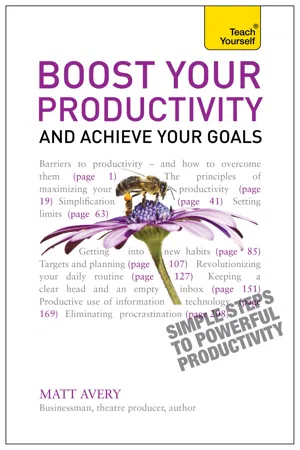
Boost Your Productivity and Achieve Your Goals: Teach Yourself
About this book
Information
1
Barriers to Productivity – and How to Overcome Them
In this chapter you will: • Define the expectations others have of you in your work. Clarifying expectations will help you to boost your productivity by sharpening your focus • Be clear about the finishing point – know when you have done enough • Evaluate whether you are in the right job and able to reach your productivity potential • Determine what needs to change in order to enable you to maximize your productivity, then do it • Examine the options for changing jobs. |

1 Do you know what exactly is expected of you in your job?
2 Is there an obvious and clearly defined finishing point to each project?
3 Can you fulfil your productivity potential in your current job?
4 Do you know what you need to change in order to boost your productivity?
5 Would you be more productive in a different job, or working for yourself?

The problem with poorly defined work
One of the principal barriers to achieving maximum productivity is disarmingly simple – a lack of understanding about what exactly our work entails. We can see the bigger picture and we understand what needs to get done and by when – a conference organized, a strategy defined, a project planned – but when it comes to buttoning down what exactly that entails the picture starts to become a little blurry. One of the problems is that what we have in mind may not be the same as other people in our organization. However, even that pales into insignificance compared to the reality that often we have no clear demarcation regarding what constitutes completion of the project. All too often we strive and strive to achieve perfection, often experiencing outside pressure to do so either from our bosses or from clients, when the truth is we may be breaking our backs to effect a minutely incremental improvement in the output. And putting in huge amounts of effort for a fractional gain is, clearly, an unproductive way to go about things. The trick is to know when to stop. Think about that for a moment – if it didn’t happen, then nothing would ever be finished!
Let’s take an example: car design and production. While it might seem a good idea, even the ‘right’ thing to do, for everyone involved in the process to strive for limitless perfection all the time, tweaking and re-tweaking endlessly in an attempt to continually refine and improve the output, the reality is that, if this were to happen without someone somewhere deciding when and where to draw the line, nothing would ever roll off the production line and the whole process would become academic. Cars wouldn’t be manufactured because the designers could always find a way to marginally improve the car’s aerodynamics or fuel consumption or reliability, or any one of a thousand other things, not least because, as the project went on and on, new materials and technologies would be discovered or become available. So the designs would never reach the manufacturing stage and car production would cease. Which would rather make the whole process obsolete. So we can see that it is vital to determine a cut-off point. However, such cut-off points are more often than not imposed on us. And that’s where three significant problems surface:
1 If we have to complete a project in a fixed, imposed timescale but feel we must push ourselves continually to reach an undefined state of perfection in our work, we will simply be opening ourselves up to untold and limitless – and completely unnecessary and avoidable – pressure.
2 If we are unable to determine at the outset the cut-off point for our part of the project, then the woolly edges of our contribution will ensure that, because we do not know where to stop, we feel we never can.
3 By not knowing where we should stop – not understanding what constitutes completion of our work – we will never feel in control of the process or the output.
What we need to do therefore is to determine both the macro and the micro cut-off points:
• Macro cut-off points – these are the end of project sections, or the end of the project whole, which constitute the bigger picture and which are often imposed on us, such as the completion of a design or design stage so that the product can go into testing or manufacture.
• Micro cut-off points – these are the boundaries which determine a smaller piece of the puzzle, the piece with which we are directly involved, and are usually self-imposed. Indeed, they should be self-imposed so that we are in control of the output we will produce and the level of input required to produce it.
It is absolutely imperative that we determine at the outset what exactly the end result should look like so that:
• we have a clear picture of the whole of our work
• we know precisely what the work entails
• we know the parameters so we know with certainty when it is completed
• we know how much time and effort will be required and can plan accordingly
• we know when to stop.
 | Remember this: Know when to stop |
This is not a way to give ourselves a ready-made excuse for being lazy nor a built-in reason why we can’t achieve excellence in our work. It is simply a vital requirement in achieving efficiency in our work. If we are unable to decide a realistic limit to the amount of time and effort we should put in, then all our efforts beyond where the cut-off point should have been will be wasted.
Productivity in – and beyond – the workplace
Increasing your productivity does not need to be limited to work – indeed, the techniques described in this book can be applied just as effectively to your non-work life. Then again, define ‘work’. For some people this means that nine-to-five routine; for others it is anything outside of their leisure time; and for some people it includes anything and everything which feels like a chore from their breadwinning occupation to doing the ironing, weeding the garden, or cleaning the car.
The truth is that no matter how you define work you can and should maximize your productivity across your entire spectrum. After all, what’s the point of being wonderfully productive in one part of your life only for another to rob you of all the time and energy you’ve saved? Rather, the techniques and lifestyle changes which will enable you to exponentially increase your productivity should become a way of life. In this way, once you have got used to them, you will find that you hardly notice them, that they shape what you do and how you do it by running unnoticed in the background. All you will notice is that you are achieving much more than you used to, much more quickly, and much more efficiently.
 | Quick fix: Boost your productivity across the board |
If you find that your productivity in increasing in your work but not in your home life, try adopting the same rules, techniques and principles there. It is perfectly possible to improve your productivity in all areas of your life simultaneously, and any gains in one area will naturally support the gains in the other.
Is your productivity diminished by your job?
One of the major barriers to productivity is a lack of enjoyment of, belief in, or motivation for the work you do. For many people their job and the day-to-day work it entails is a drag endured only because it pays the bills. Ask people whether they would continue in their job if it weren’t for the money and many of them would answer with a resounding ‘No!’ Yet, if our work lives are unfulfilling, something is terribly amiss. After all, we spend a large...
Table of contents
- Cover
- Dedication
- About the author
- Title
- Contents
- Introduction
- 1 Barriers to productivity – and how to overcome them
- 2 The principles of maximizing your productivity
- 3 Simplification
- 4 Setting limits
- 5 Getting into new habits
- 6 Targets, motivation and planning
- 7 Revolutionizing your daily routine
- 8 Keeping a clear head and an empty inbox
- 9 Productive use of information technology
- 10 Barriers to productivity – and how to overcome them
Trusted by 375,005 students
Access to over 1.5 million titles for a fair monthly price.
Study more efficiently using our study tools.
Frequently asked questions
Yes, you can cancel anytime from the Subscription tab in your account settings on the Perlego website. Your subscription will stay active until the end of your current billing period. Learn how to cancel your subscription
No, books cannot be downloaded as external files, such as PDFs, for use outside of Perlego. However, you can download books within the Perlego app for offline reading on mobile or tablet. Learn how to download books offline
Perlego offers two plans: Essential and Complete
- Essential is ideal for learners and professionals who enjoy exploring a wide range of subjects. Access the Essential Library with 800,000+ trusted titles and best-sellers across business, personal growth, and the humanities. Includes unlimited reading time and Standard Read Aloud voice.
- Complete: Perfect for advanced learners and researchers needing full, unrestricted access. Unlock 1.5M+ books across hundreds of subjects, including academic and specialized titles. The Complete Plan also includes advanced features like Premium Read Aloud and Research Assistant.
We are an online textbook subscription service, where you can get access to an entire online library for less than the price of a single book per month. With over 1.5 million books across 990+ topics, we’ve got you covered! Learn about our mission
Look out for the read-aloud symbol on your next book to see if you can listen to it. The read-aloud tool reads text aloud for you, highlighting the text as it is being read. You can pause it, speed it up and slow it down. Learn more about Read Aloud
Yes! You can use the Perlego app on both iOS and Android devices to read anytime, anywhere — even offline. Perfect for commutes or when you’re on the go.
Please note we cannot support devices running on iOS 13 and Android 7 or earlier. Learn more about using the app
Please note we cannot support devices running on iOS 13 and Android 7 or earlier. Learn more about using the app
Yes, you can access Boost Your Productivity and Achieve Your Goals: Teach Yourself by Matt Avery in PDF and/or ePUB format, as well as other popular books in Business & Business Skills. We have over 1.5 million books available in our catalogue for you to explore.